
Dwarf planet (astronomical classification)
A dwarf planet is a Sun-orbiting object massive enough to be rounded by gravity but too small to clear its orbital zone; includes Ceres, Pluto and other bodies in the asteroid belt and trans-Neptunian regions.
The term dwarf planet was formalised by the International Astronomical Union in 2006 to describe a distinct class of bodies in the Solar System. By that definition a dwarf planet orbits the Sun, has enough mass for its own gravity to pull it into an approximately round shape (hydrostatic equilibrium), but has not cleared other debris and small bodies from the vicinity of its orbit. The name distinguishes these objects from classical planets while separating them from smaller irregular minor planets and comets.
Image gallery
10 Images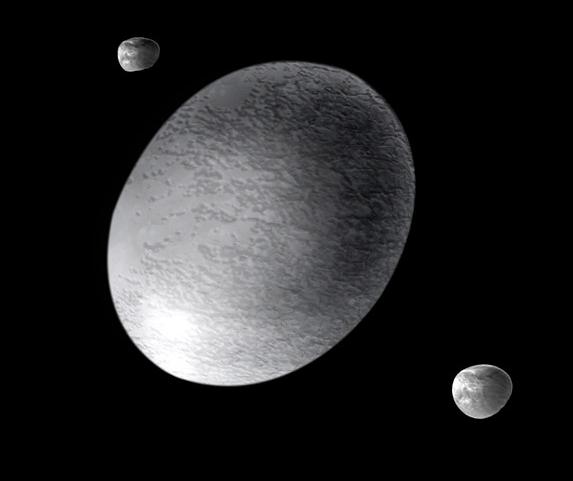




Defining characteristics
Three features are central to the classification. First, the object must orbit the Sun directly rather than being a satellite. Second, self-gravity must be sufficient to overcome rigid-body forces so the object is nearly spherical. Third, the body has not cleared its orbital neighborhood of other material — a key technical distinction from full-fledged planets. These traits place dwarf planets between the larger planets and the many smaller, irregular bodies in the Solar System such as most asteroids and cometary nuclei. The category is distinct from the terrestrial and gas giant planet types, which are defined by composition and orbital dominance rather than by a single mass or shape criterion.
Where they are found
Dwarf planets are found in more than one region of the Solar System. The best-known example inside the main asteroid region is Ceres, located in the asteroid belt between Mars and Jupiter. Many other candidates lie in the outer system beyond Neptune: the scattered-disc and the wider Kuiper belt, sometimes generically called the trans-Neptune region. Some outer bodies follow elongated or inclined orbits; for example, the large former planet candidate Pluto has a substantial orbital eccentricity that carries it inside Neptune's distance for part of its orbit.
Notable examples
- Ceres — a round body in the asteroid belt and the first dwarf planet visited by orbiting spacecraft.
- Pluto — long classified as the ninth planet until 2006; now a prototypical trans-Neptunian dwarf planet.
- Eris — a distant, massive object whose discovery prompted renewed debate about planetary status.
- Haumea, Makemake and Sedna — among several large outer Solar System bodies considered likely dwarf planets.
- Orcus, Quaoar and the body commonly called Gonggong are additional candidates that illustrate the variety of sizes and orbits in the outer regions.
Missions and observations
Direct exploration has advanced understanding of dwarf planets. The NASA mission Dawn visited asteroid belt targets including Vesta and later orbited and studied Ceres, revealing geological activity and surface ice. The New Horizons spacecraft flew past Pluto and its moons, returning high-resolution images and data that transformed ideas about dwarf-planet geology and atmospheres. Ground-based telescopes and occultation measurements continue to refine sizes, shapes and compositions for many candidate objects.
Importance and open questions
Dwarf planets occupy an intermediate role that helps scientists trace the Solar System's formation and evolution. They preserve records of early collisional processes, migration of the giant planets and the distribution of ices and rock in different regions. Debate continues over the precise list of dwarf planets, the threshold for hydrostatic equilibrium in varied compositions, and whether the label is the best way to communicate the objects' scientific importance. For further background see institutional summaries and surveys from the IAU and exploratory mission pages from NASA.
Readers seeking specific entries or discovery histories can follow links to individual bodies and regions such as Kuiper belt, the asteroid belt, or mission pages for Dawn and New Horizons to explore images, data and ongoing research.
Questions and answers
Q: What is a dwarf planet?
A: A dwarf planet is an object orbiting the Sun that is big enough to round itself by its own gravity, but has not cleared its orbital path of other rival bodies.
Q: When was the definition of a dwarf planet created?
A: The definition of a dwarf planet was created on August 24, 2006 by the International Astronomical Union (IAU).
Q: Who named Pluto?
A: Pluto was named by an 11-year-old girl because it was the initials of the astronomer who found it.
Q: How many known dwarf planets are there in our solar system?
A: There are nine known dwarf planets in our solar system. They are Ceres, Orcus, Pluto, Haumea, Quaoar, Makemake, Gonggong, Eris and Sedna.
Q: Where can most of these objects be found?
A: Most of these objects can be found in the trans-Neptune region or Kuiper belt.
Q: What missions have been sent to observe some of these objects?
A: NASA's Dawn and New Horizons missions reached Ceres and Pluto respectively in 2015. Dawn had already orbited and observed Vesta in 2011.
Related articles
Author
AlegsaOnline.com Dwarf planet (astronomical classification) Leandro Alegsa
URL: https://en.alegsaonline.com/art/29391