
Nereid (Neptune II) — irregular outer moon of Neptune
Nereid is a distant, irregular moon of Neptune, discovered in 1949 by Gerard Kuiper. It has a highly eccentric orbit, an irregular shape about 340 km across, and may be a captured or perturbed remnant.
Overview
Nereid (Neptune II) is a natural satellite of Neptune discovered on 1 May 1949 by Gerard Kuiper. The name derives from the sea-nymphs of Greek myth, the Nereids, reflecting Neptune’s association with the sea. Nereid is one of Neptune’s larger irregular moons and is notable for its unusually elongated, or highly eccentric, orbit.
Image gallery
10 Images


Discovery and naming
The discovery of Nereid expanded knowledge of the Neptunian system in the mid-20th century. Kuiper proposed the name in his report of discovery, following the convention of naming Neptunian satellites after sea-associated figures. Subsequent surveys of Neptune’s system have found many smaller satellites beyond Nereid, including distant objects such as Halimede and Neso.
Physical characteristics
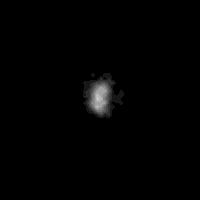
Nereid is relatively small compared with the major moons, with an estimated diameter near 340 kilometres. Imaging indicates a non-spherical shape, consistent with a body that lacks sufficient mass to relax into a round form. Photometric observations record variations in brightness; these can be produced by an irregular shape, surface albedo differences, and/or a complicated rotational state.
Orbit, classification and dynamics
The moon follows a distant, highly eccentric path around Neptune: its average orbital radius is several million kilometres, with reported distances varying between roughly 1,353,600 and 9,623,700 kilometres during its orbit, according to published orbital elements (orbit). The orbit’s pronounced oval shape is described as highly eccentric. For many years Nereid held the record for the most eccentric known moon orbit until the discovery of other irregular satellites such as Saturn’s Bestla.
Origin hypotheses
A number of hypotheses have been proposed to explain Nereid’s unusual orbit. One possibility is that Nereid is a captured small body, perhaps an asteroid or an object originating in the Kuiper belt, whose orbit was altered by Neptune’s gravity during close approach. Another widely discussed scenario is that Nereid’s orbit was significantly perturbed during the dramatic capture of Neptune’s largest moon, Triton, early in the Solar System’s history. Either capture or perturbation can account for a distant, eccentric, and inclined orbit more typical of irregular satellites.
Observations and exploration
Direct exploration of Nereid has been limited. When the Voyager 2 spacecraft visited Neptune in 1989 it was too distant from Nereid to return detailed surface maps; images from the encounter provide only a coarse view that confirmed a markedly irregular shape but did not resolve surface features (Voyager 2 encounter). Ground-based telescopes and space observatories have since monitored Nereid’s brightness and refined its orbital parameters.
Scientific importance and open questions
Nereid remains of interest because its orbit preserves clues about past gravitational interactions and the processes that populated giant-planet satellite systems with irregular bodies. Important open questions include its precise rotation state, surface composition and geology, and whether it originated near Neptune or was captured from a distant reservoir. Continued photometric monitoring and improved observations from large telescopes or future spacecraft could help resolve these uncertainties.
Notable facts
- Nereid was discovered in 1949 by Kuiper and named for the Nereids.
- It was long the farthest known Neptunian moon until searches found remote satellites such as Halimede and Neso.
- Its orbital eccentricity is extreme compared with most regular moons and rivalled by later discoveries like Bestla.
- Proposed origins include capture of an asteroid or Kuiper belt object, or perturbation during the arrival of Triton.
- High-resolution imaging was not obtained during the Voyager 2 flyby; available photographs show an irregular, non-spherical body (Voyager 2 encounter).
Because many details remain uncertain, Nereid is an attractive target for future study to better understand irregular satellites and the dynamical history of the outer Solar System.
Questions and answers
Q: What is Nereid?
A: Nereid, also known as Neptune II, is a moon of Neptune.
Q: Who discovered Nereid?
A: Nereid was discovered on 1 May 1949 by Gerard Kuiper.
Q: What is the name of this moon derived from?
A: The name of this moon is derived from the Nereids, sea-nymphs of Greek mythology.
Q: How big is Nereid?
A: Nereid has a diameter of 340 km and it is the third biggest out of all Neptune's moons.
Q: What does its orbit look like?
A: Its orbit averages 5,513,400 km in radius but it has an eccentricity that varies from 1,353,600 to 9,623,700 kilometres. It had the most highly eccentric orbit out of any known moon in the solar system for a long time until Bestla was discovered with an even more eccentric orbit.
Q: Was Voyager 2 able to take pictures of Nereid when it visited Neptune in 1989?
A: No, Voyager 2 was not able to take clear pictures due to how far away it was and no surface features could be seen at the resolution available.
Q: What are some theories about why its orbit looks so unusual?
A: Some theories suggest that it may have been captured from an asteroid or Kuiper belt object or possibly perturbed during Triton's capture as Neptune's largest moon.
Related articles
Author
AlegsaOnline.com Nereid (Neptune II) — irregular outer moon of Neptune Leandro Alegsa
URL: https://en.alegsaonline.com/art/69206