
Newtonian telescope: design, history, and uses
Overview of the Newtonian reflecting telescope: design principles, main parts, history from Newton’s work to modern amateur use, advantages, limitations, and common variants like the Dobsonian.
A Newtonian telescope is a reflecting telescope that uses a concave primary mirror to gather light and a small flat secondary mirror to direct that light to an eyepiece at the side of the optical tube. The design was developed in the 17th century to avoid color errors found in early refracting instruments and remains one of the simplest and most widely used optical arrangements. For general information about optical instruments see telescope. The configuration is closely associated with the English scientist Sir Isaac Newton, who built an early successful example of this type.
Image gallery
8 Images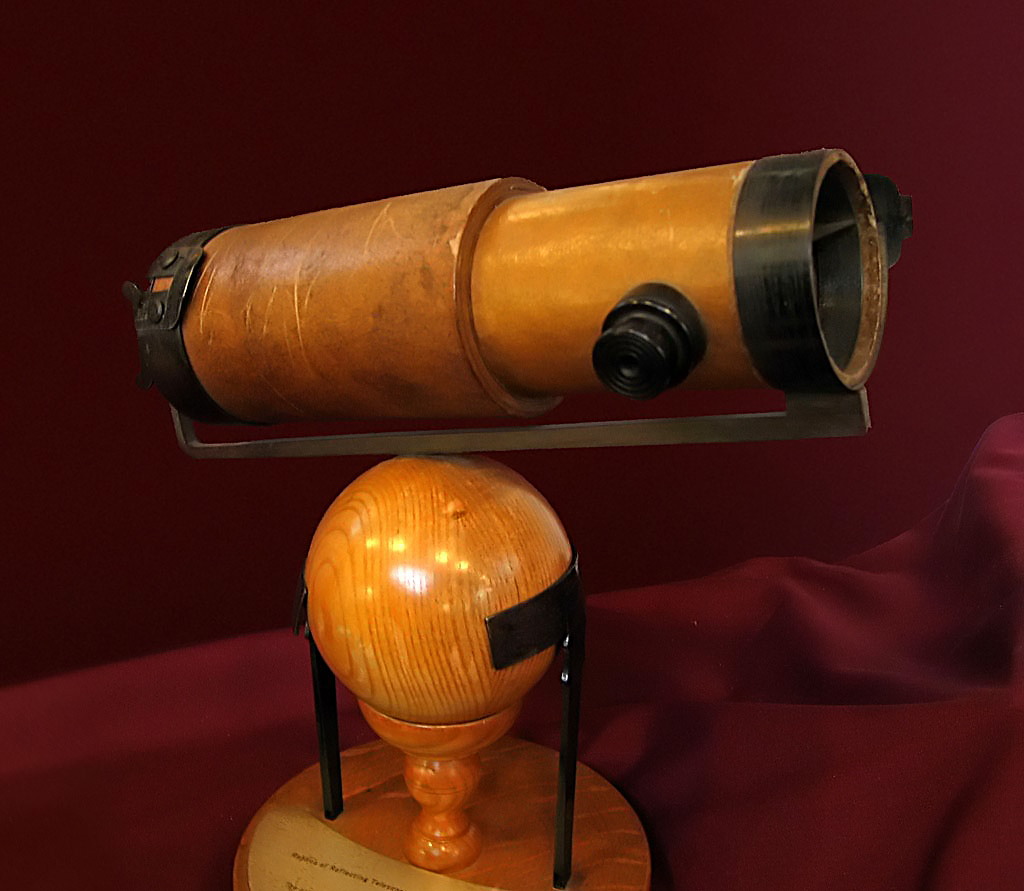





Design and main components
- Primary mirror: A parabolic or spherical concave mirror at the base of the tube gathers and focuses incoming light. The mirror is the principal light-collecting element and determines the instrument's aperture.
- Secondary (diagonal) mirror: A small flat mirror mounted at a 45° angle near the front of the tube redirects the focused beam to the side where the eyepiece is located. This angled mirror is often called the diagonal or secondary and is essential to the Newtonian layout; see angled mirror.
- Focuser and eyepiece: The eyepiece assembly holds one or more lenses that magnify the image formed by the primary mirror. Different eyepiece designs alter magnification and field of view; common eyepiece lens designs are discussed under lenses.
- Tubework and mount: The optical tube maintains alignment of components. Newtonians can be mounted on many types of supports, from small equatorial tripods to simple rockerbox mounts used on Dobsonians.
The design is mechanically straightforward: light enters the open end of the tube, reflects from the primary mirror to the small diagonal, then out through the side to the eyepiece. Because the light is reflected by mirrors rather than refracted through glass elements, Newtonians avoid chromatic aberration, a color distortion common in single-lens refractors.
History and development
The Newtonian arrangement originated as a practical solution to chromatic problems in early refractors. By using reflection rather than refraction, pioneers of the design reduced color fringing and achieved sharper images with simpler optics. Over time, mirror-making techniques improved—better polishing, coatings to increase reflectivity, and lighter support structures—allowing Newtonians to grow in aperture and performance. While large professional observatories often use variant reflecting designs (Cassegrain, Ritchey–Chrétien) for specific imaging and instrumentation needs, the Newtonian remains a staple for portable and amateur instruments due to its cost-to-aperture advantages.
One important historical offshoot is the Dobsonian telescope: a Newtonian optical tube combined with a simplified altazimuth 'rockerbox' mount. Dobsonians popularized very large amateur apertures because the mount is inexpensive, sturdy, and easy to build and use.
Uses, strengths, and limitations
Newtonian telescopes are widely used in amateur astronomy for visual observing of planets, the Moon, star clusters, nebulae, and galaxies. Their main strengths are low cost for a given aperture, straightforward construction, and good contrast for deep-sky viewing. Typical limitations include the central obstruction created by the secondary mirror, which slightly reduces contrast, and sensitivity to misalignment: Newtonians require periodic collimation (optical alignment) to perform at their best.
There are many practical variants and accessories: truss-tube designs reduce weight and allow large apertures to be transported, coma correctors improve edge sharpness in fast (short focal ratio) systems, and different eyepiece combinations trade field of view for magnification. For practical resources and buying guides, consult general references on reflector telescopes and observational equipment at popular astronomy sites and guides (see telescope resources). Beginner observers often find Newtonians on Dobsonian mounts a cost-effective way to access larger apertures and brighter views of faint objects.
In short, the Newtonian telescope is a durable, economical reflecting design that played an important role in the history of optical astronomy and continues to be a workhorse for education and amateur observing. For introductions to basic optics and eyepiece choices, see materials on optical principles and eyepiece lenses.
For a concise technical primer, many hobbyist manuals and online guides discuss setup, collimation, and common troubleshooting steps; these practical tutorials are commonly available through astronomy clubs and outreach organizations (beginner guides, mirror care).
Related articles
Author
AlegsaOnline.com Newtonian telescope: design, history, and uses Leandro Alegsa
URL: https://en.alegsaonline.com/art/69822