
Neutron star
A neutron star is an extremely compact remnant of a massive star: mostly neutrons, very dense, strongly magnetized, and often rapidly rotating; observed as pulsars, magnetars, or in binaries.
A neutron star is the compact, extremely dense remnant left after the core of a massive star collapses in a supernova explosion. Composed predominantly of neutrons, these objects squeeze roughly solar masses of material into a sphere only a few tens of kilometres across. Typical values for a neutron star include a radius on the order of 10–12 kilometres and a mass comparable to one to two times that of the Sun. Because so much mass is concentrated in so little volume, neutron stars are among the densest stars known and represent a distinct endpoint of stellar evolution after a supernova.
Image gallery
10 Images


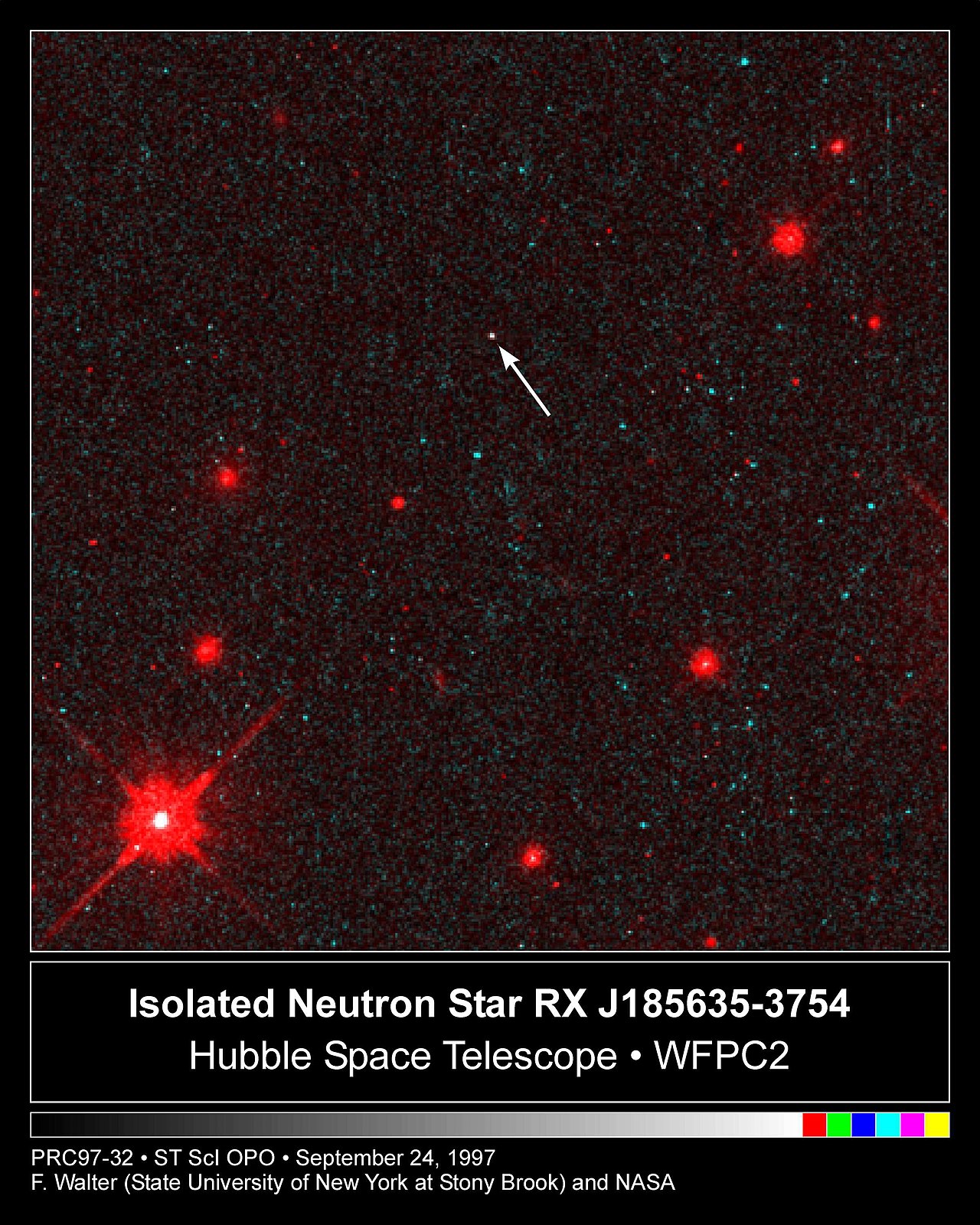
Structure and physical properties
The internal structure of a neutron star is layered. The outermost crust contains ions and electrons in a crystalline lattice; below this is an inner crust with free neutrons that behave like a superfluid. The deeper core is much less certain but is expected to contain mostly neutrons and may include exotic states such as hyperons or deconfined quarks. The density inside approaches that of an atomic nucleus, so a small volume equals an enormous mass: a teaspoon of neutron-star matter would weigh billions of tons. Surface gravity is extreme, many billions or hundreds of billions of times stronger than on Earth, and the gravitational field at the surface is strong enough to significantly bend light.
Rotation, magnetism, and temperature
Neutron stars often spin rapidly because the progenitor star's core conserved angular momentum during collapse; observed rotation periods range from milliseconds to seconds. Some rotate so fast that they complete hundreds of turns per second. They also possess very strong magnetic fields—commonly many orders of magnitude greater than Earth's field—typically spanning roughly 10^8 to 10^15 times stronger. Young neutron stars are hot, with observable surface temperatures of hundreds of thousands to millions of kelvin, and they cool over time by emitting neutrinos and electromagnetic radiation.
Observable types and behaviour
- Pulsars: rapidly rotating neutron stars that emit beams of electromagnetic radiation; when a beam sweeps past Earth the object appears as a pulsing source, hence the term pulsars.
- Magnetars: a class with exceptionally strong fields that power sporadic X-ray and gamma-ray outbursts; these are referred to as magnetars.
- Binary systems: neutron stars in orbit with a companion (other stars or compact objects) can accrete matter, emit X-rays, or form relativistic systems known as binary pulsars, which are important laboratories for gravity.
Formation, evolution, and scientific importance
Neutron stars form when the iron core of a massive star collapses under gravity and protons and electrons combine into neutrons in the newly formed compact object. If the remnant is too massive, collapse continues to a black hole. When neutron stars merge, they produce powerful gravitational waves and electromagnetic counterparts; such mergers are thought to create many of the universe's heavy elements and have opened a field of multimessenger astronomy. Observations of neutron stars test nuclear physics at densities unreachable in terrestrial laboratories and provide stringent checks on theories of strong gravity and dense matter.
Notable facts and distinctions
To appreciate their scale, imagine compressing the mass of the Sun into a sphere with a small multiple-kilometre diameter, and you get an intuition for neutron-star densities. Their extreme properties—high rotation rates measured in milliseconds, magnetic fields far stronger than those of planets, and surface gravities orders of magnitude above Earth's—distinguish them from white dwarfs and black holes. Astronomers continue to refine models and observations to resolve open questions about their inner composition and the limits of matter under the most extreme conditions.
Questions and answers
Q: What is a neutron star?
A: A neutron star is a very small and dense star made almost completely of neutrons. It has a radius of about 11-11.5 kilometres and a mass of about twice that of the Sun.
Q: How dense is a neutron star?
A: The density of the star is like that of the nucleus of an atom, with its gravitational field at the surface being 2x10¹¹ times stronger than on Earth. To put it into perspective, all the mass from our sun could be pushed down into a ball with 19 kilometres diameter. One teaspoon of matter from the neutron star would weigh 6 billion tons.
Q: How fast do neutron stars spin?
A: Neutron stars spin very fast, from 0.001 second up to 30 seconds to turn.
Q: What types are there?
A: There are different types such as pulsars, magnetars and binary pulsars which emit beams of electromagnetic radiation or have strong magnetic fields between 108 and 1015 times as strong as that on Earth respectively.
Q: What temperature do they typically have?
A: Neutron stars that can be observed are very hot and typically have a surface temperature of around 600000 K (600000 degrees Kelvin).
Related articles
Author
AlegsaOnline.com Neutron star Leandro Alegsa
URL: https://en.alegsaonline.com/art/69387
Sources
- books.google.com : Compact stars: nuclear physics, particle physics and general relativity
- books.google.com : Extract of page 1
- arxiv.org : astro-ph/0601337
- ui.adsabs.harvard.edu : 2006Sci...311.1901H
- doi.org : 10.1126/science.1123430
- pubmed.ncbi.nlm.nih.gov : 16410486
- skyandtelescope.com : "Spinning pulsar smashes record"
- ui.adsabs.harvard.edu : 1934PhRv...46...76B
- doi.org : 10.1103/PhysRev.46.76.2
- ui.adsabs.harvard.edu : 1932Natur.129Q.312C
- doi.org : 10.1038/129312a0
- doi.org : 10.1038/216567a0
- doi.org : 10.1038/217709a0