
NGC 1291 (ring galaxy in Eridanus)
NGC 1291 is a nearby ringed galaxy in the constellation Eridanus, about 33 million light-years away. It features a bright central region, an extended outer ring, and is a target for multiwavelength studies of galactic structure.
Overview
NGC 1291 is a prominent nearby ring galaxy located in the constellation Eridanus. At a distance of roughly 33 million light-years (about 10 megaparsecs), it is bright enough to be observed with modest amateur telescopes and is frequently cited in studies of ringed and early-type disk galaxies. The galaxy presents a luminous central bulge and a striking outer ring that defines its appearance.
Image gallery
7 Images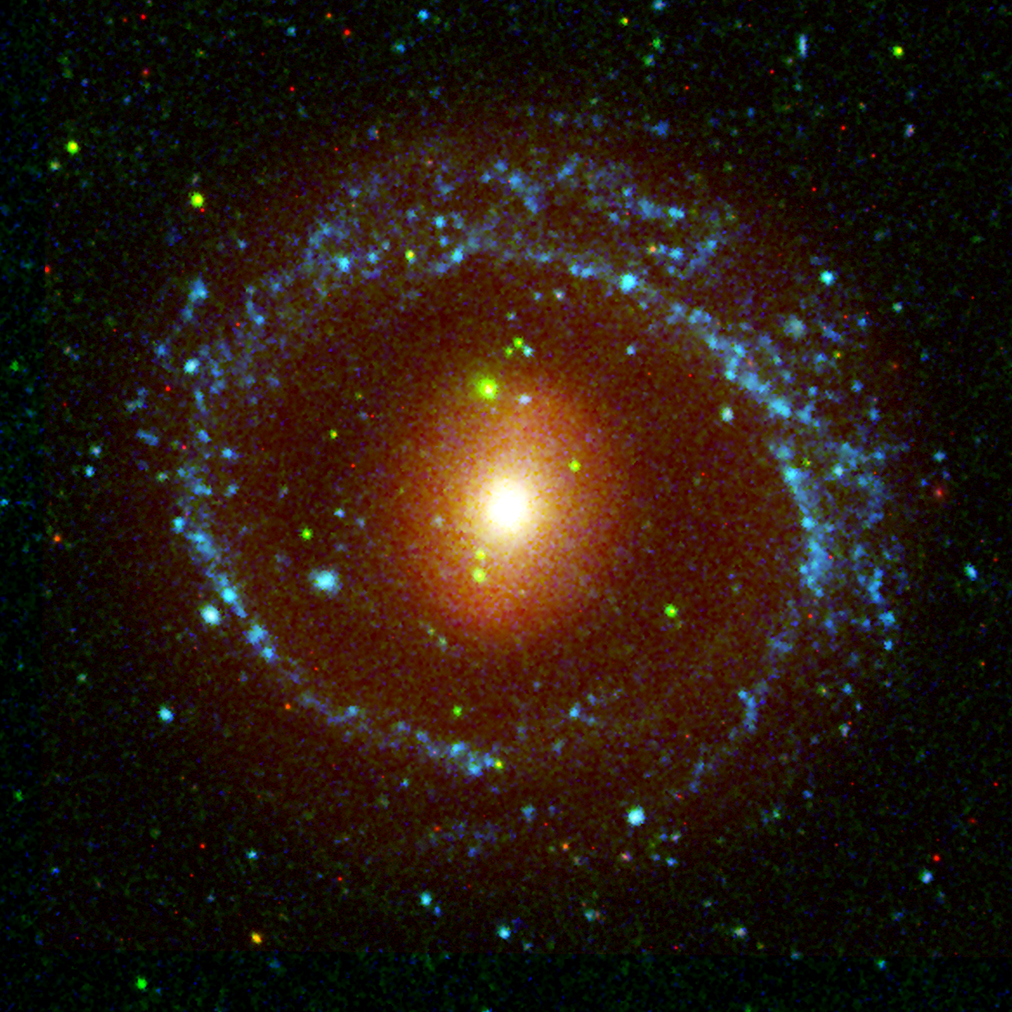


Structure and characteristics
The defining feature of NGC 1291 is its large, well-defined outer ring surrounding a comparatively smooth inner region. The inner area contains a bright bulge and a bar-like distortion in some images, while the ring shows clumps and knots that often indicate localized star formation. These structural components place NGC 1291 among galaxies described as ringed or early-type disk systems rather than irregular or merger remnants.
Origin and formation
Rings in galaxies can arise in different ways. In many disk galaxies, rings are created by orbital resonances driven by a rotating bar or by secular (slow) internal evolution; in other cases, rings result from interactions with companions. For NGC 1291 the consensus view in the literature favors an internal resonance or secular origin as a likely explanation for its symmetrical, well-centered ring, although past tidal encounters cannot be ruled out without detailed dynamical modelling.
Observation and scientific importance
NGC 1291 is of interest because its clear ring and relatively nearby distance make it a useful laboratory for studying how bars and disks redistribute gas and trigger star formation. Observations at optical, infrared and radio wavelengths can reveal contrasts between the old stellar population in the bulge and younger stars in the ring. Amateur observers value it as a visually attractive object, while professional astronomers use it in comparative studies of ring morphology.
Notable facts and distinctions
- Classified in the group of ringed disk galaxies and often referenced simply as a prominent example of a ring system (ring galaxy).
- Visible in the southern sky near the constellation marker Eridanus and listed in many galaxy catalogs for study and observation.
- Serves as a test case in discussions of bar-driven resonances and the secular evolution of disk galaxies; related background appears in general reviews of galaxy morphology (further reading).
Related articles
Author
AlegsaOnline.com NGC 1291 (ring galaxy in Eridanus) Leandro Alegsa
URL: https://en.alegsaonline.com/art/69856