
Kuiper Belt: the distant trans-Neptunian region of icy bodies
A summary of the Kuiper Belt: its location beyond Neptune, composition of icy bodies and dwarf planets, discovery history, relationship to scattered disk and comets, and why it matters.
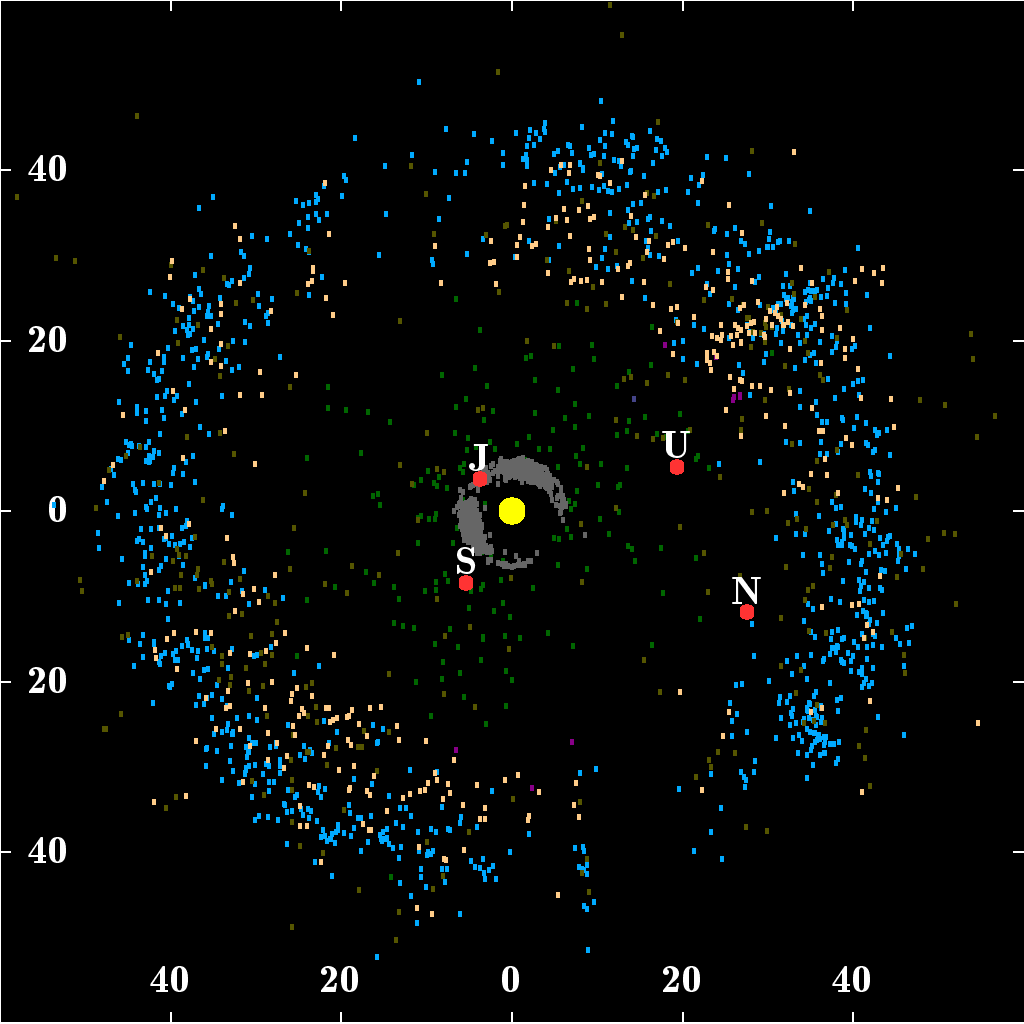
The Kuiper Belt is a broad, torus-shaped region of the Solar System that lies beyond the orbit of Neptune and extends roughly from about 30 to 50 astronomical units from the Sun. It is often described as the inner part of the population of small bodies that orbit the Sun beyond the giant planets. The name Kuiper Belt refers to a zone of mainly icy objects and remnants from the era of planet formation; this region is sometimes discussed together with more distant populations when people use the term trans-Neptunian objects.
Image gallery
10 Images




Location and boundaries
The belt begins near Neptune’s path at about 30 astronomical units and extends outward to roughly 50 AU. Its inner edge is set by gravitational interactions with Neptune’s orbit, while the outer edge is less sharply defined and blends into a more dynamically excited region called the scattered disk. When describing the Kuiper Belt it is common to mention the precise relation to the orbit of Neptune because many objects are trapped in orbital resonances with that planet.
Composition and characteristics
Kuiper Belt objects (KBOs) are predominantly composed of ices — water, methane, ammonia and other volatile compounds — mixed with rock. Compared with the rocky asteroid belt between Mars and Jupiter, many KBOs are larger and icier; several are massive enough for their gravity to pull them into a round shape and are classified as dwarf planets. The population includes a range of sizes from small kilometer-scale bodies to large objects hundreds or more kilometers across. Dynamically, the belt contains distinct groups: classical (or cold) objects with relatively circular, low-inclination orbits; resonant objects such as the plutinos locked in Neptune’s 3:2 resonance; and scattered objects with more eccentric, inclined paths.
History of discovery
Pluto and its moon Pluto and Charon were discovered long before the Kuiper Belt was recognized as a population. For many decades Pluto was treated as an odd isolated body beyond Neptune. In 1992 astronomers discovered the first object clearly identifying a larger population beyond Neptune, and surveys since then have located thousands of KBOs. While only a few thousand individual objects have been cataloged by telescopes, astronomers estimate that there may be many tens of thousands of objects larger than 100 km across within the belt.
Notable members and examples
- Pluto — once counted as the ninth planet, now a well-known dwarf planet and binary system with Charon (Pluto, Charon).
- Eris and Makemake — other large trans-Neptunian dwarf planets that helped reshape classification of planets.
- Haumea — notable for its elongated shape and fast rotation.
- Many smaller bodies — including the targets of flyby missions, which have revealed surface diversity and complex geology.
Significance and distinctions
The Kuiper Belt is important for several reasons: it preserves primitive material from the early Solar System and therefore holds clues about planetary formation; it is the principal source of many short-period comets that move inward toward the Sun; and its dynamical structure records the past migrations and interactions of the giant planets. The belt should be distinguished from the more distant, roughly spherical Oort Cloud and from the scattered disk, though these populations overlap in origin and behavior. When people speak about the Kuiper Belt in scientific or popular contexts, they often link to broader resources about the region and the catalogue of trans-Neptunian discoveries (Kuiper Belt overview).
Observationally, the belt remains an active field: better telescopes and dedicated surveys continue to find new objects and to refine estimates of the number and size distribution of KBOs. Space missions that have visited Kuiper Belt objects provide ground truth about surface composition and history, changing our understanding of these distant, icy worlds. For additional introductory material and lists of objects, consult specialized databases and surveys that track trans-Neptunian discoveries (orbital data, distance scales, comparisons with asteroids, and general references on dwarf planets and small bodies).
Related articles
Author
AlegsaOnline.com Kuiper Belt: the distant trans-Neptunian region of icy bodies Leandro Alegsa
URL: https://en.alegsaonline.com/art/54555