
Halimede — irregular outer moon of Neptune
Halimede (Neptune IX) is an irregular, non-spherical outer moon discovered in 2002. It has a highly inclined, eccentric retrograde orbit, an estimated diameter ~62 km, and may be related to Nereid.
Overview
Halimede is one of Neptune's irregular satellites. Designated S/2002 N 1 at discovery and later named Halimede (Neptune IX), it is a small, non-spherical body that orbits far from the planet. Like many distant moons of the giant planets, Halimede is believed to be a captured object or the result of past collisional events rather than having formed in place with Neptune's regular satellites. For a definition of irregular and non-spherical satellites see non-spherical moon.
Image gallery
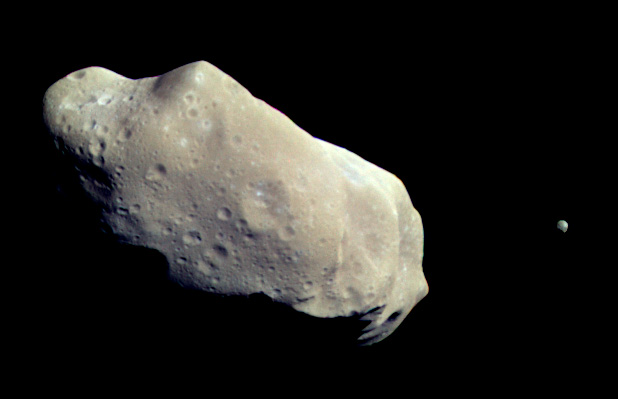
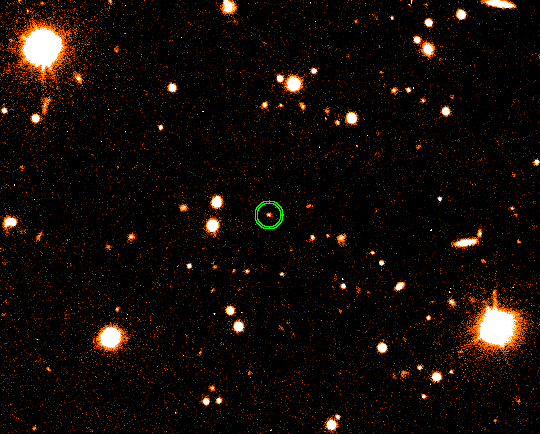
6 Images


Physical characteristics
Halimede is faint and therefore only roughly characterized. Its diameter is estimated to be about 62 kilometres if a dark surface albedo of roughly 0.04 is assumed; a higher albedo would imply a smaller size and vice versa. In visible light the moon appears neutral to slightly grey in colour, showing no strong reddening. Its small size and irregular shape indicate it lacks sufficient gravity to pull itself into a spherical form.
Orbit and motion
Halimede follows a distant, highly inclined and significantly eccentric orbit around Neptune. It is classified as an irregular, likely retrograde satellite, meaning it orbits in the opposite direction to Neptune's rotation and the motion of the large inner moons. The orbit stands out when plotted alongside other non-spherical outer moons because of its tilt and elongated path; more on its orbital parameters can be found at resources describing irregular orbits orbital details.
Origin hypotheses and relationship to Nereid
Two common explanations for irregular satellites apply to Halimede: capture of a heliocentric object by Neptune's gravity, or formation as a fragment produced by a collisional disruption of a larger moon. Observationally, Halimede's neutral colour is similar to that of the larger Neptunian moon Nereid. Some dynamical studies have suggested a non-negligible chance that Halimede and Nereid could have collided over the age of the Solar System, and this has led to the hypothesis that Halimede might be a fragment of Nereid. The suggestion is not definitive but remains an active possibility in explanations of the system's collisional history.
Discovery, designation and name
Halimede was discovered on 14 August 2002 by a team led by Matthew J. Holman and colleagues. Until an official name was assigned, it was referred to by its provisional designation S/2002 N 1. The International Astronomical Union announced the name Halimede (after one of the Nereids from Greek mythology) in 2007; many of Neptune's distant moons bear names drawn from those mythological sea figures. For background on albedo measurements and their influence on size estimates see albedo, and for information on Nereid see Nereid.
Importance and further study
Although Halimede is small and faint, studying such moons helps astronomers reconstruct the dynamical and collisional history of the outer planetary systems. Measurements of colour, orbit, and dynamics constrain models of capture and fragmentation. Future observations, especially with larger telescopes and dedicated surveys, may better determine its exact size, composition, and whether it shares a direct physical link to other Neptunian satellites.
- Provisional designation: S/2002 N 1
- Common name: Halimede (Neptune IX)
- Estimated diameter: ~62 km (assuming albedo ~0.04)
- Discovery: 14 August 2002 by M. J. Holman et al.
Questions and answers
Q: What is Halimede?
A: Halimede is a non-spherical moon of Neptune.
Q: When was Halimede discovered?
A: Halimede was found on August 14, 2002, by Matthew J. Holman et al.
Q: What is the diameter of Halimede?
A: Halimede is about 62 kilometres in diameter (assuming an albedo of 0.04).
Q: What is the orbit of Halimede like?
A: Halimede follows a very inclined and very eccentric orbit seen on the image in relation to other non-spherical moons of Neptune.
Q: What is Halimede's color?
A: Halimede appears neutral (grey) in visible light.
Q: Why is Halimede suggested to be a piece of Nereid?
A: Given the very similar colour of the moon to that of Nereid together with a high probability (41%) of their collision in the lifespan of the Solar system, it has been suggested that the moon could be a piece of Nereid.
Q: What is Halimede's name based on?
A: Halimede, or Neptune IX, like many of the farther moons of Neptune, is named after one of the Nereids, the fifty daughters of Nereus and Doris.
Related articles
Author
AlegsaOnline.com Halimede — irregular outer moon of Neptune Leandro Alegsa
URL: https://en.alegsaonline.com/art/41898