
Assault rifle: definition, history, characteristics, and global impact
An assault rifle is a selective-fire shoulder firearm that uses intermediate cartridges and detachable magazines. This article covers its defining features, development, uses, and how it differs from related weapons.
Overview
An assault rifle is a portable, shoulder-fired firearm designed for individual infantry use. Its defining characteristics are a detachable magazine, the ability to switch between semi-automatic and automatic (or burst) fire, and the use of intermediate-power cartridges that lie between full-power rifle rounds and pistol ammunition. These properties make assault rifles a compromise between controllability in automatic fire and effective range and terminal performance, suitable for general infantry roles.
Image gallery
10 Images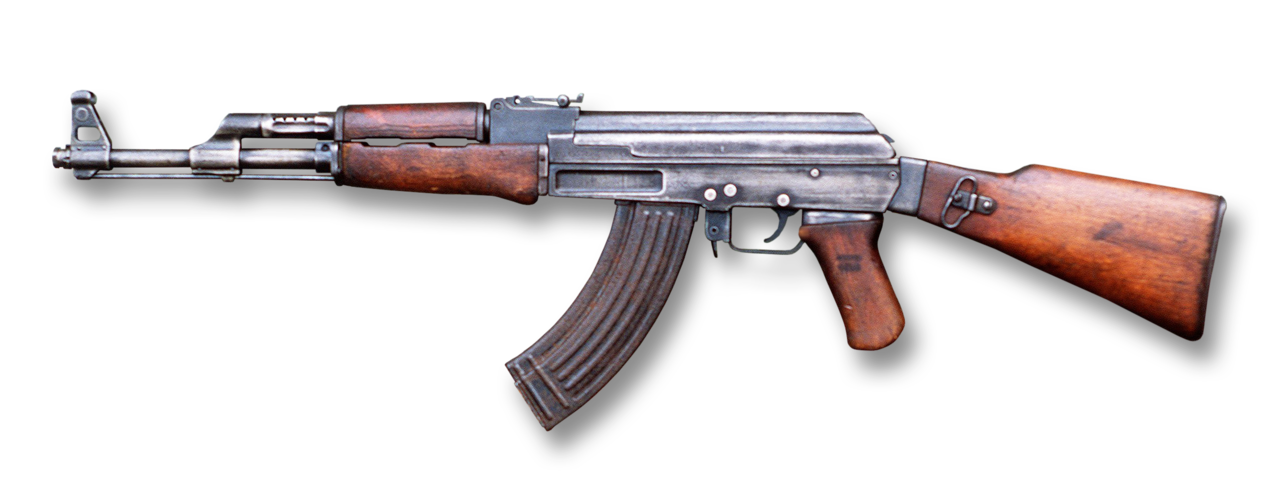




Key characteristics
- Selective fire: The mechanism permits the shooter to select semi-automatic, burst, or fully automatic modes, often linked to a combined safety/selector control. See further detail here.
- Detachable magazine: High-capacity, removable magazines enable rapid reloads and sustained fire; the feature is frequently noted as essential to the category (removable magazine).
- Intermediate cartridges: These rounds balance recoil and lethality, allowing controllable automatic fire at typical combat ranges; they are distinct from larger battle-rifle calibers and pistol cartridges used in submachine guns (intermediate cartridges).
- Compact ergonomics: Assault rifles often have shorter barrels and stocks suitable for close-quarters while retaining reasonable accuracy at moderate distances. For technical comparisons see cartridge performance and fire modes.
History and development
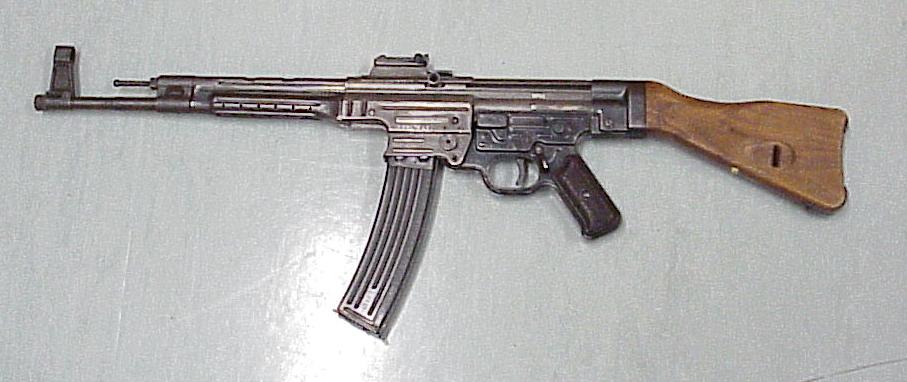
The term "assault rifle" was popularized by the German Sturmgewehr 44 (StG 44), literally "assault rifle 44," which combined selective fire with an intermediate cartridge and was produced in significant numbers during the Second World War (StG 44). Earlier individual experimental designs from nations such as Italy and Russia before World War I are sometimes cited as conceptual precursors, but they lacked the combination of features that later defined the class (Italian precursors, Russian precursors).
Germany was the first power to field an assault-rifle-type weapon on a large scale during World War II (German adoption). After the war, the concept influenced many postwar designs: the Soviet AK-47 became a widely produced and exported example (AK-47), while the United States adopted the M16 family (M16). Several nations later developed their own standard service rifles, such as the British L85 (L85), reflecting different design priorities and doctrines.
Uses and operational importance
Assault rifles are the principal individual weapon of modern infantry units because they are versatile across urban, forest, and open-field environments. Their balance of weight, ammunition capacity, and firepower makes them practical for squad-level tactics. Specialized variants include carbine versions, designated marksman adaptations, and light-support configurations. The global spread of assault rifles has shaped post‑war conflicts, training, and small-arms logistics (global adoption).
Distinctions, controversies, and legal context
Important distinctions exist between an "assault rifle" (a technical military category) and terms used in public policy such as "assault weapon," which vary by jurisdiction and often focus on cosmetic or accessory features rather than internal function. Comparisons with other classes of firearms are common: battle rifles fire larger full-power cartridges and tend to be heavier and longer-ranged, while submachine guns fire pistol cartridges and are designed for very short-range automatic fire (comparisons).
Political and legal debates around civilian ownership, classification, and regulation of weapons described in popular discourse as "assault rifles" remain contentious; discussions typically address selective-fire capability (often restricted), magazine capacity, and the weapon's role in public safety (policy debates).
Further reading and resources
- Detachable magazines and logistics
- Fire selectors and mechanisms
- Ammunition categories and effects
- Differences between firing modes
- Intermediate cartridges: theory and practice
- Sturmgewehr 44 history
- Early Italian designs
- Early Russian experiments
- German wartime adoption
- AK-47 development
- M16 family overview
- British service rifles
- Global proliferation and impact
- Battle rifle vs assault rifle vs submachine gun
- Regulation and public policy
Related articles
Author
AlegsaOnline.com Assault rifle: definition, history, characteristics, and global impact Leandro Alegsa
URL: https://en.alegsaonline.com/art/6714