
Atlanta Campaign (1864): Sherman's Advance and the Fall of Atlanta
Union General William T. Sherman's series of operations in northwestern Georgia (May–September 1864) that captured Atlanta, weakened Confederate logistics and shaped the final campaigns of the American Civil War.
The Atlanta Campaign (6 May 1864 – 2 September 1864) was a sustained series of battles and maneuvers fought during the American Civil War. Planned and led as a major campaign by the Union Army under Major General William T. Sherman, its principal military aims were to defeat or neutralize the Confederate Army of Tennessee commanded by General Joseph E. Johnston (later opposed by John Bell Hood) and to seize the strategic rail and industrial center of Atlanta.
Image gallery
10 Images
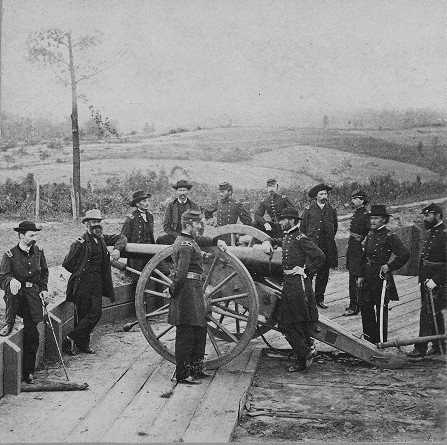


Scope and principal engagements
The campaign unfolded across northwestern Georgia and parts of eastern Tennessee as Sherman pushed southeast from Chattanooga toward Atlanta. It combined set-piece battles, entrenchments, reconnaissance in force and repeated flanking movements. Notable clashes included actions at Resaca, New Hope Church, Kennesaw Mountain and the battle at Peachtree Creek, culminating in the investment and capture of Atlanta after protracted operations around the city.
Forces, logistics and tactics
Sherman directed three principal field armies in coordinated operations, relying on cavalry for reconnaissance and on engineering parties to repair or destroy railroads and bridges as operations required. Logistics played a decisive role: protecting supply lines, controlling rail hubs and maintaining depot networks shaped operational choices. Sherman frequently avoided costly frontal assaults when a maneuver could turn Confederate positions or sever their lines of communication.
Command changes and Confederate response
Confederate strategy under Johnston emphasized defensive works and trading space for time, but as Johnston withdrew repeatedly he was replaced by General John Bell Hood late in the summer. Hood adopted a more aggressive posture and launched several counterattacks that altered the character of the fighting and raised Confederate risk in hopes of stopping Sherman before Atlanta fell.
Outcomes and significance
The fall of Atlanta in early September 1864 deprived the Confederacy of a vital manufacturing and railroad center, disrupted its ability to move materiel in the West, and delivered a significant political and psychological blow to the Southern cause. In the North, the victory bolstered public support for the Lincoln administration during the 1864 election campaign. Militarily, the campaign is studied for its use of operational maneuver, coordination of multiple armies and deliberate targeting of enemy infrastructure.
Aftermath and legacy
After capturing Atlanta, Sherman ordered its evacuation and later conducted the famous March to the Sea, applying the principles of total war to undermine Confederate capacity to sustain the conflict. The Atlanta Campaign remains an important case in Civil War studies for how logistics, engineering, and coordinated corps-level maneuvers combine with strategic objectives to produce decisive results.
Key points
- The campaign ran from May to September 1864 and involved continuous operations across a wide theater.
- Sherman's approach favored mobility, flanking and cutting rail supply rather than repeated frontal assaults.
- Command change from Johnston to Hood marked a shift to more aggressive Confederate tactics late in the campaign.
- Capture of Atlanta had both military and political consequences, influencing Northern morale and the 1864 presidential election.
- Historians view the campaign as a model of operational maneuver and logistics-driven strategy in the American Civil War era.
Questions and answers
Q: What was the Atlanta Campaign?
A: The Atlanta Campaign was a series of battles during the American Civil War.
Q: Who was the leader of the Union Army during the Atlanta Campaign?
A: Major General William T. Sherman was the leader of the Union Army during the Atlanta Campaign.
Q: What was the first goal of the Atlanta Campaign?
A: The first goal of the Atlanta Campaign was to defeat the Confederate Army of Tennessee led by General Joseph E. Johnston.
Q: What was the second goal of the Atlanta Campaign?
A: The second goal of the Atlanta Campaign was to take the important city of Atlanta.
Q: Did Sherman capture Atlanta?
A: Yes, Sherman captured Atlanta.
Q: Was the Army of Tennessee completely destroyed during the Atlanta Campaign?
A: No, the Army of Tennessee was not completely destroyed during the Atlanta Campaign.
Q: Who was the leader of the Confederate Army of Tennessee during the Atlanta Campaign?
A: General Joseph E. Johnston was the leader of the Confederate Army of Tennessee during the Atlanta Campaign.
Related articles
Author
AlegsaOnline.com Atlanta Campaign (1864): Sherman's Advance and the Fall of Atlanta Leandro Alegsa
URL: https://en.alegsaonline.com/art/6961
Sources
- civilwar.org : "The Atlanta Campaign; A Strategic Overview"