
Firearm magazine: design, types, history and use
A magazine stores and feeds ammunition for firearms and other weapons. This article explains parts, common types, how magazines work, historical development, uses, safety and notable distinctions.
Overview
A magazine is a device or compartment for storing ammunition. In military contexts the word can also mean a depot for larger munitions, such as an artillery magazine building or a secure warehouse, and enclosed magazines aboard a warship. In small arms parlance a magazine specifically denotes the component that holds and feeds cartridges into a firearm.
Image gallery
10 Images


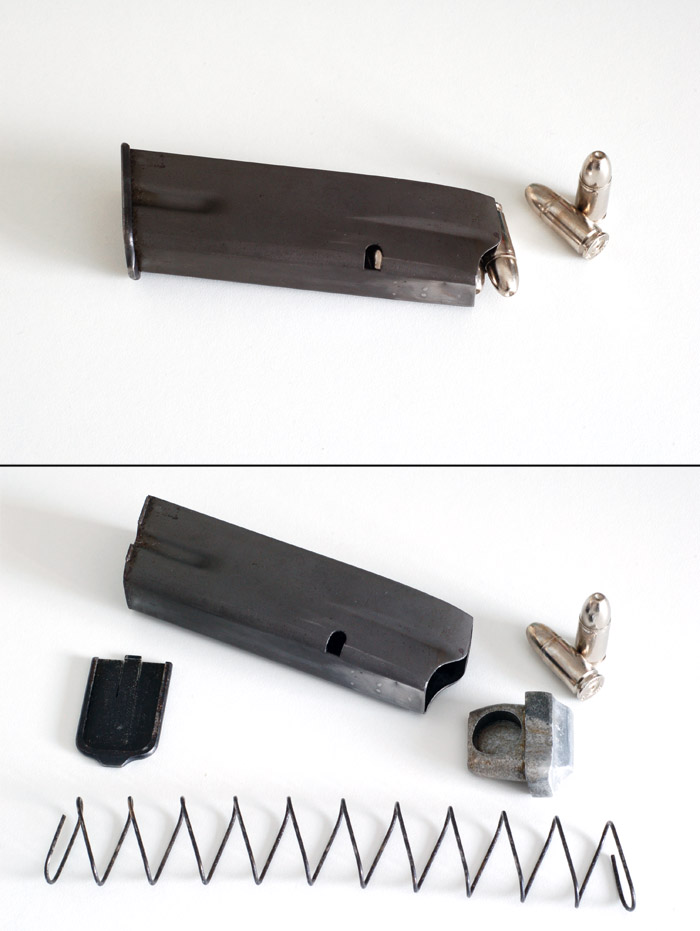


Basic parts and how it works
Most magazines consist of a body, a follower that bears on the lowest cartridge, and a resilient element — typically a coil or leaf spring — that pushes cartridges toward the feed lips and into the action. The body may be made of stamped metal or molded plastic. Some designs include transparent or translucent windows that let the shooter see remaining rounds (see-through panels). Magazines can be internal (fixed in the firearm) or detachable: removing an empty magazine and inserting a loaded one is commonly called reloading the firearm, while topping off the magazine itself is called reloading the magazine.
Common types
- Box magazine – the most widespread form; cartridges are stacked in one or more columns and fed from the top.
- Drum magazine – a cylindrical container that stores more cartridges in a radial pattern, often used where high capacity is needed.
- Pan magazine – a flat, circular plate that holds cartridges horizontally around a central spindle.
- Helix magazine – uses a spiral path to store many rounds in a compact length.
- Tubular magazine – common on many shotguns and lever-action rifles; cartridges lie end-to-end under the barrel and usually accept bullets or shotgun shells depending on the weapon.
Loading methods and distinctions
Magazines are loaded in different ways: by inserting single cartridges, using stripper clips to top off an internal magazine, swapping detachable magazines, or employing speedloaders for shotguns and revolvers. A frequent point of confusion is the term "clip": a clip is a simple device for holding cartridges together to ease loading into a magazine or chamber, but it is not itself a magazine. Detachable magazines have become standard on most modern pistols and rifles, while revolvers and some older rifles rely on other loading systems.
History and development
Magazine-fed firearms evolved with improvements in cartridge and propellant technology that made repeating arms practical. Early repeating weapons used tubular and plate systems; later, detachable box magazines provided faster reloading and more compact storage, helping pave the way for semi-automatic pistols and modern service rifles. Over time materials and manufacturing methods changed, moving from heavy metals to lighter alloys and durable polymers.
Uses, maintenance and legal notes
Magazines are critical to the function and ergonomics of pistols, rifles and many shotguns; they influence capacity, balance and reload speed. Maintenance is important: springs lose tension, followers can bind, and dirt or corrosion reduces reliability. Users regularly inspect, clean, and replace worn parts. Some jurisdictions regulate magazine capacity and design; where laws apply, owners must follow local restrictions. For more on shotgun-specific loaders see references on shotguns and speedloader systems.
Notable facts and compatibility
- Magazines are often model- and caliber-specific; interchangeability should never be assumed.
- Materials and windows affect weight and round-count visibility: metal for durability, polymer for lighter weight, and transparent inserts for quick checks.
- Design trade-offs balance capacity, feeding reliability and size — a high-capacity drum holds many bullets but may be bulkier than a box magazine.
For technical references and safety guidelines consult specialized sources and manufacturers' documentation. Additional reading and resources are available via general reference links: ammunition, artillery, warehousing, naval magazines, and material and component guides for springs, metal and plastic magazine construction. See also manufacturer pages and armory manuals for specific models and service procedures (inspection windows).
Related articles
Author
AlegsaOnline.com Firearm magazine: design, types, history and use Leandro Alegsa
URL: https://en.alegsaonline.com/art/60558