
M16 rifle
A lightweight 5.56×45mm NATO military rifle developed from the AR-15 in the 1950s–60s; widely used by the US military and many other countries in several variants.
Overview
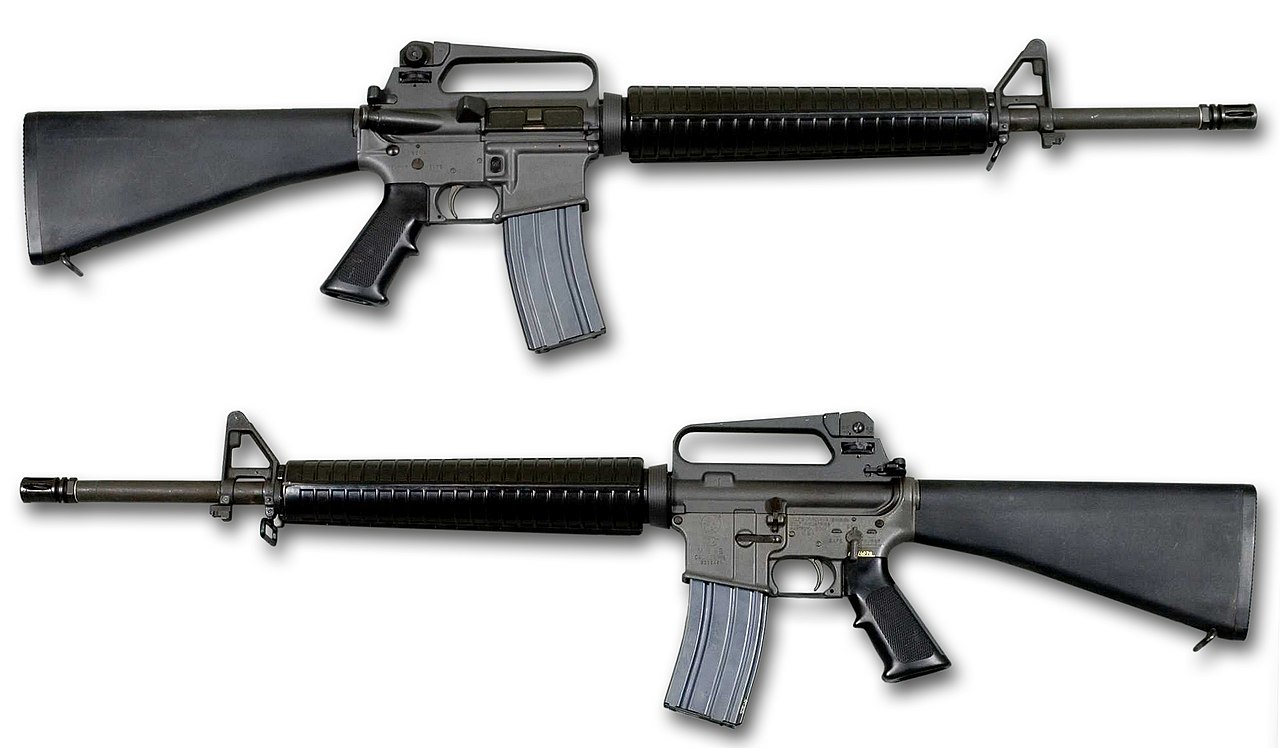
The M16 is a family of lightweight, magazine-fed military rifles that fire the 5.56×45mm NATO cartridge. Developed from the AR-15 design of the late 1950s, it entered widespread U.S. service during the Vietnam War era and has since become one of the most recognizable infantry rifles in modern history. The weapon is often described as an assault rifle in general terms and has been produced in many variants for different roles.
Image gallery
2 Images
Design and technical characteristics
The M16 family uses a gas-operated, rotating-bolt system derived from the original ArmaLite AR-15. Early production rifles employed a direct gas impingement arrangement that routes gas from the barrel to operate the bolt carrier group. The rifle is chambered for the 5.56×45mm NATO cartridge (historically tied to the .223 Remington), and typical performance figures include muzzle velocity on the order of about 900 m/s and an effective individual target range of several hundred meters, depending on barrel length and sighting. Magazines are generally detachable box magazines with a common nominal capacity of 30 rounds.
Variants and evolution
- M16 (original): Early service models introduced to U.S. forces in the 1960s, adapted from the civilian AR-15.
- M16A1: Introduced durability improvements and a chrome-lined chamber to reduce corrosion and fouling; widely used in Vietnam.
- M16A2/A3/A4: Series of upgrades including heavier barrels, improved sights, stock and handguard refinements; the A2 introduced a three-round burst fire mode on many service rifles, while the A4 offers a flat-top receiver for removable optics.
- M4 carbine: A shorter, lighter carbine derivative intended for close-quarters use; it retains much of the M16's operating system but with a compact barrel and telescoping stock.
History and service
Designed by Eugene Stoner and originally marketed as the AR-15, the design was produced by several manufacturers after ArmaLite licensed and sold the rights. The U.S. military adopted the rifle in the early 1960s and used it extensively during the Vietnam War. Early adoption highlighted both advantages—lighter weight and higher velocity ammunition—and challenges, such as sensitivity to maintenance and ammunition specifications, which prompted design and doctrinal changes. Over subsequent decades the M16 platform was adapted into multiple configurations and exported or produced under license by many nations.
Operational use, ammunition and accessories
In service the M16 family has been fitted with a wide range of sights, optics, bayonets, grenade-launching devices, and accessory rails. The standard magazine capacity is commonly 30 rounds, though 10- and 20-round magazines are also used; many countries and units have standardized on magazines compatible with NATO magazine interfaces. Different units may select full-automatic, burst, or semi-automatic firing modes depending on variant and doctrine. The rifle's relatively small caliber and high-velocity round contribute to controllable recoil and the ability to carry more ammunition per soldier compared with larger calibers.
Users, distinctions and legacy
The M16 family has been adopted, manufactured under license, or copied by scores of countries and remains in service around the world. It was the primary U.S. service rifle for decades and influenced later designs, including the widely used M4 carbine. While some militaries have shifted to different platforms or modernized variants, the M16's combination of light weight, modularity, and widespread parts commonality has left a lasting impact on small-arms design. For further historical context see discussions of the Vietnam War era and infantry doctrine changes: Vietnam War and modern infantry sources.
Related articles
Author
AlegsaOnline.com M16 rifle Leandro Alegsa
URL: https://en.alegsaonline.com/art/60207
Sources
- nationaldefensemagazine.org : "Focus on Basics, Urges Small Arms Designer"
- books.google.com : Military Small Arms of the 20th Century
- colt.com : Customers / Weapon users
- peosoldier.army.mil : "M16A2/A4 rifle"
- armystudyguide.com : "M16/A2 - 5.56 mm Semiautomatic Rifle"