
AK-47: design, history, variants and global impact
An overview of the AK‑47 assault rifle: origin, mechanism, major variants, operational characteristics, global use and legacy in military and civilian contexts.
Overview
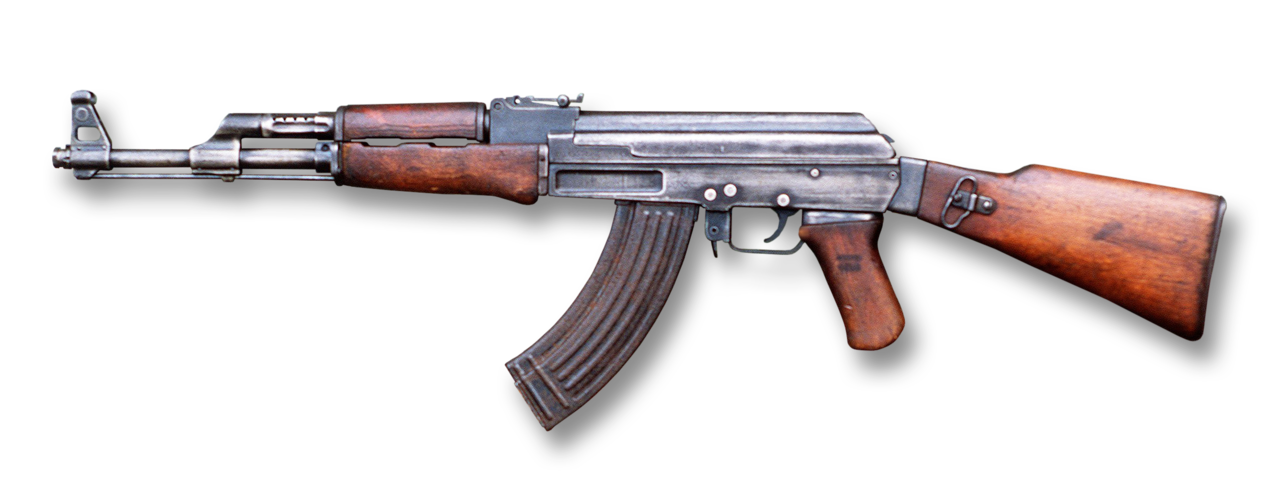
The AK‑47 is a gas‑operated assault rifle first produced in the Soviet Union in the late 1940s and widely adopted thereafter. Conceived by Mikhail Kalashnikov, it became known for its simplicity, ruggedness and ease of maintenance. The basic model fires an intermediate cartridge and can be configured for semi‑automatic or fully automatic fire, which contributed to its rapid spread among state armed forces, irregular formations and civilian markets worldwide. For more on early development see origins and adoption by the Soviet military.
Image gallery
2 Images
Design and operation
The AK family uses a long‑stroke gas piston system that extracts some of the propellant gases from the barrel to cycle the action. This gas‑operated mechanism permits rapid, reliable reloading under adverse conditions and is one reason for the design's reputation for resilience. The rifle chambers a mid‑range cartridge commonly associated with the type, and it feeds from detachable box magazines. The trigger group supports selective fire on most military models, while civilian derivatives are often semi‑automatic only. For technical summaries see gas operation, the role of propellant gases, and basic parts such as the chamber. The inventor, Mikhail Kalashnikov, is frequently referenced in general histories.
Variants and related weapons
Over time the original design was adapted into many variants and related weapons. A modernized production version known as the AKM refined manufacture and materials. Foldable‑stock models aimed at airborne and vehicle crews were issued as compact variants. A light machine gun derivative, with a longer barrel and heavier components, performs a squad‑support role. Notable family members and related systems include the AKM, the smaller‑caliber successor that became standard in later decades, and other designs influenced by the AK series. See links for specific models and types: non‑state actors, selective and full auto, squad LMG, civilian sporting variants, and semi‑automatic classifications. A compact carbine variant and urban short‑barrel models were developed for confined environments and vehicle crews.
History and global deployment
After its introduction the rifle and its derivatives were produced in large numbers both inside the Soviet bloc and in many other countries under license or in unlicensed copies. It saw service across continents in regular armies, liberation movements and insurgencies because it combined low production cost with field durability. During later decades, militaries adopted newer calibers and designs to meet changing requirements, but the AK pattern remained common in numerous armed forces and paramilitary groups around the world. For transitions and replacements consult later models and national procurement histories at comparative sources.
Uses, cultural role and notable facts
Beyond military employment, the rifle became a potent symbol in iconography, politics and popular culture. Its image appears on flags, emblems and media, reflecting both its practical role and its symbolic association with revolution and defense. The weapon's affordability and maintainability made it accessible to non‑state actors as well as to armed forces, influencing conflict dynamics in many regions; see links on use by irregular groups and on civilian firearms policy at official military archives. Derivative civilian shotguns and hunting rifles drew mechanical inspiration from the AK layout; examples include certain semi‑automatic sports models mentioned at industry pages and product descriptions.
Distinguishing features and legacy
Key characteristics that distinguish the AK family are mechanical simplicity, tolerance of fouling and a design optimized for mass production and field repair. While newer rifles offer improvements in ergonomics, accuracy and modularity, the AK platform's wide distribution and durable reputation ensure its continued presence in arsenals and conflicts worldwide. For a technical comparison and extended reading consult ballistics and gas, practical maintenance guidance at biographical sources, and archival material at historical repositories.
- See also: designer biography at Kalashnikov.
- Technical overview: operating system.
- Variants and civilian analogues: sports models and comparisons.
Questions and answers
Q: What is the AK-47?
A: The AK-47 is a Russian combat rifle first used in 1949. It was designed by Mikhail Kalashnikov and quickly became famous for its reliability, simplicity, and ease of use.
Q: Who uses the AK-47?
A: The AK-47 and its successors continue to be used by many of the world's armies, as well as terrorist and insurgent groups.
Q: What are some variants of the AK-47?
A: Variants of the AK-47 include the folding stock version (AKS-47), a shortened version with a folding stock (AKMSU), a light machine gun variant (RPK), and others such as the sks/Dragunov sniper rifle and Saiga-12 semi-automatic shotgun.
Q: How does an AK-47 reload?
A: An AK-47 uses gas operated reloading - when a bullet is fired down the barrel, some of the gas behind it goes up a small tube that pushes away the bolt so that it can be reloaded without having to manually do so each time.
Q: Is an AK-47 semi or fully automatic?
A: Most versions of an AK-47 are fully automatic firearms, but there are also some versions made to only be used in semi automatic mode where you have to pull and release then trigger again after every shot.
Q: What type of cartridge does an AKS74U fire?
A: The AKS74U fires 5.45 cartridges from an Ak 74 weapon system.
Q: Who designed the Ak 47 ?
A: The Ak 47 was designed by Mikhail Kalashnikov in 1947
Related articles
Author
AlegsaOnline.com AK-47: design, history, variants and global impact Leandro Alegsa
URL: https://en.alegsaonline.com/art/1762
Sources
- nybooks.com : nybooks.com/articles/2011/02/10/most-influential-weapon-our-time/
- www-wds.worldbank.org : "Weaponomics: The Global Market for Assault Rifles"
- foxnews.com : "AK-47 Inventor Doesn't Lose Sleep Over Havoc Wrought With His Invention"
- worldcat.org : 36334372 · web.archive.org
- izhmash.ru : izhmash.ru/eng/product/akm.shtml
- worldpress.org : worldpress.org/cover5.htm
- nytimes.com : "IN THE LAND OF THE KHMER ROUGE." · web.archive.org
- nytimes.com : nytimes.com/1997/03/13/world/burst-of-pride-for-a-staccato-executioner-ak-47.html