
Atlas (missile) — U.S. ICBM turned long-lived launch vehicle family
Atlas began as the United States' first operational ICBM in the late 1950s and later evolved into a versatile family of space launch vehicles used for crewed Mercury flights, satellites and probes.
Overview
The Atlas began life as an intercontinental ballistic missile developed by the Convair Division of General Dynamics in the late 1950s. Initially built as an armed strategic weapon, the basic vehicle design was adapted for spaceflight and became the backbone of a multi-decade family of launchers. Early accounts and technical histories often refer to the vehicle simply as the Atlas missile, while its descendants are commonly known as Atlas launch vehicles.
Image gallery
10 Images



Design and characteristics
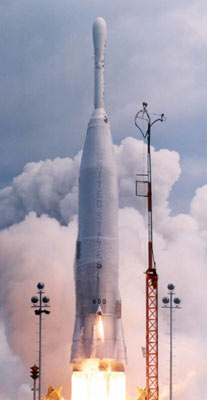
One of Atlas's most distinctive engineering features was its "stage-and-a-half" configuration: a central sustainer engine and two booster engines that were jettisoned in flight while the main tank structure remained. The rocket used very thin, pressurized tanks — sometimes called "balloon tanks" — that relied on internal pressurization for rigidity. Early operational versions burned a kerosene-type fuel with liquid oxygen; later variants incorporated cryogenic upper stages using liquid hydrogen and oxygen to increase payload performance.
History and development
Developed under Cold War pressures, Atlas became the first operational U.S. intercontinental ballistic missile and entered service in the late 1950s. As strategic requirements and missile technology progressed, Atlas missiles were phased out of the nuclear role and repurposed as space launchers. Notably, modified Atlas boosters launched the Mercury crewed capsules during the early U.S. human spaceflight program, placing the first American astronauts into orbit.
Variants and uses
Over time the basic Atlas architecture gave rise to many variants and combinations with upper stages. Examples include Atlas vehicles paired with Agena or Centaur stages, and later family members that bore the Atlas name while using updated structures and engines. These vehicles have served a broad range of missions: putting commercial and military satellites into orbit, carrying scientific probes, and supporting crewed capsules. Modern descendants of the original design continue to serve government and commercial customers, operated by industry consortia and launch providers.
Notable missions and importance
Atlas launchers played a central role in the early space age. In addition to the Mercury orbital flights, they launched many early Earth-observation and scientific satellites and served as workhorses for both government and commercial payloads. Their flexibility — from ballistic missile to reliable orbital booster — illustrates a successful transition from military hardware to civilian space infrastructure. For summaries of payload applications and operational flights see historical mission lists and contemporary launch archives.
Legacy and distinguishing facts
- The Atlas is widely cited as the United States' first operational ICBM and one of the first U.S. rockets to evolve into a long-lived launch family.
- Its stage-and-a-half layout and thin-walled pressurized tanks made it visually and technically distinctive among early rockets.
- Conversions of Atlas boosters enabled a broad range of orbital missions, from national security satellites to scientific probes and crewed flights; many of these missions placed both commercial and military satellites into orbit and deployed other types of spacecraft, including scientific payloads and probes for exploration (examples and mission summaries).
Together, these features secure the Atlas family's place in aerospace history as a bridge between Cold War missile technology and the modern commercial and institutional launch industry.
Questions and answers
Q: Who built the Atlas missile?
A: The Atlas missile was built by the Convair Division of General Dynamics.
Q: What was the Atlas missile originally designed as?
A: The Atlas missile was originally designed as an ICBM in the late 1950s.
Q: What space project did the Atlas missile launch?
A: The Atlas missile launched the Mercury project space capsules.
Q: What currently builds the Atlas rocket family?
A: The Atlas rocket family is currently built by United Launch Alliance.
Q: What is the Atlas rocket family used for today?
A: The Atlas rocket family is used as a launch platform for commercial and military satellites, and other spacecraft.
Q: Which company owns United Launch Alliance?
A: United Launch Alliance is owned by Lockheed Martin and Boeing.
Q: What is the significance of the Atlas rocket family?
A: The Atlas rocket family is significant because it has been successful in launching various space missions, and continues to be used as a launch platform today.
Related articles
Author
AlegsaOnline.com Atlas (missile) — U.S. ICBM turned long-lived launch vehicle family Leandro Alegsa
URL: https://en.alegsaonline.com/art/7013