
Semi-automatic firearm
A firearm that uses energy from each fired cartridge to cycle the action and chamber the next round, producing one shot per trigger pull; used in pistols, rifles and shotguns for military, law enforcement and civilian purposes.
A semi-automatic firearm, often called self-loading, is a gun that fires a single shot for each pull of the trigger and automatically uses part of the energy from that shot to prepare the weapon for the next discharge. In practice the fired cartridge powers extraction, ejection and the feeding of the next round so the shooter need only pull the trigger again to fire. This contrasts with manual actions such as pump, bolt or lever systems, and with revolvers that require the shooter to manually chamber or rotate a cylinder; it also differs from fully automatic firearms, which continue firing while the trigger is held.
Image gallery
8 Images



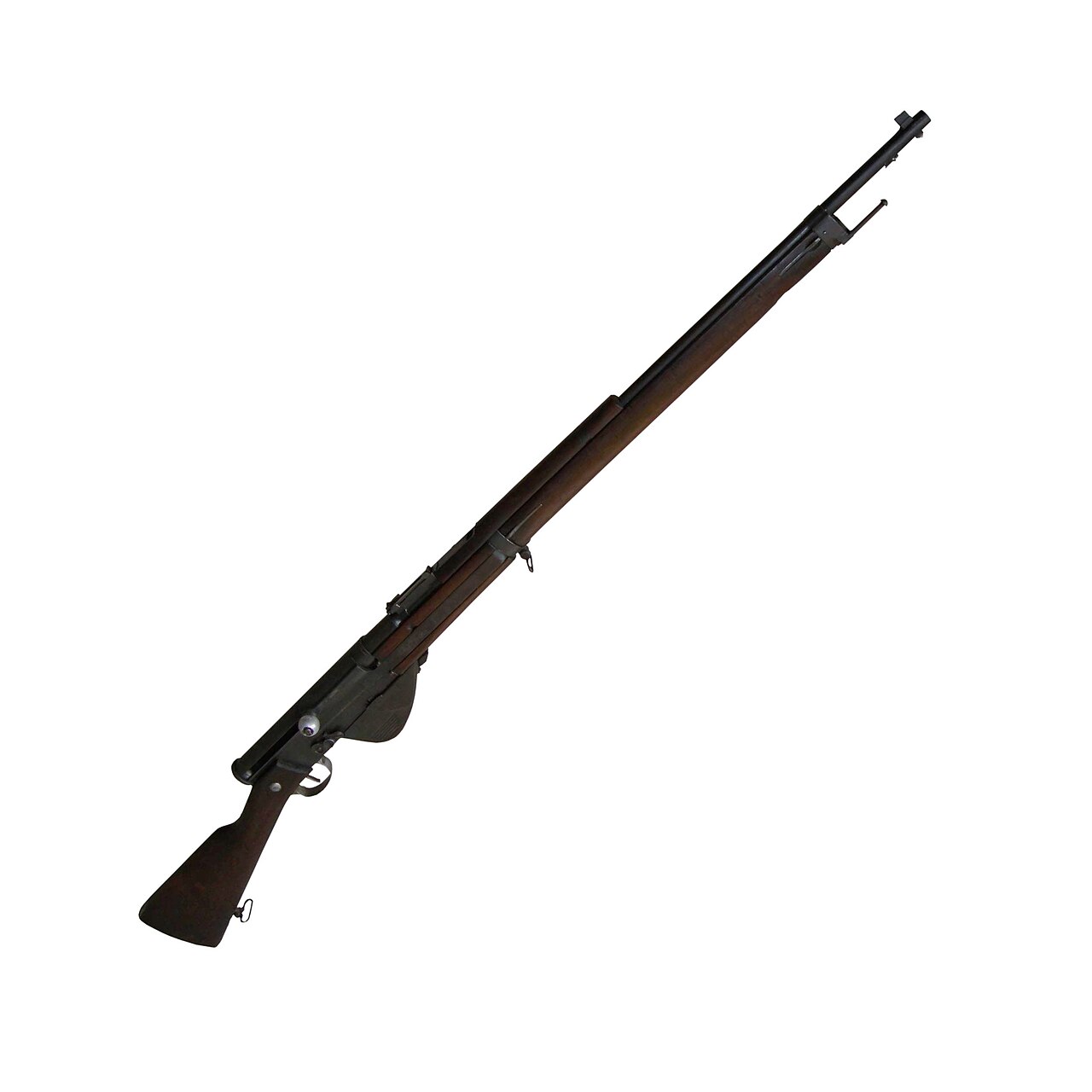


How it works
The basic cycle of a semi-automatic firearm involves several repeatable stages: firing, unlocking, extraction and ejection of the spent case, feeding and chambering a fresh cartridge, and locking and cocking the firing mechanism. Different designs accomplish these stages by various means, most commonly:
- Blowback — using the rearward force on the cartridge case to move the bolt or slide.
- Recoil-operated — using barrel and slide movement from recoil to cycle the action.
- Gas-operated — diverting gas from the barrel to drive a piston or direct impingement system.
Components and variants
Typical parts include a barrel, chamber, slide or bolt, recoil or return spring, magazine and trigger assembly. Semi-automatic designs are common in handguns (pistols), rifles and shotguns. Magazines may be detachable or integral, and feeding mechanisms differ between designs. Early practical semi-automatic pistols and rifles appeared in the late 19th and early 20th centuries and were developed into many standardized military and civilian models; examples include well-known pistols like the Mauser C96 and several designs by John Browning.
Uses, advantages and limitations
Semi-automatic firearms are widely used for military and police service, hunting, competitive shooting and personal defense. They allow faster follow-up shots without manual cycling and often have higher ammunition capacity than contemporary manual-action guns. Drawbacks include greater mechanical complexity, sensitivity to ammunition and maintenance, and the potential for stoppages (failures to feed, extract or eject).
Terminology and legal notes
The term "semi-automatic" is technical but can be treated differently in law and public discussion; legal definitions and restrictions vary by jurisdiction. For those learning about or handling these firearms, emphasis on safe handling, routine maintenance and understanding the specific operating system is essential. For further technical detail and standards, see external resources such as those linked below.
Related concepts and comparisons: one round per trigger pull, single-action revolver, and distinctions between loading systems and cycling methods.
Related articles
Author
AlegsaOnline.com Semi-automatic firearm Leandro Alegsa
URL: https://en.alegsaonline.com/art/88735