
Manchukuo: Japanese puppet state in Northeast China (1932–1945)
Manchukuo was a Japanese-controlled polity in Manchuria and parts of Inner Mongolia from 1932 to 1945, nominally headed by the last Qing emperor Puyi and remembered for its short-lived institutions and wartime abuses.
Overview
Manchukuo was established in 1932 in the region commonly called Manchuria (northeast China) and expanded to include parts of Inner Mongolia. It functioned as a state-like entity under the dominant influence of Imperial Japan. Nominal authority was vested in the last Qing emperor Puyi, who served first as a regent and after 1934 as a proclaimed monarch. In practice political and military decisions were made by Japanese agencies and the Kwantung Army, which oversaw security, economic planning and colonization policies.
Image gallery
10 Images

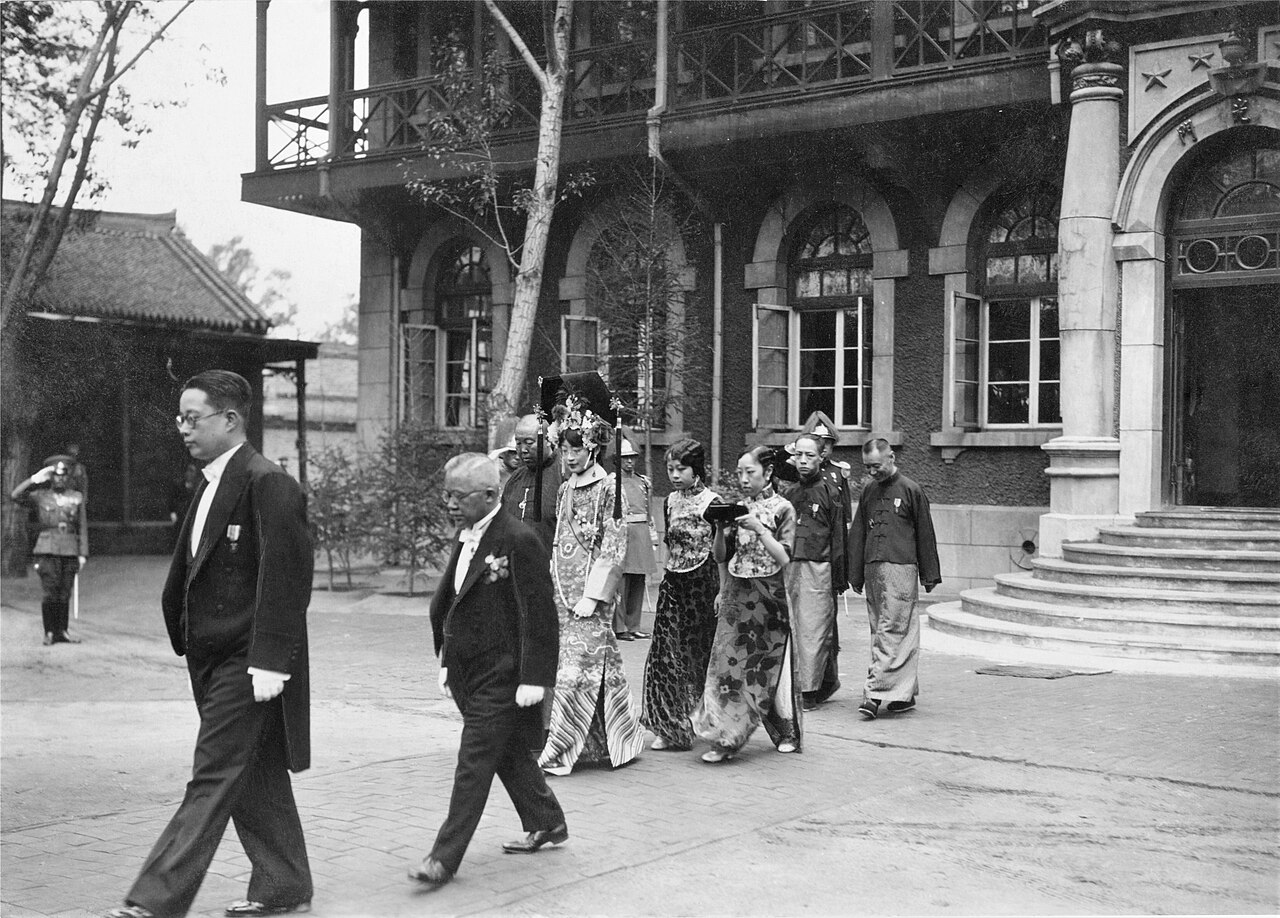


Formation and governance
The creation of Manchukuo followed the 1931 Mukden Incident, an episode engineered by members of the Japanese military that provided a pretext for occupation. A local pro-Japanese administration was declared the following year; its institutions mimicked those of an independent state but multiple levers of power remained under Japanese control. In 1934 the regime adopted the trappings of a constitutional monarchy, and its capital was established at Changchun (renamed Xinjing). The territory included areas administered as special zones by Japan, such as the Kwantung Leased Territory on the Liaodong Peninsula.
Territory, population and economy
Manchukuo covered a large and diverse region of Northeast Asia, incorporating traditional Manchu homelands, Han-majority agricultural plains and industrial centres developed under Japanese investment. Ethnic composition was plural: Han Chinese constituted the majority, with Manchus, Koreans, Japanese settlers, Mongols and White Russian émigrés among other groups. The occupying authorities promoted industrialization, rail and resource extraction projects, and migration of settlers; these policies transformed local economies but also produced social dislocation and resentment.
Wartime activities and abuses
During its existence Manchukuo was linked to broader Japanese military and scientific programs. Units under Japanese direction undertook biological and chemical warfare research and human experimentation in the region; these actions caused great suffering and were later prosecuted or documented after the war. The state’s institutions and security apparatus also suppressed dissent, and many residents experienced harsh measures associated with occupation and forced labour.
Collapse and aftermath
The Soviet Union invaded Manchukuo in August 1945, near the end of World War II, rapidly defeating Japanese forces and occupying the region. After Japan’s surrender, control was transferred to Chinese authorities and the territory became a theatre in the resumption of the Chinese civil war. Equipment, infrastructure and the temporary Soviet presence influenced subsequent campaigns and logistics. The legacy of Manchukuo—its contested legal status, wartime crimes, demographic shifts and economic changes—remains a subject of historical study and public memory in East Asia.
Notable facts and distinctions
- Legal status: widely regarded by historians as a puppet state with limited international recognition despite appearing to have conventional state organs.
- Leadership: Puyi served as the symbolic head of state, but real authority rested with Japanese military and civilian administrators.
- Administrative variety: the region included territories under special Japanese control and areas incorporated into Manchukuo’s nominal provincial structure.
- Legacy: the region’s resources, industry and transport networks played a role in postwar Chinese conflicts and reconstruction.
Further information
- Puppet state concept and legal issues
- History of the Empire of Japan and its expansion
- Context for Chinese territorial history
- Inner Mongolia and regional politics
- Early government forms claimed by Manchukuo
- Constitutional arrangements of 1934
- De facto control mechanisms used by occupiers
- Geography and importance of Manchuria
- The Manchu people and their historical homelands
- The Qing dynasty and its end
- Military occupation as a historical process
- Mukden Incident: causes and consequences
- Puyi: biography and role in Manchukuo
- World War II in East Asia
- Soviet entry into the war against Japan
- Impact on Chinese Communist forces
- People's Liberation Army origins and equipment supply
- Nationalist forces and the later civil war
- Ethnic composition: Han, Manchu and others
- Mongol populations and regional arrangements
- White Russian émigrés in Northeast Asia
- Military and medical abuses documented in the region
- Soviet advances in Northeast Asia in 1945
- Division of the Korean Peninsula context
- Second Chinese Civil War and its international dimensions
Related articles
Author
AlegsaOnline.com Manchukuo: Japanese puppet state in Northeast China (1932–1945) Leandro Alegsa
URL: https://en.alegsaonline.com/art/61220
Sources
- concise.britannica.com : Encyclopædia Britannica article on Manchukuo
- ww2db.com : "Manchurian Strategic Offensive Operation | World War II Database" · web.archive.org