
Qing dynasty (1644–1912)
Last imperial dynasty of China, established by the Manchu Aisin Gioro clan; it expanded and governed a multiethnic empire from 1644 until the 1911–12 revolution that led to the Republic.
The Qing dynasty was the final imperial dynasty to rule China, governing from the mid-17th century until the early 20th century. Founded by leaders of the Manchu people, the dynasty is often identified by its Chinese name — 清朝 — and its Mandarin romanization — Qīng cháo. The ruling house carried the clan name Aisin Gioro, and over its nearly three centuries it presided over major territorial expansion, cultural developments, and significant political change.
Image gallery
10 Images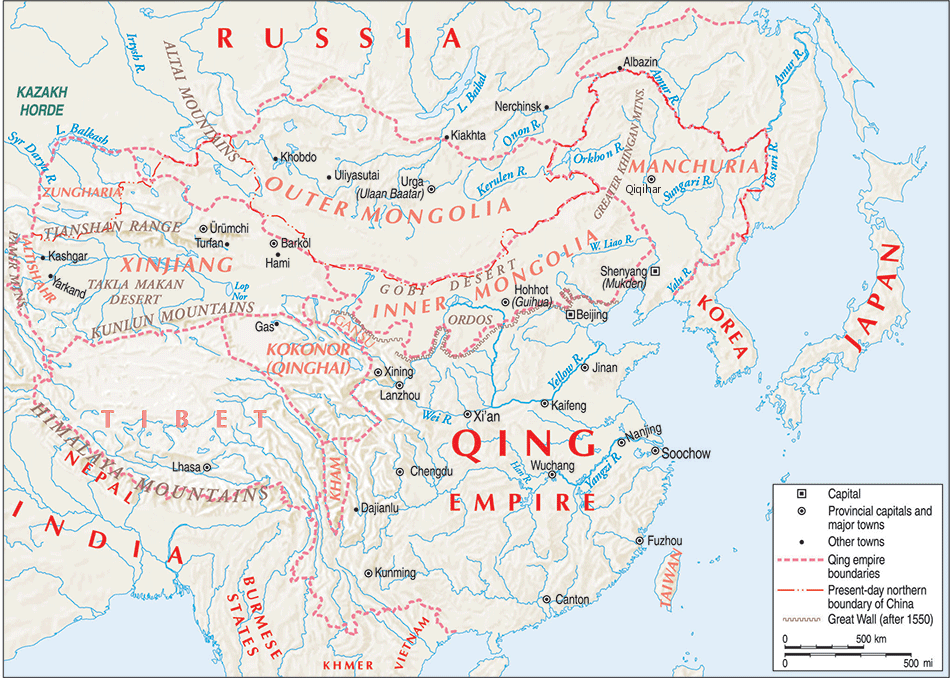


Origins and consolidation
The dynasty grew out of a federation of Jurchen/Manchu tribes in the northeast. These leaders capitalized on the declining Ming state and entered the Chinese heartland in 1644, eventually establishing Beijing as their capital. The new rulers retained many traditional institutions while also relying on military structures such as the Eight Banners system to organize Manchu society and power. Early Qing emperors worked to secure legitimacy among Han Chinese elites and the broader population.
Government, society and institutions
The Qing combined Manchu military traditions with much of the existing Ming administrative framework. It used the imperial examination system to staff civil offices, appointed Han and non-Han officials, and managed a vast bureaucracy. At the same time the court pursued policies to preserve its own ethnic identity, including language and bannermen privileges. The empire was multiethnic and multilingual, incorporating regions with distinct legal and social arrangements.
Economy, culture and achievements
During much of the Qing era the population and economy expanded, stimulating trade, agricultural development, and urban life. The period produced notable achievements in painting, porcelain, literature and palace architecture. Under certain long-reigning emperors the dynasty extended control into Tibet, Xinjiang and Mongolia, shaping borders that in many respects persisted into modern times. Cultural exchange with Europe increased, bringing new ideas, sciences and technologies as well as tensions.
Challenges, foreign pressure and fall
From the 19th century the Qing faced mounting problems: internal uprisings, fiscal strain, and military defeats in conflicts with foreign powers. The Opium Wars, unequal treaties, and rebellions such as the Taiping uprising weakened the state. Efforts at reform and modernization achieved mixed results. Political collapse culminated in the 1911 popular and elite uprisings associated with the Xinhai Revolution, which led to the abdication of the last emperor and the establishment of the Republic of China.
Legacy and significance
The Qing era left a complex legacy: territorial consolidation, rich cultural production, and administrative continuity, alongside episodes of repression and decline. Its history is central to understanding modern China and debates about ethnicity, governance and reform. For further linguistic and historical references see the dynasty's Manchu origins and records of the imperial clan Aisin Gioro.
- Timeframe: c. 1644–1912
- Founders: Manchu leaders organized under the Eight Banners
- End: 1911–12 revolution led to republican government
Questions and answers
Q: Who were the rulers of China during the Qing Dynasty?
A: The rulers of China during the Qing Dynasty were the Manchus.
Q: What is another name for the Qing Dynasty?
A: The Qing Dynasty is also commonly known as the Manchu dynasty.
Q: From what year to what year did the Qing Dynasty rule China?
A: The Qing Dynasty ruled China from 1644 to 1912.
Q: What was the surname of the Qing emperors?
A: The surname of the Qing emperors was Aisin Gioro.
Q: What is the significance of the 1911 Xinhai Revolution in relation to the Qing Dynasty?
A: The 1911 Xinhai Revolution marked the end of the Qing Dynasty and paved the way for the establishment of the Republic of China.
Q: Who founded the Qing Dynasty?
A: The Qing Dynasty was founded by the Manchus.
Q: In what year did the Qing Dynasty end?
A: The Qing Dynasty ended in 1912 after the 1911 Xinhai Revolution.
Related articles
Author
AlegsaOnline.com Qing dynasty (1644–1912) Leandro Alegsa
URL: https://en.alegsaonline.com/art/80331