
Neptune: the Solar System’s distant ice giant
Neptune is the eighth planet from the Sun, an ice giant with powerful winds, a system of faint rings and moons, and a discovery driven by mathematical prediction rather than direct observation.
Overview
Neptune is the eighth and most distant known planet orbiting the Sun within the classical Solar System. Classified as an ice giant, it is the fourth-largest planet by diameter and is more massive than its near-twin Uranus. Neptune completes one orbit in about 165 Earth years and appears as a vivid blue disk when viewed through large telescopes, a color influenced by atmospheric methane and other factors.
Image gallery
10 Images




Physical characteristics
Neptune has about seventeen times the mass of Earth and is slightly smaller in size but denser than Uranus. Its interior is believed to contain a dense core of rock and metal surrounded by a thick mantle of water, ammonia and methane ices transformed under pressure into exotic fluid phases. The upper atmosphere consists predominantly of hydrogen and helium with traces of methane, which absorbs red light and contributes to Neptune’s deep blue hue. Neptune exhibits the strongest sustained winds measured in the Solar System, with speeds reaching well over 1,000 miles per hour in some regions.
Rings, moons and magnetic field
Neptune is surrounded by a system of faint rings and numerous satellites. The planet’s ring system includes several narrow, dusty rings and arcs named in modern catalogs, and it is commonly described as having five principal rings. Neptune has a collection of known moons, led by the large retrograde moon Triton, which is thought to be a captured body and is geologically active. The planet’s magnetic field is unusually tilted and offset relative to its rotation axis and center, producing a complex magnetosphere.
Discovery and naming
The existence of Neptune was predicted through mathematical analysis of perturbations in Uranus’s orbit. Independent calculations by Urbain Le Verrier and John Couch Adams led to the planet’s identification by telescopic observation; this marked the first time a planet was located by theoretical prediction rather than solely by direct survey, a process noted in historical accounts of astronomers. The planet was named for the Roman god of the sea, Neptune, and its astronomical symbol is the trident (♆).
Exploration and notable phenomena
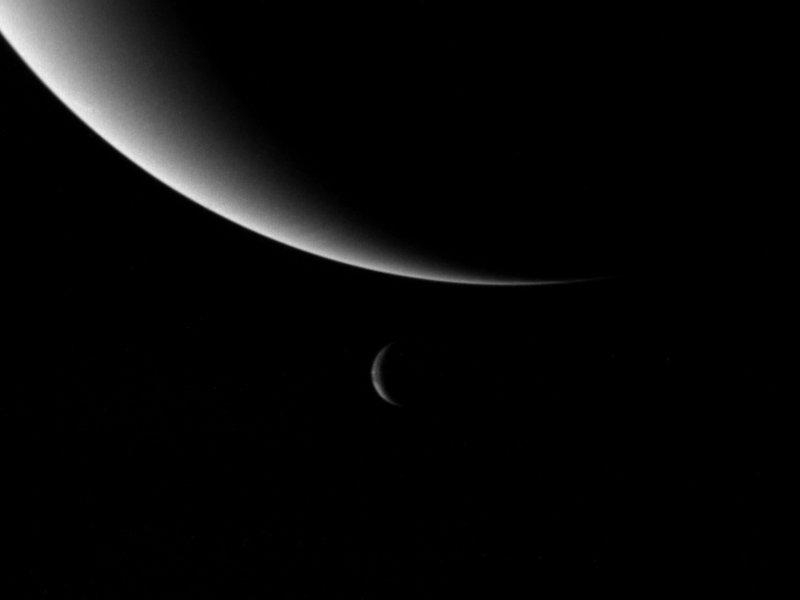
Only one spacecraft, Voyager 2, has flown by Neptune, providing the bulk of direct measurements and imagery during its 1989 encounter. Voyager 2 returned detailed views of the planet’s clouds, rings and moons and discovered transient weather features such as the large, dark anticyclonic storm known as the Great Dark Spot. That particular storm later disappeared, and other dark vortices have been observed at different times, illustrating Neptune’s active and changing atmosphere. Future mission concepts and proposals for additional space probes continue to appear in planetary science planning documents, aiming to study Neptune’s interior, atmosphere and Triton in greater detail.
Importance and distinguishing facts
- Neptune’s discovery is an early triumph of celestial mechanics and predictive astronomy.
- Its status as an ice giant distinguishes it from the gas giants Jupiter and Saturn by composition and structure.
- Neptune’s extreme winds, vivid blue color, faint rings and captured moon Triton make it a subject of ongoing scientific interest.
For concise data tables, historical sources, mission archives and images, see related reference pages and mission documentation: classification, observational history, and instrument summaries from past and proposed missions (Sun‑planet relations, atmospheric composition). Additional educational and technical resources are available through planetary science portals and university collections (helium and thermodynamics studies, methane absorption research, spectral analysis), as well as broader Solar System overviews (system context, planetary comparisons).
Questions and answers
Q: What is Neptune?
A: Neptune is the eighth and last planet from the Sun in the Solar System. It is an ice giant and the fourth-largest planet in the system.
Q: Does Neptune have rings?
A: Yes, Neptune has five rings which are hard to see from Earth.
Q: How does Neptune compare to Uranus in terms of mass and size?
A: Neptune has 17 times more mass than Earth and a little bit more mass than Uranus. It is also denser and physically smaller than Uranus, with its greater mass causing more gravitational compression of its atmosphere.
Q: Who named Neptune after the Roman god of the sea?
A: The planet was named after the Roman god of the sea, Neptune, by astronomers Urbain Le Verrier and John Couch Adams.
Q: What makes up most of Neptune's atmosphere?
A: Most of Neptune's atmosphere is made up of hydrogen and helium, with small amounts of methane which give it a blue color that is darker than Uranus'.
Q: What was discovered about Uranus' orbit that led to discovery of another planet nearby?
A: In 1821, it was found that Uranus' orbit had some differences from its expected orbit, which meant another planet was nearby. This led to discovery of what we now know as Neptune.
Q: When did Voyager 2 visit Nepture?
A:Voyager 2 visited Nepture on 25 August 1989 - making it the only spacecraft to ever do so.
Related articles
Author
AlegsaOnline.com Neptune: the Solar System’s distant ice giant Leandro Alegsa
URL: https://en.alegsaonline.com/art/69197
Sources
- solarviews.com : "Neptune"
- solarsystem.nasa.gov : "Neptune: Facts & Figures"
- cseligman.com : "Rotation Period and Day Length"
- nssdc.gsfc.nasa.gov : "Neptune Fact Sheet"
- home.comcast.net : "The MeanPlane (Invariable plane) of the Solar System passing through the barycenter"
- chemistry.unina.it : Solex 10
- ssd.jpl.nasa.gov : "HORIZONS System"
- ui.adsabs.harvard.edu : 2007CeMDA..98..155S
- doi.org : 10.1007/s10569-007-9072-y
- home.comcast.net : "Horizons Output for Neptune 2010–2011"
- adsabs.harvard.edu : "Report of the IAU/IAGWorking Group on cartographic coordinates and rotational elements"
- sunearth.gsfc.nasa.gov : "Twelve Year Planetary Ephemeris: 1995–2006"
- nineplanets.org : "Neptune"
- starchild.gsfc.nasa.gov : "StarChild Question of the Month for August 2002"