
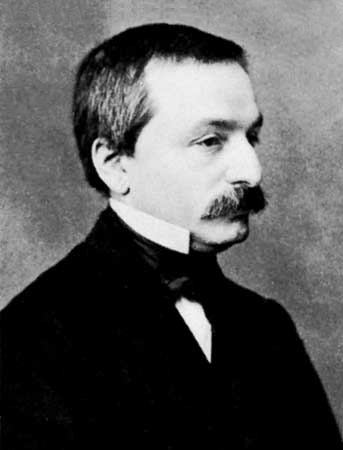
Leopold Kronecker (1823–1891)
German mathematician Leopold Kronecker contributed to number theory, algebra and determinants. He favored concrete, finitist methods, opposed Cantorian set theory, and was a student and friend of Ernst Kummer.
Overview
Leopold Kronecker (7 December 1823 – 29 December 1891) was a German mathematician known for influential work in arithmetic, algebra and the theory of determinants. Born in Liegnitz, then in Prussia, he initially pursued a commercial career and later devoted himself to mathematics, supporting himself independently while producing research that shaped parts of nineteenth-century number theory and algebra. For primary biographical records see birth record and death record, and for context about his birthplace consult Liegnitz.
Image gallery
2 Images
Life and career
Kronecker came from a family engaged in commerce and acquired substantial means before turning to mathematical studies. He is commonly described in historical sources as a German mathematician (national context) and is represented in biographical summaries and archival catalogs (biographical note). His family background included Jewish ancestry, a detail noted in contemporary and later accounts (ancestral note). He maintained close relations with leading mathematicians of his era and continued to publish and correspond widely after leaving business.
Mathematical contributions
Kronecker made enduring contributions to several areas. In number theory his ideas anticipated aspects of algebraic number theory and influenced later developments connecting field extensions and abelian extensions; one historically associated topic is the Kronecker–Weber direction relating certain abelian extensions of the rationals to cyclotomic fields. He studied determinants and algebraic structures and introduced notations and concepts that remain in common use, such as the Kronecker delta and the Kronecker symbol. For survey material see treatments of number theory, determinants and algebraic topics.
Philosophy and controversies
Kronecker is well known for a philosophical stance often described as finitism: he emphasized constructive, arithmetical methods and was critical of abstract, nonconstructive uses of the infinite. He became a prominent opponent of some aspects of Georg Cantor's emerging set theory and transfinite methods, raising objections to the use of actual infinities and certain set-theoretic arguments (Cantor debate, set theory critique). His critiques stimulated discussion about mathematical foundations that continued into the twentieth century.
Associations and influence
Kronecker was a pupil and lifelong friend of Ernst Kummer, and their association influenced his work in arithmetic and in the exchange of ideas on algebraic questions (Kummer connection). Through publications, correspondence and teaching he affected the development of German mathematical schools. While his philosophical restrictions limited the methods he accepted, many of the problems he studied and the concrete constructions he proposed remained central to later research.
Notable concepts and legacy
- Kronecker delta — an index function widely used in linear algebra and combinatorics.
- Kronecker symbol — a generalization used in number-theoretic reciprocity laws.
- Contributions to algebraic number theory — ideas that anticipated structural approaches to field extensions and abelian fields.
- Philosophical impact — an influential voice in debates over mathematical rigor and the role of the infinite.
Further reading
For general introductions and more detailed accounts consult standard histories of nineteenth-century mathematics, collected papers, and specialized biographies. Helpful starting points include biographical and archival entries (primary biographical source, archival catalog) and thematic surveys on number theory and algebra (number theory overview, algebraic topics). Discussions of the foundational disputes in which he participated can be found in treatments of Cantor and the development of set theory (Cantor debate, foundations critique), while accounts of his early life and place of origin appear in local and national records (Liegnitz, ancestral note). For connections with Kummer and contemporary mathematicians see correspondence and historical notes (Kummer connection, determinants).
Related articles
Author
AlegsaOnline.com Leopold Kronecker (1823–1891) Leandro Alegsa
URL: https://en.alegsaonline.com/art/57250
Sources
- wikidata.org : wikidata.org/wiki/Q76410
- catalogue.bnf.fr : cb12388213f
- data.bnf.fr : (data)
- d-nb.info : 118567020
- isni.org : 0000 0001 2136 5453
- id.loc.gov : n84804770
- genealogy.math.ndsu.nodak.edu : 17982
- aleph.nkp.cz : mub2017947762
- uli.nli.org.il : 000078904
- data.bibliotheken.nl : 070625697
- libris.kb.se : 237503
- snaccooperative.org : w6154m7z
- idref.fr : 032957440
- viaf.org : 64088533
- worldcat.org : lccn-n84804770