
Algebra: concepts, notation, history, branches and applications
Overview of algebra: fundamentals, notation, common problem types (linear, quadratic), historical origins, branches (elementary, linear, abstract) and practical applications across science and everyday life.
Algebra is a major branch of mathematics that studies symbols and the rules for manipulating them. It provides a language for expressing general relationships between quantities using variables, constants and operations. An algebraic statement that asserts two expressions represent the same quantity uses an equals sign and is called an equation. Simple examples, such as 2 + 3 = x, illustrate the idea of an unknown quantity to be determined by solving the equation . Solving means finding values for variables that make an equation true; this basic activity underpins much of algebra.
Image gallery
8 Images




Basic elements and notation
Algebraic notation compresses information so that general methods apply in many situations. Core elements include expressions (combinations of numbers and variables), equations and inequalities, which compare sizes rather than assert equality. Functions are rules that assign each permitted input exactly one output and are often visualized with graphs. Common arithmetic operations—addition, subtraction, multiplication and division—appear in algebra together with operations on powers and roots: exponents, squares and square roots . Notation also includes parentheses, brackets and symbols for operations and relations so that procedures can be described precisely.
Operations, rules and methods
Algebra relies on predictable rules coming from the properties of numbers and the accepted set of mathematical operations. Textbooks present identities and laws such as distributivity, associativity and commutativity as tools to manipulate expressions. Solving a problem often involves combining like terms, applying inverse operations, factoring polynomials and isolating variables. These methods let a practitioner transform a complicated statement into an equivalent but simpler one. The general guidance is to perform the same operation on both sides of an equation to preserve equality; when working with inequalities one must also watch for direction changes when multiplying or dividing by negative quantities .
Common problem types and examples
Two classical families of algebraic problems are linear equations and quadratic equations. A linear equation in two variables commonly appears in the form y = m x + b and describes a straight line on a plane; it is fundamental to modelling proportional relationships and to systems that combine several linear constraints . Quadratic equations contain a squared term (for example x·x) and appear in contexts such as areas, projectile motion and simple optimization. Understanding how to expand, factor and use the quadratic formula or completing-the-square method is a central skill .
Worked examples and symbolic reasoning
Elementary algebra shows how to convert practical problems into symbolic form. For instance, a price problem might translate a sentence about quantities and costs into an equation that can be solved for the unknown price. More formal manipulations include factoring expressions like x^2 - 5x + 6 into (x - 2)(x - 3) or solving a system of linear equations by substitution or elimination. Computer algebra systems implement these symbolic methods algorithmically to perform exact manipulations on expressions and solve equations automatically .
History and development
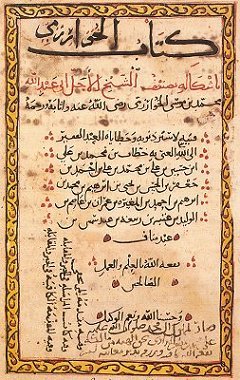
The word algebra derives from the Arabic al-jabr, a term used in medieval mathematics to describe rules for restoring balance to equations. Early algebraic ideas developed in many cultures; systematic techniques for solving particular types of equations appeared in Babylonian, Greek, Indian and Islamic mathematics and were later refined in Europe. Over centuries algebra evolved from concrete methods for numbers to abstract theories that study structures such as groups, rings and fields; this abstraction allows mathematicians to study common patterns that appear across diverse mathematical objects .
Branches and modern perspectives
Algebra spans a broad spectrum. Elementary algebra is taught in schools to introduce variables and solution methods. Linear algebra studies vectors, matrices and linear transformations and is essential in applied science. Abstract (or modern) algebra investigates algebraic structures—groups, rings, fields and modules—and provides language and theorems that unify many mathematical areas. Other subfields include Boolean algebra used in logic and computer science and computer algebra that combines algorithmic techniques with symbolic math .
Applications and practical importance
Algebraic thinking is widely applied. In the physical sciences and engineering, algebra helps formulate laws and predict behaviour; practitioners use it in physics and engineering to derive formulas and solve design problems. Algorithm designers and programmers use algebraic reasoning in computer programming, while industries such as surveying, construction, business and accounting apply algebraic models to estimate quantities, schedule resources and analyze costs. The subject’s power lies in replacing many concrete cases with a single general argument that applies repeatedly .
- Further study: historical treatments examine the origins of techniques for solving equations and the term mathematics in different languages.
- Core study topics include manipulation of expressions, working with exponents and squares, solving linear and quadratic problems and understanding functions and graphs.
- Mastery of the basic operations and the logical rules that govern them (rules of numbers and the accepted operations) prepares learners for advanced work in both pure and applied mathematics.
Questions and answers
Q: What is algebra?
A: Algebra is a part of mathematics that uses variables to represent a value that is not yet known.
Q: What does an equals sign signify in algebra?
A: An equals sign (=) signifies an equation in algebra.
Q: What is a function in algebra?
A: A function in algebra is a special type of equation that always turns one input into one output.
Q: How can algebra be used to solve real problems?
A: Algebra can be used to solve real problems because the rules of algebra work in real life and numbers can be used to represent the values of real things. Physics, engineering and computer programming are areas that use algebra all the time. It is also useful to know in surveying, construction and business, especially accounting.
Q: What are some mathematical operations used on numbers in algebra?
A: In algebra people use the rules of numbers and mathematical operations such as adding, subtracting, multiplying, and dividing on numbers. More advanced operations involve exponents, starting with squares and square roots.
Q: What are examples of equations used in algebra?
A: Examples of equations used in algebra include linear equations (the equation of a straight line) and quadratic equations which have variables that are squared (multiplied by itself).
Related articles
Author
AlegsaOnline.com Algebra: concepts, notation, history, branches and applications Leandro Alegsa
URL: https://en.alegsaonline.com/art/2529
Sources
- mathworld.wolfram.com : "Math or Maths"
- mathsisfun.com : "Algebra Introduction"
- ucs.louisiana.edu : "History of Algebra"