
Charon — moon of Pluto
Charon is the largest moon of the dwarf planet Pluto. Roughly half Pluto's diameter, it forms a binary system with Pluto and was explored in detail by NASA's New Horizons in 2015.
Overview
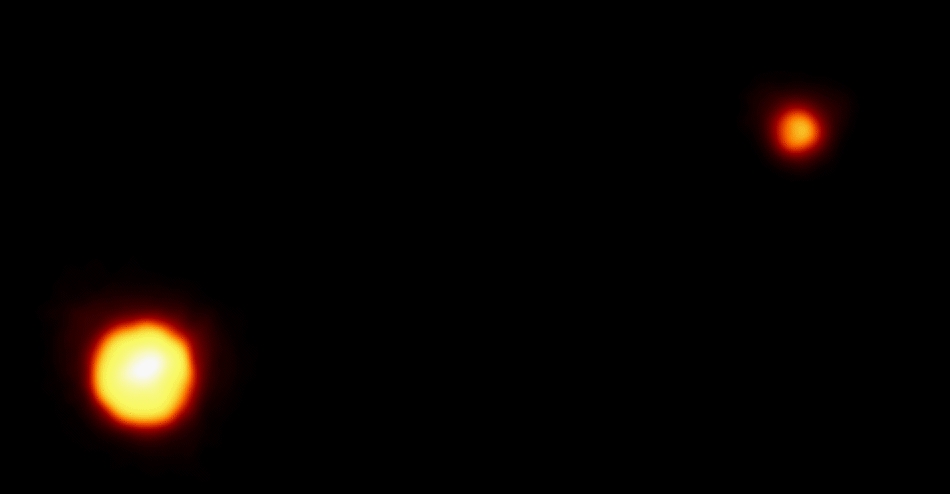
Charon is the largest natural satellite of the dwarf planet Pluto. Discovered in 1978, it is unusually large relative to its primary — roughly half Pluto's diameter — and together they orbit a common center of mass that lies outside Pluto. Because of this arrangement and their mutual tidal locking, Pluto and Charon are often described as a binary or double system rather than a conventional planet–moon pair.
Image gallery
10 Images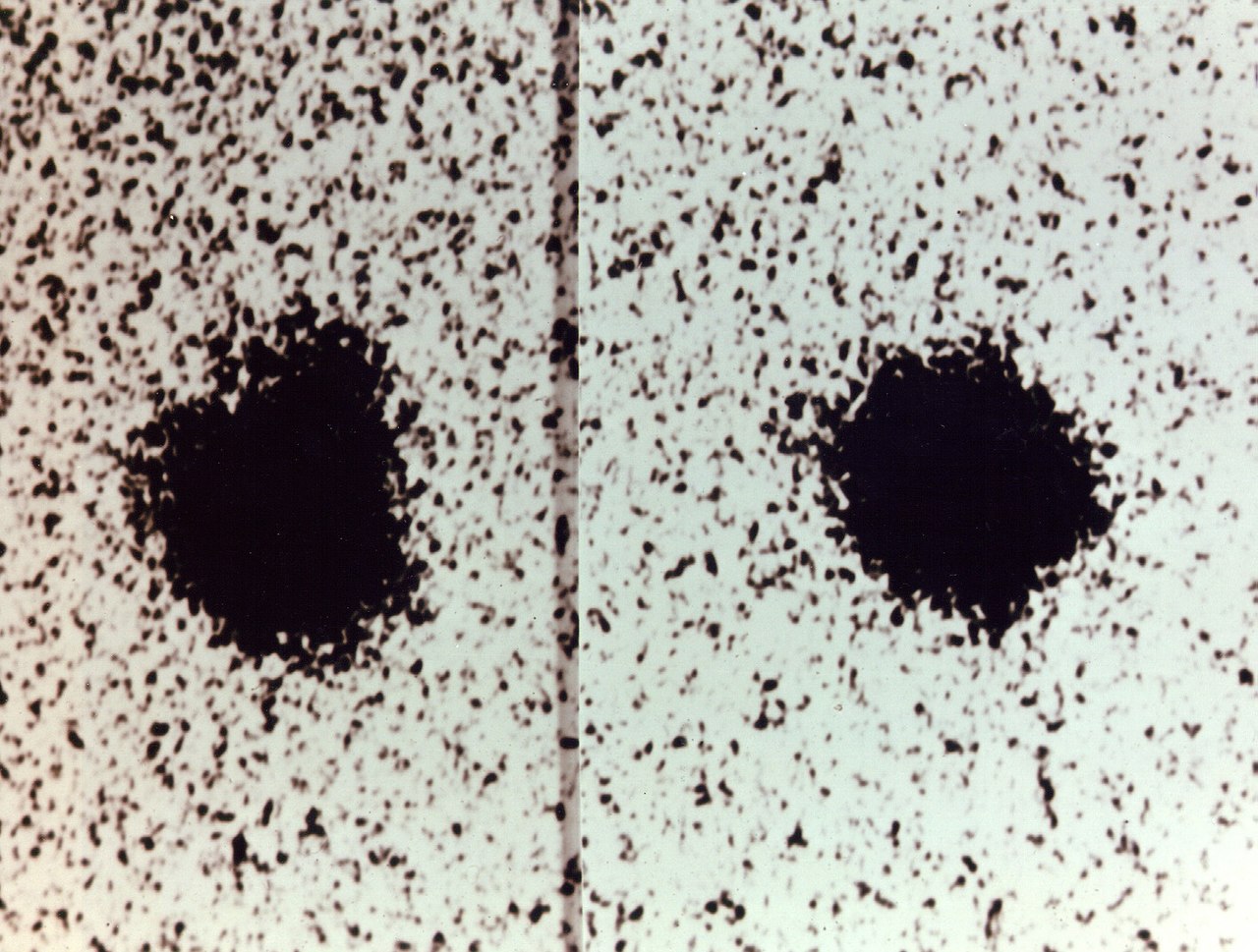








Physical characteristics
Charon's surface is dominated by water ice with a rocky interior. Its overall appearance contrasts with Pluto's: Charon lacks a substantial atmosphere and shows extensive tectonic features, including canyons, scarps and plains. One hemisphere contains a dark reddish area near the pole, interpreted as material redistributed from Pluto and chemically altered by radiation. The surface also displays regions that appear relatively smooth, suggesting geologic modification in the past.
Orbit and rotation
Charon and Pluto revolve around a barycenter located outside of Pluto, causing both bodies to orbit one another. The two are tidally locked: each keeps the same face toward the other, so a given point on Charon always faces Pluto. Their orbital and rotational period are matched, resulting in a slow apparent motion as seen from either body.
Origin and evolution
The leading explanation for Charon's origin is a giant impact early in the Pluto system's history, in which a collision produced debris that coalesced into the satellite. Subsequent cooling and differentiation may have produced the water-ice crust and subsurface structures inferred from surface fractures. Exchanges of gas and particles between Pluto and Charon, plus radiation-driven chemistry, likely contributed to Charon's polar coloration.
Exploration and significance
Prior to spacecraft visits, knowledge of Charon came from ground-based telescopes and stellar occultations. The NASA New Horizons mission flew past the Pluto–Charon system in 2015 and returned high-resolution images and other data that revealed Charon's complex geology and provided precise measurements of its size and orbit. Because of its size relative to Pluto and its distinctive geologic history, Charon is important for understanding the formation and evolution of icy bodies in the outer Solar System.
Notable distinctions
- Large relative size: Charon is one of the largest moons relative to its primary in the Solar System.
- Binary behavior: The barycenter of the Pluto–Charon system lies outside Pluto, a key reason the pair are sometimes called a binary dwarf planet system.
- Contrasting geology: Unlike Pluto's volatile-rich surface and thin atmosphere, Charon shows prominent water-ice features and little to no atmosphere today.
Related articles
Author
AlegsaOnline.com Charon — moon of Pluto Leandro Alegsa
URL: https://en.alegsaonline.com/art/18874
Sources
- pluto.jhuapl.edu : "New Horizons: NASA's Pluto-Kuiper Belt Missions"
- cfa-www.harvard.edu : "IAUC 3241: 1978 P 1; 1978 (532) 1; 1977n"