
KY Cygni — a very large red supergiant in Cygnus
KY Cygni is an extremely large, luminous red supergiant in the constellation Cygnus, notable for its vast radius and high luminosity; size estimates and distance carry significant uncertainties.
Overview
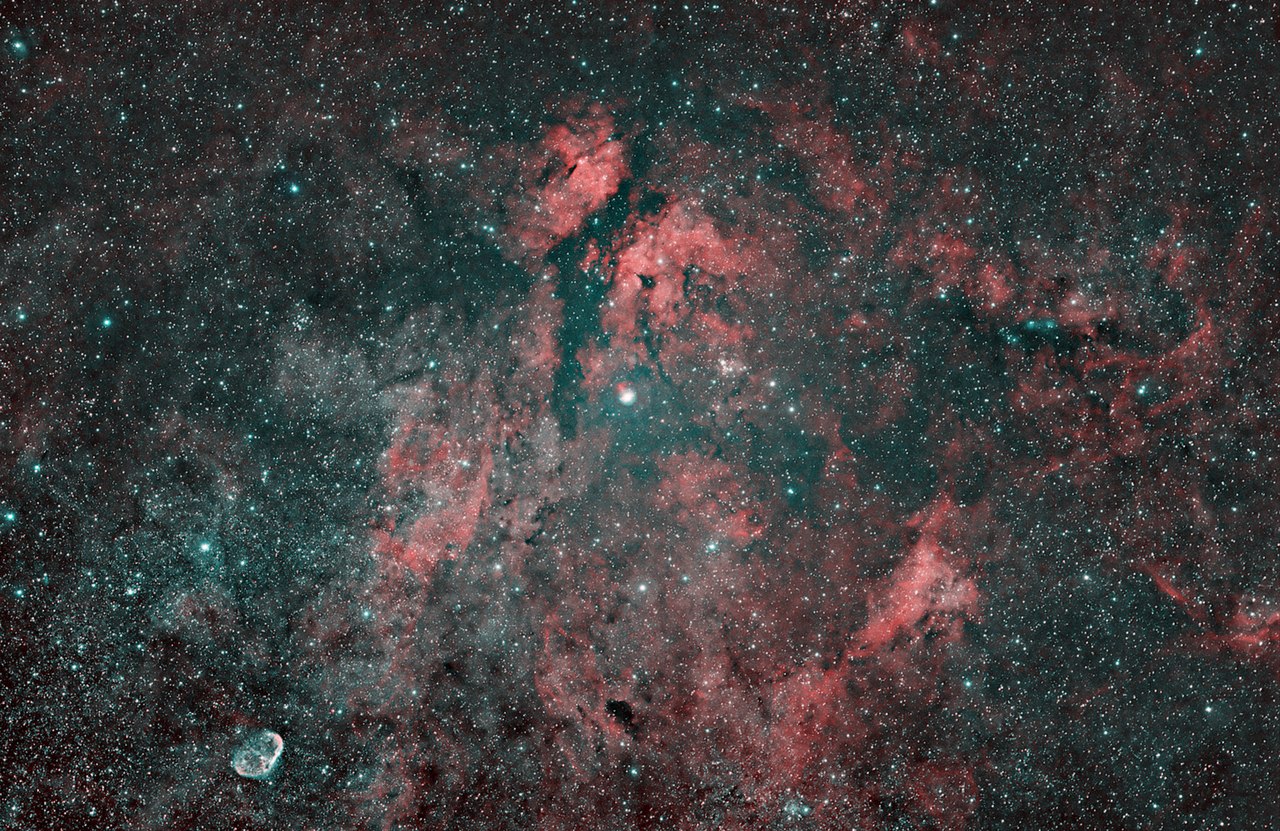
KY Cygni is a very cool, red luminous star in the constellation of Cygnus. It is classified among the extended red supergiants and has attracted attention because of its exceptionally large radius and high luminosity. Observational estimates place it thousands of light‑years from Earth; as with many distant evolved stars, those measurements depend on indirect methods and carry uncertainties. For more on its appearance and classification see red star data and its constellation context at Cygnus.
Image gallery
4 Images


Physical characteristics
KY Cygni has been estimated to have a radius on the order of a thousand solar radii. Published ranges of its radius include values around 1,420–1,503 R☉, which correspond to roughly 6.60–6.99 astronomical units. If placed at the center of the Solar System the star would extend beyond the orbit of Jupiter and, depending on the adopted value, could approach or exceed the distance of Saturn. Its luminosity is also very large; some estimates give values on the order of hundreds of thousands of times the Sun's output, often stated as about 3×10^5 L☉ or more.
Evolution and environment
Stars like KY Cygni are in a late phase of stellar evolution. Having exhausted the hydrogen in their cores, they expand and cool to become red supergiants. Such stars typically have cool photospheres (a few thousand kelvins), strong stellar winds and significant mass loss that can create dusty circumstellar envelopes visible at infrared wavelengths. These processes make them important contributors to the chemical enrichment of the interstellar medium.
Importance and study
KY Cygni is studied as an example of extreme stellar size and brightness among evolved massive stars. Astronomers use its observed spectrum, brightness variations, and surrounding infrared emission to constrain models of mass loss, pulsation and late-stage evolution. Because direct measurement of angular size and distance is challenging at the star’s distance, different techniques (spectroscopy, photometry, interferometry when possible) are combined to refine its parameters.
Notable facts and uncertainties
- Distance estimates are approximate; the commonly quoted figure is a few thousand light‑years from Earth.
- Radius and luminosity values vary between studies because of measurement uncertainties and assumptions about reddening and temperature.
- Placing the star at the center of the Solar System is a useful illustration: its outer layers would reach past the orbit of the gas giants, emphasizing the star’s enormous scale relative to the Sun.
KY Cygni remains one of the more extreme examples of red supergiants visible in our Galaxy and serves as a case study in the challenges of characterizing the largest known stars. Continued observations, particularly in the infrared and with high angular resolution techniques, can improve estimates of its true size, luminosity and distance.
Related articles
Author
AlegsaOnline.com KY Cygni — a very large red supergiant in Cygnus Leandro Alegsa
URL: https://en.alegsaonline.com/art/54743
Sources
- universeguide.com : "KY Cygni"
- sciencedaily.com : "Supergiants"