
Scattered disc (Scattered disk) – distant trans‑Neptunian region
A remote region of the Solar System of icy minor planets on eccentric, often highly inclined orbits, produced largely by gravitational interactions with the giant planets.
Overview
The scattered disc is a distant and dynamically active region of the Solar System populated by small, icy bodies known as scattered disc objects (SDOs). It lies outside the main concentration of the Kuiper belt and inside the vast, largely hypothetical Oort cloud, forming a transitional reservoir between these populations. The scattered disc contains objects that range in size from kilometre‑scale bodies to known dwarf planets, and it is an important component in models of Solar System formation and evolution.
Image gallery
9 Images





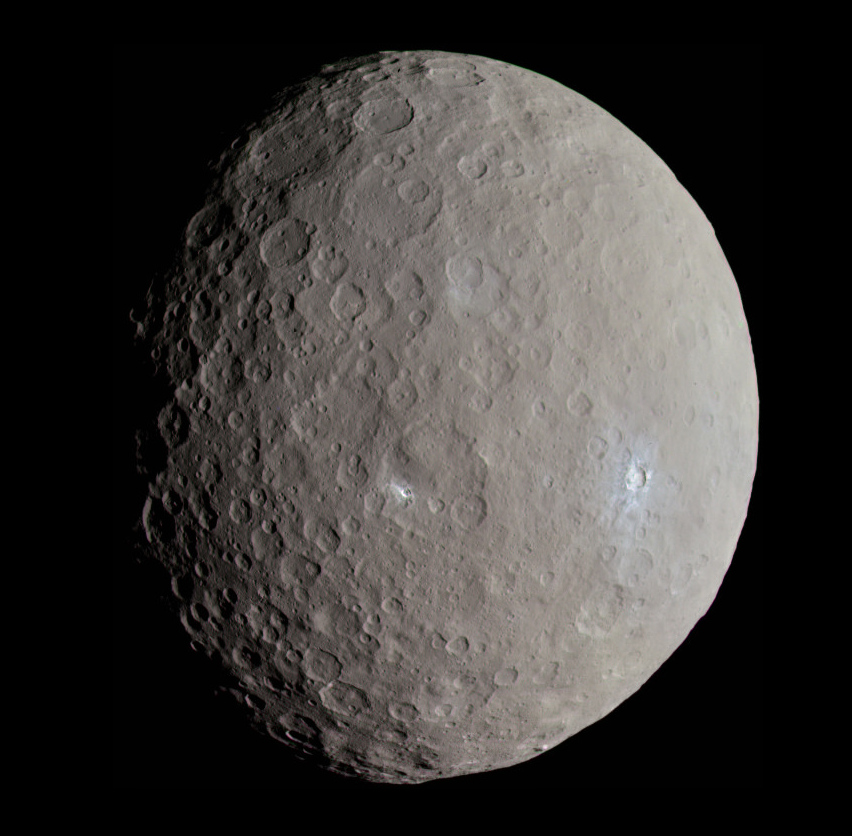

Boundaries and relation to other reservoirs
The inner edge of the scattered disc is not sharply defined; it overlaps with the outer regions of the Kuiper belt and with populations that are trapped in orbital resonances with Neptune. The scattered disc extends outward into regions where long‑period perturbations and galactic tides are thought to influence object trajectories, approaching the domain associated with the Oort cloud. Because the region is defined dynamically rather than by a fixed distance, membership is assigned based on orbital behaviour rather than a strict radial cut.
Orbital characteristics and dynamics
Scattered disc objects are distinguished by large variations in distance from the Sun during a single orbit, often showing high eccentricity and substantial inclination. Unlike the relatively circular and planar orbits of many main‑belt and classical Kuiper belt objects, SDOs frequently follow elongated, inclined paths. Their orbits are shaped primarily by long‑term gravitational interactions with the giant planets and by occasional close encounters that can dramatically alter orbital energy and inclination. Resonant interactions with Neptune can temporarily stabilize otherwise unstable orbits.
Origin and evolution
Most models propose that the scattered disc formed when objects in a primordial trans‑Neptunian population were gravitationally scattered outward by the migrating giant planets, especially Neptune. During the early history of the Solar System, planet migration and dynamical instabilities would have produced repeated encounters that placed objects onto more eccentric and inclined trajectories. Contemporary astronomers use numerical simulations to reproduce the observed distribution and to explore how the scattered disc feeds other populations over time.
Discovery and observation
The first recognized members of this population were discovered in the 1990s, as dedicated surveys and improved detectors extended the observable volume beyond Neptune. Early survey programs such as Spacewatch and other wide‑field searches located objects in unusual orbits in the mid‑1990s, prompting the designation of a separate scattered population. Observationally, SDOs are faint, move slowly across the sky, and require repeated imaging and orbit determination to confirm membership.
Composition and physical properties
SDOs are believed to consist largely of mixtures of rock and volatile ices such as water, methane and nitrogen, similar to other trans‑Neptunian objects. Surface colours and spectral signatures vary, reflecting differences in composition, irradiation history, and surface processing. Some larger SDOs are massive enough to be rounded by their own gravity and have been classified as dwarf planets; examples include the well known dwarf planet Eris and other distant trans‑Neptunian bodies that help constrain models of bulk composition.
Role in Solar System dynamics
The scattered disc is an important source region for Centaurs and short‑period comets. Objects whose perihelia are lowered by perturbations can be transferred inward to become Centaurs, and further interactions can deliver them into the inner Solar System as active comets. Because SDO orbits can evolve on timescales of millions of years, the scattered disc plays an ongoing role in replenishing nearer populations.
Open questions and future study
Key open questions include the exact size distribution, total mass of the scattered disc, the boundary between scattered and detached objects, and the relative importance of different scattering mechanisms. Continued surveys, improved telescopes and targeted missions will refine the census of SDOs and test formation scenarios. For accessible summaries and more technical reviews see linked resources and literature by planetary dynamics researchers, and survey project pages such as those maintained by observational teams and institutions referenced above here and here.
- Some SDOs become dynamically detached and may record additional perturbations or early stellar encounters.
- Because orbital classification can change as orbits evolve, an object can move between categories such as SDO, Centaur, or comet over time.
- Cataloguing and characterising SDOs remains an active area of observational and theoretical research.
For further reading consult surveys and project pages linked above and general reviews of trans‑Neptunian populations maintained by research groups and observatories (circular orbits), (planar dynamics), and broader educational resources (orbital eccentricity) and (orbital inclination). Historical and discovery notes may be found through archive summaries of early surveys such as Spacewatch and other programs from the 1990s, while current theoretical work is discussed in planetary dynamics literature and online summaries about the Kuiper belt and by astronomers.
Related articles
Author
AlegsaOnline.com Scattered disc (Scattered disk) – distant trans‑Neptunian region Leandro Alegsa
URL: https://en.alegsaonline.com/art/87811
Sources
- arxiv.org : astro-ph/0512256