
KW Sagittarii: a very large red supergiant in Sagittarius
KW Sagittarii (KW Sgr) is a cool, luminous red supergiant in the constellation Sagittarius. With a radius around 1,009 times the Sun, it is among the largest known stars and a subject of stellar-evolution study.
KW Sagittarii (often written KW Sgr) is a cool, luminous red supergiant star located in the constellation Sagittarius. It is notable for its extremely large radius—about 1,009 times that of the Sun—which places it among the most voluminous stars known. Its red color and low surface temperature compared with the Sun make it a classic example of an evolved massive star.
Image gallery
1 Image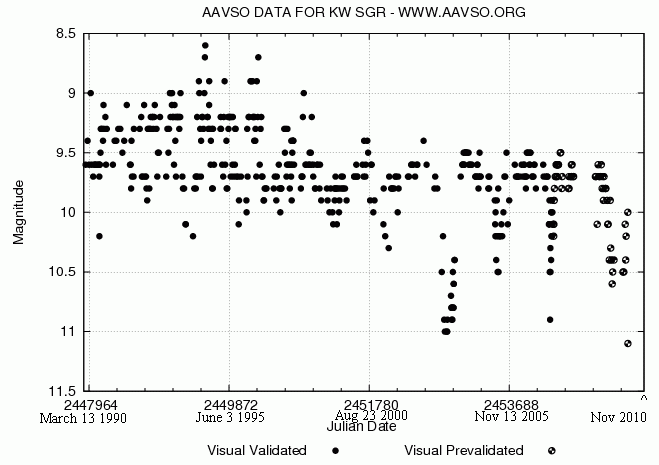
Physical characteristics
As a red supergiant, KW Sgr has an extended, diffuse atmosphere and loses mass through a slow stellar wind that can produce circumstellar dust and molecules. These features, together with its high luminosity, are typical of late-stage massive stars. Observations that measure angular size, spectra and infrared emission have been used to estimate its radius and other parameters.
Stellar classification and variability
KW Sgr is classified among the cool, evolved stars often referred to as red supergiants. It carries a variable-star designation (the letters "KW" indicate its entry in variable star catalogs), and it has been observed to change in brightness over time. Such variability is common in large, convective, pulsating stellar envelopes and provides diagnostics of interior structure and mass-loss processes. See general notes on variable star naming for context.
Scientific importance
Stars like KW Sgr are important test cases for models of late stellar evolution, nucleosynthesis and dust production. Astronomers study objects of this type with spectroscopy, photometric monitoring and high-resolution techniques such as interferometry to resolve their discs and circumstellar material. Research on KW Sgr contributes to understanding how massive stars shed mass before their final fate and how they enrich the interstellar medium.
History, location and cataloguing
KW Sagittarii appears in modern star catalogs and surveys that map the Milky Way; it lies in the direction of the constellation Sagittarius. Its catalog entries and measurements are recorded in large databases of stellar properties and variable stars; see general catalog resources at stellar catalogs and observational archives for comparison with the Sun and other reference stars.
Fate and notable facts
- Notable size: Radius roughly 1,009 times that of the Sun, making KW Sgr one of the largest stars by radius known in current literature.
- Evolutionary end: As an evolved massive star, it is expected to end its life in a core-collapse event if it retains sufficient mass—this outcome depends on its initial mass and the amount lost during the supergiant phase.
- Research use: It serves as a laboratory for studying mass loss, pulsation and dust formation in late stellar evolution; follow-up observations and modeling continue to refine its properties.
For further reading and observational data, specialized catalogs and peer-reviewed publications provide up-to-date measurements and analysis. General reference links and datasets can be found through observatory archives and catalog portals about red supergiants, stellar catalogs, and the constellation context Sagittarius. Additional summaries of variable star conventions are available at variable-star resources, and comparisons with solar parameters can be referenced at Sun reference data.
Related articles
Author
AlegsaOnline.com KW Sagittarii: a very large red supergiant in Sagittarius Leandro Alegsa
URL: https://en.alegsaonline.com/art/54729