
Asteroid belt (Main Belt) between Mars and Jupiter
The asteroid belt is a broad ring of rocky bodies and dust orbiting the Sun between Mars and Jupiter. It contains objects from dust grains to the dwarf planet Ceres and shows gaps caused by Jupiter's gravity.
Overview
The asteroid belt, commonly called the main belt, is a region of the Solar System occupied by a large population of rocky and metal-rich bodies orbiting the Sun between the orbits of Mars and Jupiter. These objects range in size from tiny dust particles to sizeable worlds; the largest resident is the dwarf planet Ceres. Most main-belt objects orbit at distances of roughly two to three times the Earth–Sun separation (astronomical units, AU), forming a broad, torus-like distribution rather than a thin ring.
Image gallery
10 Images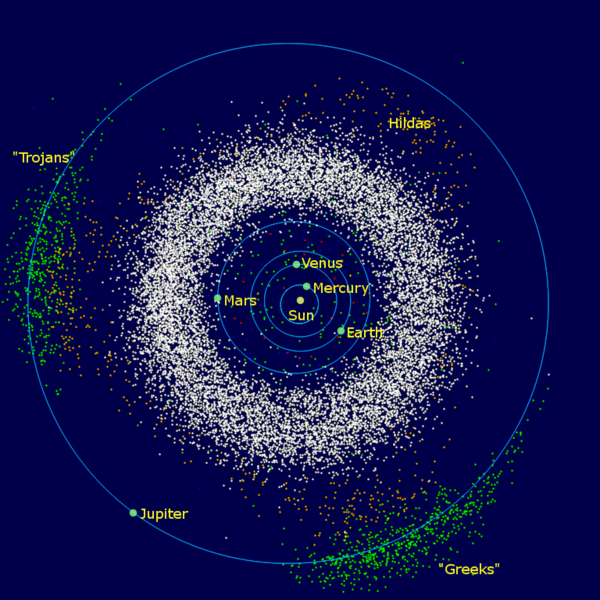




Structure and composition
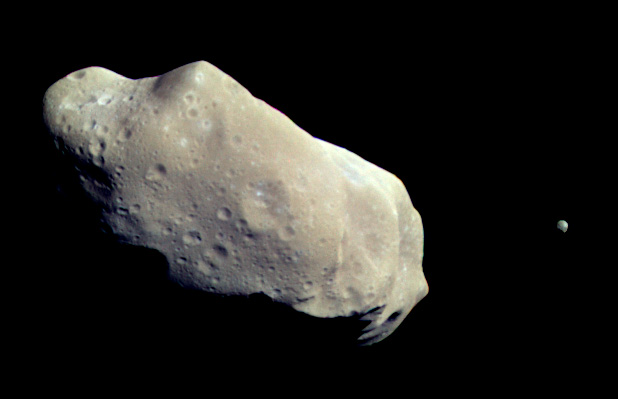
The belt is not uniform. It contains dense concentrations, family groupings produced by past collisions, and pronounced gaps where bodies are scarce. The Kirkwood gaps are well-known empty regions created by orbital resonances with Jupiter, which perturb and remove objects on unstable orbits. Main-belt objects (generally called asteroids) show a variety of compositions and surface properties:
- C-type (carbonaceous): dark, primitive, rich in carbon and volatile compounds.
- S-type (silicaceous): brighter, composed mostly of silicate rock and metal.
- M-type (metallic): relatively metal-rich and denser.
Origin and evolution
Current models suggest the main belt represents remnants of the early Solar System that never coalesced into a planet. Strong gravitational influences from the nearby giant planet Jupiter prevented accretion in this zone and stirred planetesimals into colliding fragments. Over billions of years collisions, fragmentation and orbital shifts produced families of related bodies and a wide size distribution from dust to bodies hundreds of kilometers across. Collisional debris from the belt is an important source of meteorites that reach Earth.
Importance, uses and exploration
Study of the belt informs our understanding of planetary formation, the delivery of water and organics to inner planets, and the physics of collisions. It is also relevant to resource and hazard assessments: some asteroids are considered potential targets for in-space resource extraction, while fragments can evolve onto Earth-crossing paths. Several missions have visited main-belt targets—most notably NASA's Dawn spacecraft, which explored the large bodies Vesta and Ceres—yielding detailed maps, composition data, and evidence for geological processes on these objects.
- Notable missions and studies: orbital surveys, telescopic spectral surveys, and spacecraft encounters.
Related populations and distinctions
The main belt differs from other small-body reservoirs. Inner planets such as Mercury, Venus, Earth and Mars lie closer to the Sun, while the giant planets Jupiter, Saturn, Uranus and Neptune lie farther out. Other small-body groups—Trojan asteroids sharing a giant planet's orbit and the distant Kuiper belt beyond Neptune—have different origins and dynamics. Within the Solar System's small-body populations, the main belt remains one of the most accessible and scientifically rich regions for studying the early history of our planetary neighborhood.
Questions and answers
Q: What is the asteroid belt?
A: The asteroid belt is a ring of small and large rocks and dust between the orbits of Mars and Jupiter.
Q: What is the biggest object in the asteroid belt?
A: The biggest object in the asteroid belt is Ceres, a dwarf planet.
Q: How is the asteroid belt separated?
A: The asteroid belt is separated into several groups by the Kirkwood gaps.
Q: What is the distance at which most asteroids orbit?
A: Most asteroids orbit at 2 to 3 times the distance between Earth and the Sun.
Q: What are the inner planets?
A: The inner planets are the planets that are "inside" - or before - the asteroid belt, which means they are closer to the sun. These planets include Mercury, Venus, Earth, and Mars.
Q: What are the outer planets?
A: The outer planets are the planets that are "outside" - that is, after - the asteroid belt. These planets include Jupiter, Saturn, Uranus, and Neptune.
Q: Is Pluto considered an inner or outer planet?
A: Pluto is not mentioned in the text, but it is classified as a dwarf planet and is located in the Kuiper Belt beyond the orbit of Neptune. Therefore, it is considered an outer planet.
Tags
Related articles
Author
AlegsaOnline.com Asteroid belt (Main Belt) between Mars and Jupiter Leandro Alegsa
URL: https://en.alegsaonline.com/art/6795
Sources
- open2.net : "A brief history of asteroid spotting"
- imagine.gsfc.nasa.gov : "Origin of the Asteroid Belt"
- jpl.nasa.gov : "Mysteries of the Solar Nebula"
- gps.caltech.edu : "The primordial excitation and clearing of the Asteroid Belt" · web.archive.org
- ui.adsabs.harvard.edu : 2001Icar..153..338P
- doi.org : 10.1006/icar.2001.6702
- astro.su.se : "Pumping of a planetesimal disc by a rapidly migrating planet"
- arxiv.org : astro-ph/0409017
- ui.adsabs.harvard.edu : 2004MNRAS.354..769E
- doi.org : 10.1111/j.1365-2966.2004.08238.x
- wikidata.org : wikidata.org/wiki/Q2179
- id.loc.gov : sh2012000460