
Lacerta (constellation)
Lacerta is a small, faint northern constellation introduced in the 17th century; notable for the BL Lacertae active nucleus and several open clusters amid a rich Milky Way field.
Overview
Lacerta (Latin for "lizard") is a minor constellation of the northern sky. It lies along a rich section of the Milky Way and is best known as a faint grouping of stars rather than a prominent classical figure. Lacerta contains no ancient myths tied to Greco‑Roman tradition: it was defined in the modern period to fill a gap between brighter neighboring constellations.
Image gallery
4 Images
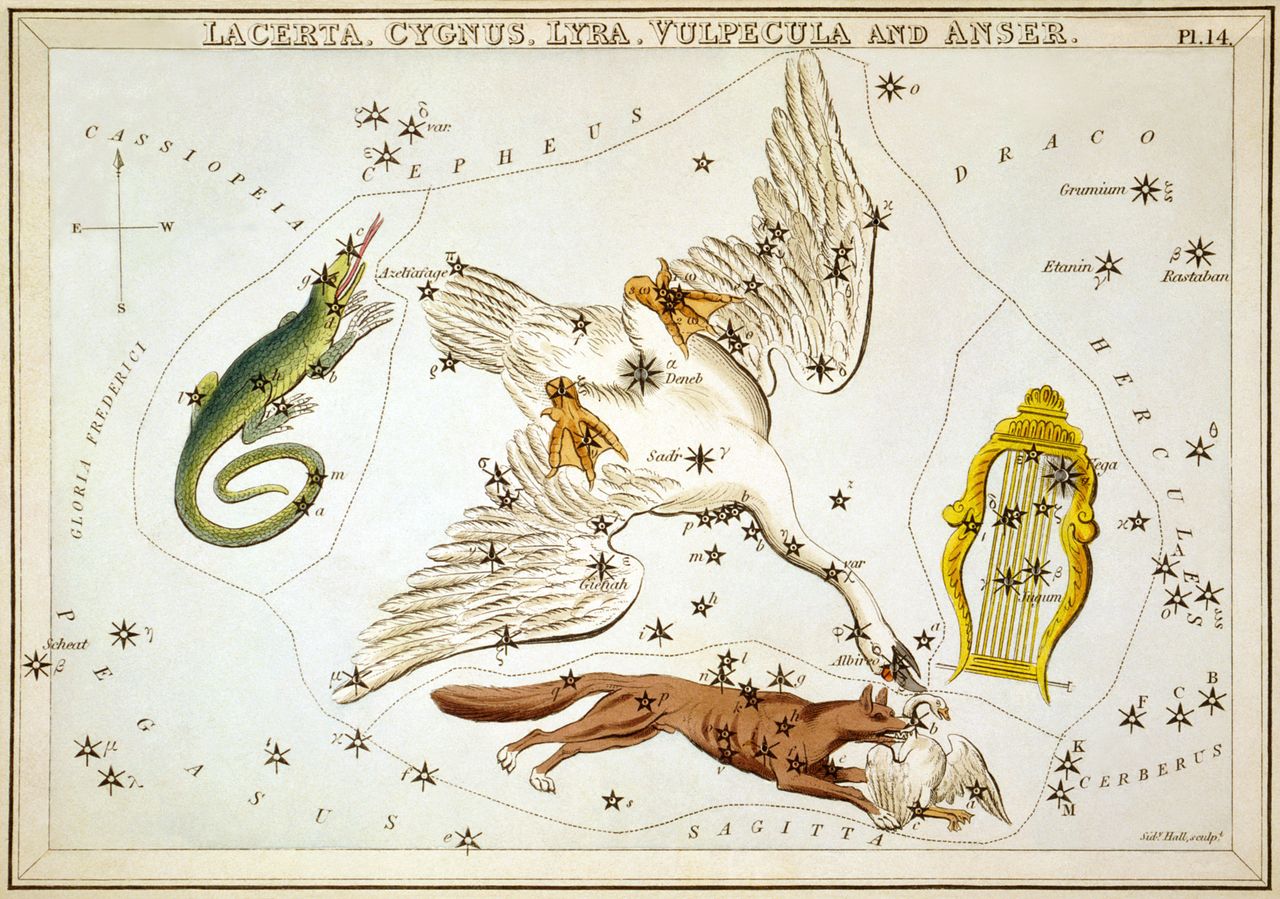


Position and appearance
Situated between the constellations of Cygnus, Andromeda, Cepheus and Pegasus, Lacerta is most easily observed from mid‑northern latitudes. It forms a zigzag or V‑shaped pattern of modest stars that together suggest the outline of a lizard. Because its stars are relatively dim and scattered, the pattern can be hard to pick out in light‑polluted skies.
Stars and deep‑sky objects
Although Lacerta lacks very bright stars, it contains several objects of interest to amateur astronomers. The constellation hosts a number of open clusters and nebulae scattered along the Milky Way. It is also the location of BL Lacertae, an active galactic nucleus whose unusual behavior gave its name to the class of "BL Lac objects" (a type of blazar).
History and naming
Lacerta was introduced in the 17th century by the astronomer Johannes Hevelius as a small lizard inserted among established constellations. Its boundaries were later formalized in the 20th century when the International Astronomical Union drew precise constellation borders that survive today.
Observation tips and significance
To find Lacerta, look for the dense star fields of the Milky Way between Cygnus and Andromeda on a clear night. Use binoculars or a small scope to explore its open clusters and compact nebulae. While it contains no first‑rate naked‑eye showpieces, Lacerta is valued for its scientific associations and for offering darker‑sky targets close to more familiar constellations.
- Notable features: BL Lacertae (prototype blazar), several open clusters
- Origin: Modern, introduced by Hevelius
- Further reading: star charts and catalogs
Related articles
Author
AlegsaOnline.com Lacerta (constellation) Leandro Alegsa
URL: https://en.alegsaonline.com/art/55253