
Helium-4 (4He): Properties, Origin, and Superfluid Behavior
Helium-4 is the dominant stable isotope of helium. This article outlines its atomic structure, cosmic and terrestrial origins, unique quantum properties (including superfluidity), and common uses.
Overview
Helium-4, written 4He, is the most abundant stable isotope of the element helium. As an isotope, it differs from other helium atoms by the number of neutrons in its nucleus. In the observable universe helium-4 is vastly more common than other isotopes of helium; nearly all helium found on Earth is helium-4. Because its nucleus contains two protons and two neutrons, the nucleus is identical to what particle physicists call an atomic nucleus that is often referred to externally as an alpha particle when emitted in radioactive decay.
Image gallery
1 Image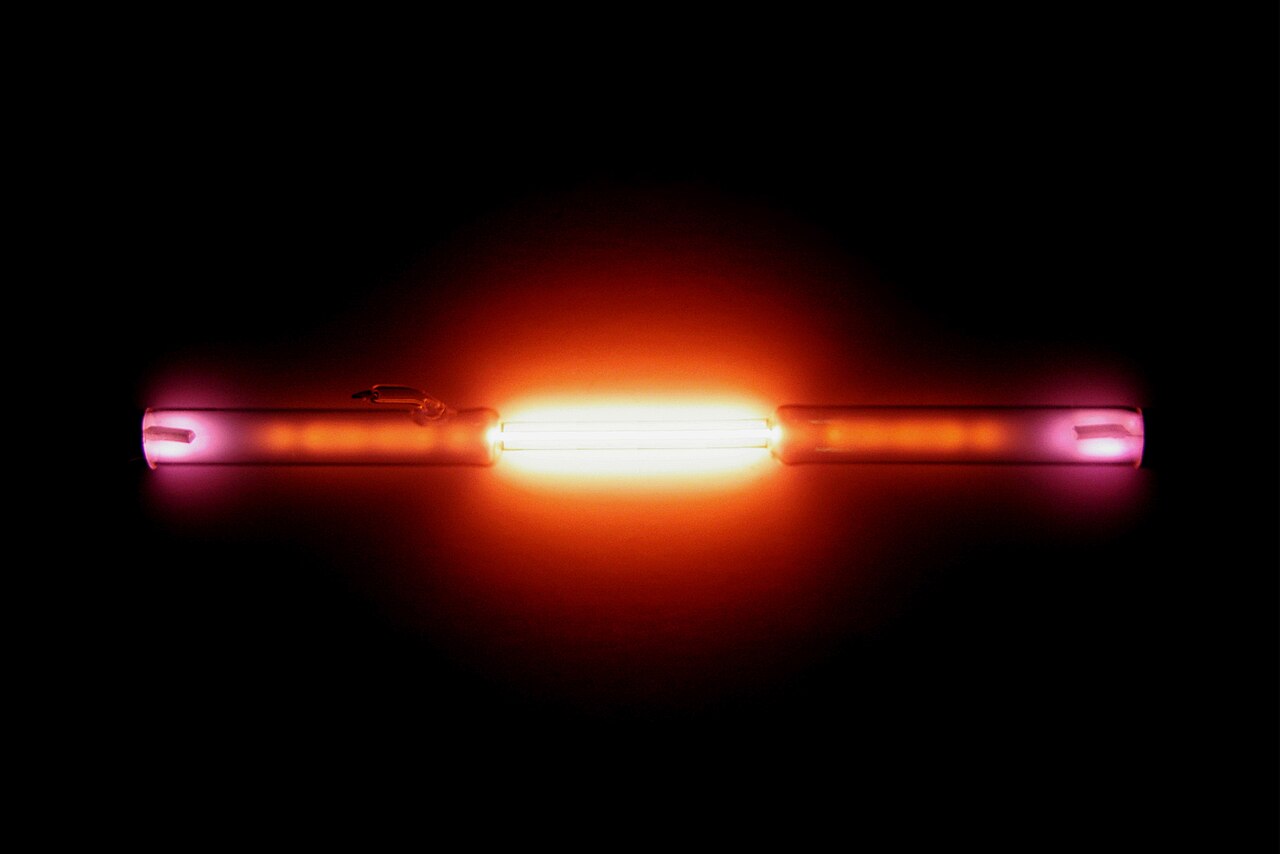
Composition and nuclear properties
A helium-4 atom consists of a nucleus with two protons and two neutrons, surrounded by two orbital electrons. The protons carry positive charge, the electrons carry negative charge, and the neutrons are electrically neutral. The tightly bound two-proton, two-neutron nucleus has total nuclear spin zero, which classifies the whole atom as a boson rather than a fermion. That bosonic character underlies many of the isotope’s striking collective quantum behaviors at low temperature.
Origin and abundance
Most helium-4 in the cosmos was synthesized during the early moments of the Big Bang in a process known as Big Bang nucleosynthesis. Additional helium-4 is produced later in stars by nuclear fusion reactions that convert hydrogen into helium in stellar cores. On terrestrial scales, much of the helium-4 present today arises from the accumulation of alpha particles produced by the radioactive decay of heavy elements in Earth’s crust. Because helium is light and chemically inert, primordial helium that existed in the proto-Earth largely escaped to space, so the planet’s helium inventory is dominated by this secondary production and by gas trapped in natural reserves.
Physical characteristics and notable facts
- Cosmic fraction: helium-4 makes up roughly a quarter of the ordinary (baryonic) mass created in the early universe, with the remainder largely composed of hydrogen.
- Chemical inertness: helium-4 is a noble gas and is chemically nonreactive at ordinary conditions.
- Atomic stability: the 4He nucleus is strongly bound and is a common product and signature of alpha decay processes.
- Occurrence beyond Earth: helium-4 has been detected in lunar samples and in the atmospheres of planets and the interstellar medium; it is present on the Moon as implanted solar wind and trapped gas.
Superfluidity and low-temperature behaviour
When cooled to temperatures near absolute zero, liquid helium-4 exhibits remarkable quantum phenomena. Below its lambda transition at approximately 2.17 K (about −271 °C), liquid helium-4 enters a superfluid phase in which it flows without measurable viscosity and shows effects that have no classical analogue. Examples include the formation of a thin climbing film (a Rollin film) that can flow over container walls, persistent frictionless currents, and quantized vortices. These macroscopic quantum behaviors are explained by a form of Bose-Einstein condensation in a system of interacting bosons and are fundamentally rooted in quantum mechanics.
Applications and uses
Helium-4 has wide practical value because of its low boiling point, chemical inertness, and lightness. Common uses include:
- Cryogenics: cooling superconducting magnets in MRI machines and particle accelerators, where liquid helium-4 provides temperatures below 4 K.
- Pressurizing and purge gas: in aerospace and laboratory systems where chemical inertness is required.
- Diving and breathing mixes: as part of gas mixtures to reduce nitrogen narcosis for deep divers.
- Industrial and scientific: shielding gas in welding, carrier gas in gas chromatography, and leak detection.
Because helium is nonrenewable on human timescales and slowly escapes planetary atmospheres, its supply and recovery from natural gas reservoirs are important concerns for industries that depend on large volumes of helium-4.
Distinctions and notable points
Helium-4 differs from the less common isotope helium-3 in its nuclear composition, quantum statistics, and low-temperature phases: helium-3 atoms are fermions and undergo superfluid transitions only at much lower temperatures and by different pairing mechanisms. The nucleus of helium-4, equivalent to the commonly known alpha particle, is central to nuclear physics and radiological processes. For further technical detail and primary data, consult specialized sources and databases maintained by physics and chemistry organizations.
Related articles
Author
AlegsaOnline.com Helium-4 (4He): Properties, Origin, and Superfluid Behavior Leandro Alegsa
URL: https://en.alegsaonline.com/art/43368