
Higgs boson
Elementary particle associated with the Higgs field; gives mass to other particles in the Standard Model and was discovered by experiments at CERN in 2012.
Overview
The Higgs boson is an elementary particle predicted by the theoretical framework of the Standard Model of physics. It is the quantum excitation of the Higgs field, a pervasive field that interacts with other fundamental particles and, through the Higgs mechanism, endows some of them with mass. The idea that such a particle should exist was proposed in the 1960s by several physicists independently; among them was Peter Higgs, whose name became associated with the boson. The particle was first observed experimentally by teams at CERN using the Large Hadron Collider, with the initial announcement in 2012 and subsequent analyses refining its measured properties.
Image gallery
10 Images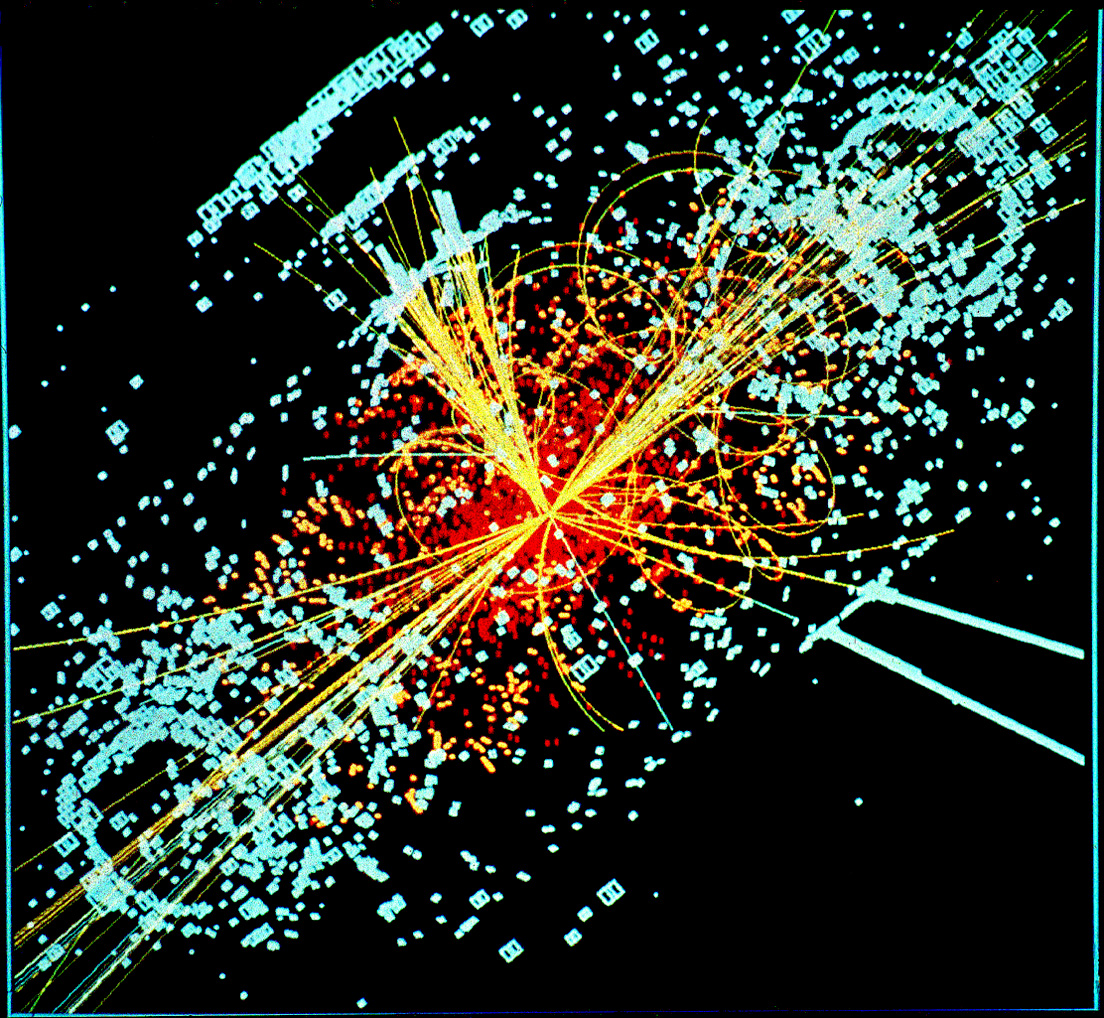



Key characteristics
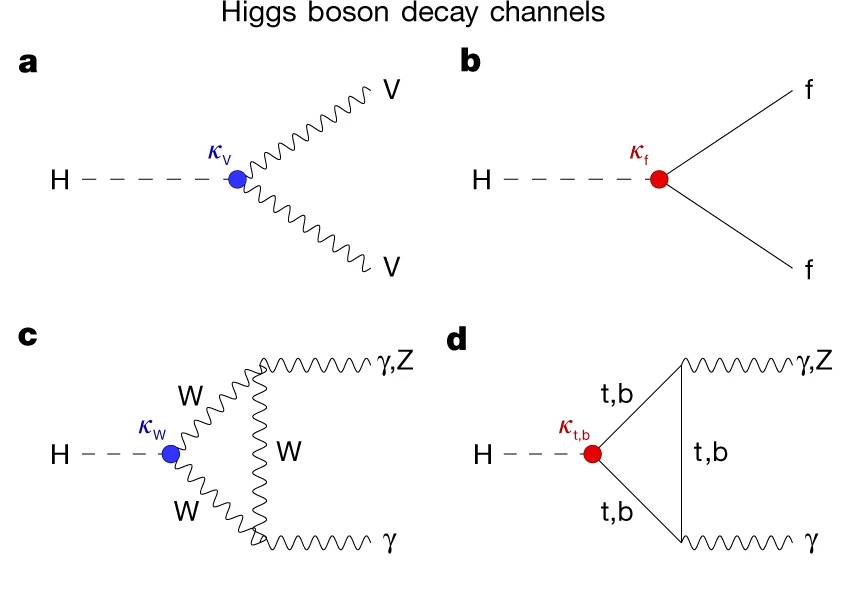
The Higgs boson is a boson (boson) with no intrinsic spin (a scalar particle). Its measured mass is about 125 GeV/c2, making it heavier than many other known elementary particles. It is unstable and decays extremely quickly into lighter particles, so it is identified indirectly via its decay products and the energy and momentum reconstructed by detectors. Common and well-studied decay channels include photons, weak bosons, and fermion pairs.
- Decays often searched for: two photons (γγ), W+W− and Z Z, bottom quark pairs (bb̄), and tau lepton pairs (τ+τ−).
- The boson mediates effects of the fundamental field that fills space and is central to particle physics theory.
Discovery and detection
Detecting the Higgs boson required collisions at unprecedented energies and rates. The LHC accelerates particles to near light speed and collides them to produce short-lived heavy states. Each collision creates many particles; only a tiny fraction of events include signatures consistent with a Higgs boson, which is why experiments accumulated enormous datasets — literally trillions of proton collisions — and relied on large-scale computing to sift signals from background noise. The probability of producing and observing a Higgs in a single collision is extremely small (sometimes described as around one in ten billion for particular channels), so statistical methods are crucial to establish discovery. The searches combine information about energy, momentum, and decay patterns constrained by conservation laws such as the conservation of energy.
Role in the Standard Model and mechanism
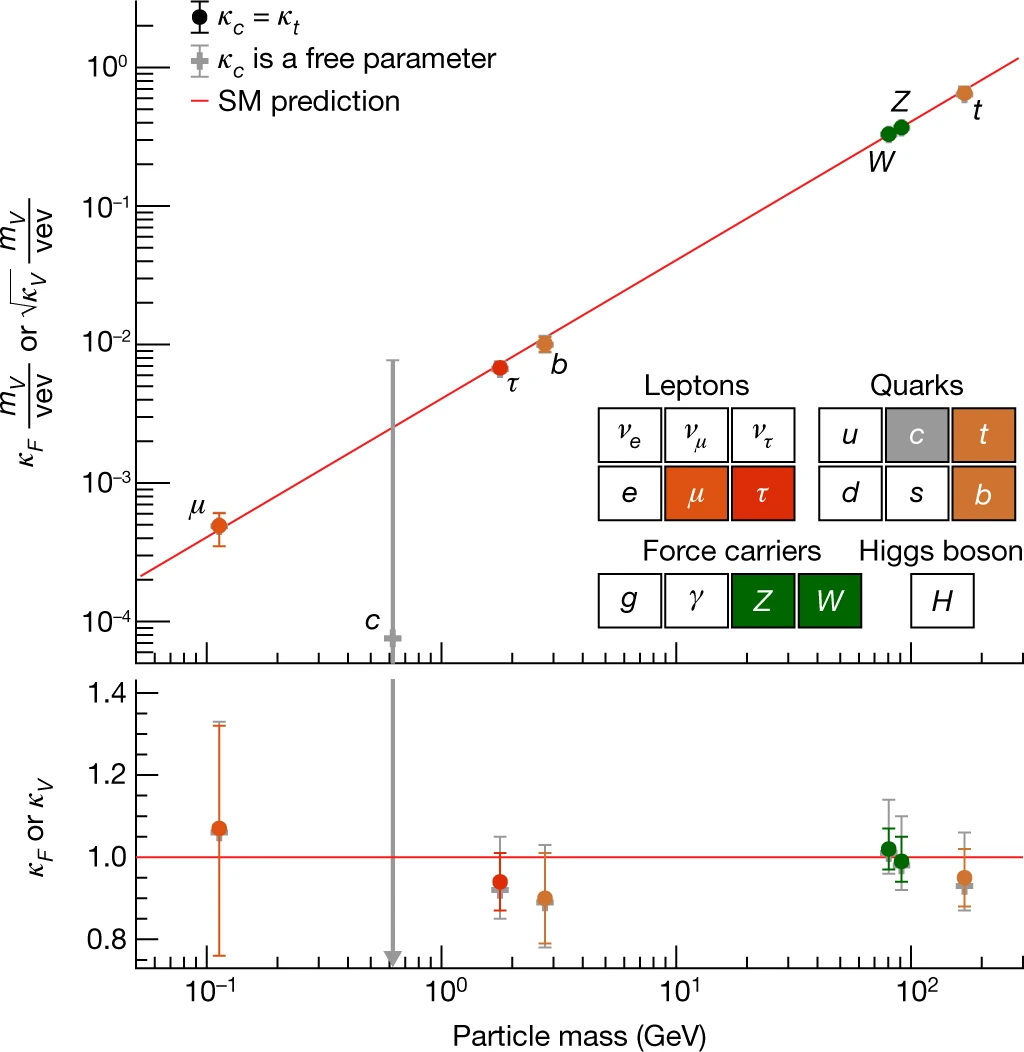
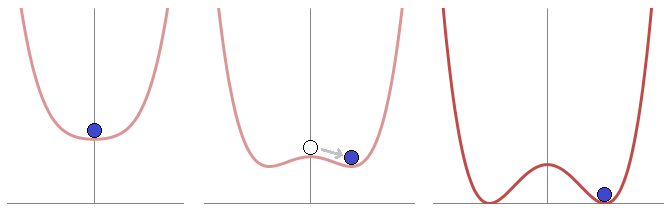
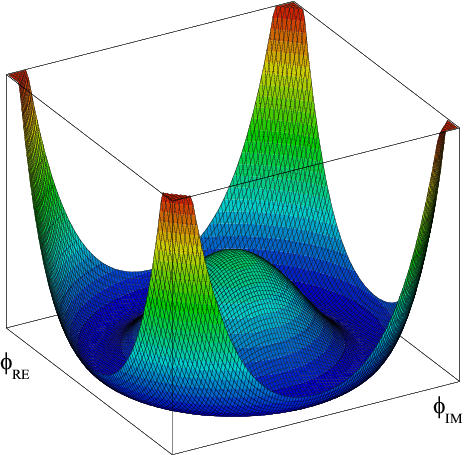
Within the Standard Model, the Higgs field provides mass to the W and Z gauge bosons through spontaneous symmetry breaking of the electroweak force; this process is often summarized as the Higgs mechanism. Gauge bosons (gauge boson) that interact with the Higgs field lose kinetic energy (kinetic energy) as their interactions alter the field configuration; that energy appears as mass-energy according to Einstein’s relation E=mc2. Fermions (quarks and leptons) acquire mass through Yukawa couplings to the Higgs field, with coupling strengths that set the particle masses. The Higgs boson is therefore distinct from other force carriers such as the photon, the W and Z bosons, and the gluon, which mediate forces rather than act as the field responsible for mass generation.
Importance, open questions and broader context
The experimental confirmation of the Higgs boson completed the roster of particles predicted by the Standard Model, but it also raised new theoretical and empirical questions. The Standard Model does not include gravity, and it leaves unanswered why the Higgs mass takes the value it does (the hierarchy problem), how the Higgs field affects the stability of the vacuum at extremely high energies, and whether additional Higgs-like particles or dynamics exist. Extensions of the Standard Model such as supersymmetry, composite Higgs models, or theories invoking new symmetries propose alternatives that would modify Higgs properties slightly; precision measurements of Higgs interactions are therefore a window on potential new physics.
Experiments, applications and cultural notes
Primary experimental study of the Higgs has come from the ATLAS and CMS collaborations at CERN, whose detectors reconstruct decay products and test the particle’s quantum numbers. The discovery has no direct technological application today but has deep conceptual significance for our understanding of mass and fundamental forces. The particle captured public imagination and entered popular culture and science fiction (science fiction), and was nicknamed the "God particle" by physicist Leon Lederman—a label many scientists regard as misleading because it exaggerates metaphysical connotations. For further technical introductions and experimental summaries see resources on the Higgs particle and overviews in educational materials linked to particle physics outreach.
For context and more detailed reading, many accessible summaries and technical reviews exist describing the Higgs field, the role of spontaneous symmetry breaking, and how modern colliders and detectors isolate fleeting signatures of new particles. Continued study centers on refining measurements of production rates and decay branching ratios, testing whether the discovered boson matches the Standard Model Higgs precisely or hints at new phenomena beyond it.
Relevant links and references are available from experimental collaborations and educational sites that explain the Higgs boson, the detectors used to observe it, and the theoretical framework in which it sits. See detector experiment pages, introductory particle physics material, and review articles for deeper study.
Physics overview • Peter Higgs biography • CERN • Boson classification • Photon • W and Z bosons • Gluon • Gravity • Higgs field • Fundamental field • Particle physics • Large Hadron Collider • Rare production probability • Collision statistics • Conservation laws • Gauge bosons • Kinetic energy • Einstein • Science fiction references • Leon Lederman
Questions and answers
Q: What is the Higgs boson?
A: The Higgs boson is a particle in the Standard Model of physics. It was first suggested by Peter Higgs in the 1960s and was confirmed to exist by scientists at CERN on 14 March 2013. It is one of 17 particles in the Standard Model and is a boson, which are thought to be responsible for physical forces.
Q: How does the Higgs field work?
A: The Higgs field is a fundamental field that takes a non-zero value almost everywhere. It was the last unverified part of the Standard Model and its existence was seen as "the central problem in particle physics". When gauge bosons interact with it, they slow down and their kinetic energy goes into creating mass-energy, which becomes what we call a Higgs boson. This process obeys conservation of energy law, where no energy is created or destroyed but instead can be transferred or change form.
Q: Why is it difficult to detect the Higgs boson?
A: The Higgs boson has a very large mass compared to other particles so it does not last very long. There are usually no around because it takes so much energy to make one. To find them, scientists use supercomputers sift through massive amounts of data from trillions of particle collisions at CERN's Large Hadron Collider (LHC). Even then there's only a small chance (one in 10 billion) that evidence of a Higgs will appear and be detected.
Q: What other known bosons are there?
A: Other known bosons include photons, W and Z Bosons, and gluons.
Q: How does Einstein's equation E=mc2 relate to the creation of mass-energy from kinetic energy?
A: Einstein's famous equation states that mass equals an extremely large amount of energy (for example 1 kg = 90 quadrillion joules). When kinetic energy from gauge bosons interacting with the Higgs field slows down, this same amount of kinetic energy goes into creating mass-energy which becomes what we call a Higgs Boson - thus conserving total energy according to conservation laws.
Q: What role do science fiction stories play with regards to understanding how higgsbosons work?
A: Science fiction stories often feature higgsbosons as part of their plotlines but these stories don't necessarily provide accurate scientific information about how they work - they're more for entertainment purposes than anything else!
Related articles
Author
AlegsaOnline.com Higgs boson Leandro Alegsa
URL: https://en.alegsaonline.com/art/44084
Sources
- home.web.cern.ch : "New results indicate that new particle is a Higgs boson"
- science.nbcnews.com : "Particle confirmed as Higgs boson"
- arxiv.org : 1503.07589
- arxiv.org : 1201.3084
- ui.adsabs.harvard.edu : 2012arXiv1201.3084L
- press.cern : "New results indicate that particle discovered at CERN is a Higgs boson | Media and Press Relations"
- wikis.utexas.edu : "Higgs boson FAQ"
- profmattstrassler.com : "The Higgs FAQ 2.0"
- thegrandpatchwork.com : quantum excitation
- books.google.com : Proceedings of the II Mexican School of Particles and Fields, Cuernavaca-Morelos, 1986
- books.google.com : The Higgs Hunter's Guide (1st ed.)
- bbc.co.uk : "LHC: Higgs Boson 'may have been glimpsed"
- bbc.co.uk : Higgs boson-like particle discovery claimed at LHC