
Big Bang (cosmology)
Overview of the Big Bang: the scientific model for the universe’s origin, its evidence, historical development, main concepts, and remaining questions.
The Big Bang is the prevailing scientific theory that describes the early development and large‑scale evolution of the universe. It explains how the structures we now observe — including stars and galaxies — emerged from an initially hot, dense state. In standard formulations the early cosmos was very hot and very small, with the known four fundamental forces behaving differently than they do today. From that early phase elementary atoms eventually formed, and over billions of years matter gathered into stars and galaxies. Observationally the age of the observable universe is commonly quoted as about 13.8 billion years, and the model describes an ongoing expansion of space.
Image gallery
10 Images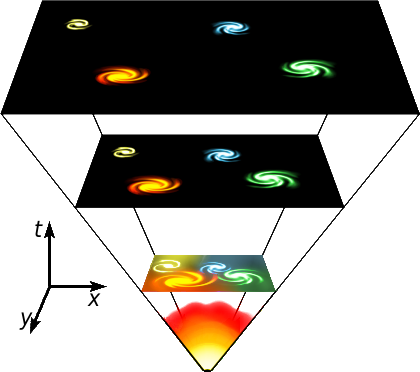





Key evidence and main components
Modern cosmology rests on several independent lines of evidence that converge on the Big Bang framework. The most important include:
- The observed redshift of distant galaxies, which shows that galaxies on average recede from us — a signature of cosmic expansion.
- The cosmic microwave background (CMB), a faint relic radiation discovered in 1965, which matches the expected cooled remnant of an initially hot phase.
- Primordial nucleosynthesis, the predicted early production of light elements (hydrogen, helium and traces of lithium) that agrees with measured cosmic abundances.
- The large‑scale distribution of galaxies and the statistical patterns in the CMB that are consistent with growth by gravity from small initial fluctuations.
To address specific puzzles about the earliest instants, theorists introduced an early rapid expansion phase called inflation, which helps explain the uniformity and flatness of the observable cosmos.
Historical development
The idea that the universe expands grew from theoretical and observational work in the early 20th century. In the late 1920s the Belgian priest and physicist Georges Lemaître proposed that an expanding universe could be traced back to an origin, and Edwin Hubble’s observations soon provided empirical support. Over the following decades the Big Bang picture was refined as measurements of the CMB, elemental abundances, galaxy surveys, and other probes accumulated. The study of cosmology transformed from speculation to a precision science, with many scientists testing and extending the model.
Concepts, common misconceptions and open questions
Four points often help clarify the Big Bang concept: it describes the expansion of space itself rather than an explosion into preexisting space; the term “singularity” refers to the breakdown of classical theories near the earliest moments rather than a definitive physical object; measured temperature falls as the universe expands; and cosmological parameters change with time. Open questions remain: the physical mechanism behind inflation, the nature of dark matter and dark energy, and how to reconcile quantum mechanics with gravity at the very earliest epoch.
Importance and distinctions
The Big Bang is distinguished from historical alternatives, such as steady‑state or plasma cosmology, by its strong observational support. It provides a framework that connects particle physics, astrophysics, and observational astronomy to explain how structure formed and how the observable universe evolved. While details of the very first instants and deeper theoretical unification remain active areas of research, the Big Bang model remains the backbone of modern cosmology.
Questions and answers
Q: What is the Big Bang?
A: The Big Bang is a scientific theory about how the universe started, and then made the stars and galaxies we see today. It is the most common theory of the universe, from its very early stages to present day.
Q: What are some alternatives to the Big Bang Theory?
A: Alternatives to the Big Bang Theory are called Steady State theory and Plasma cosmology, both of which suggest that there is no beginning or end to the universe.
Q: How did it all start according to this theory?
A: According to this theory, it began as a very hot, small, and dense superforce (the mix of four fundamental forces) with no stars, atoms, form or structure (called a "singularity"). Then about 13.8 billion years ago space expanded quickly leading to formation of atoms which eventually led to formation of stars and galaxies.
Q: Who first noted an expanding universe could be traced back in time?
A: Georges Lemaitre was first one who noted in 1927 that an expanding universe could be traced back in time to an originating single point.
Q: Is the Universe still expanding today?
A: Yes, as a whole, the Universe is still expanding today and getting colder as time passes.
Q: What is Cosmology?
A: Cosmology is the study of how the Universe began and its development over time.
Q: Do scientists agree with this theory so far?
A:Yes, some scientists who study cosmology have agreed that The Big Bang Theory matches what they have observed so far.
Tags
Related articles
Author
AlegsaOnline.com Big Bang (cosmology) Leandro Alegsa
URL: https://en.alegsaonline.com/art/11314