
Hertz: the SI unit of frequency
Hertz (Hz) is the SI-derived unit for frequency, equal to one event per second. Used across acoustics, electronics and radio, it quantifies cycles per second and relates to period and angular frequency.
The hertz (symbol: Hz) is the International System of Units (SI) derived unit used to measure frequency. Frequency describes how often a repeating event occurs in a given time: 1 hertz means one occurrence per second. In SI notation this is written as one per second, or s−1, so Hz and s−1 are equivalent. The concept connects directly to the period of a repeating phenomenon: the period is the time for one cycle and is the reciprocal of frequency.
Image gallery
2 Images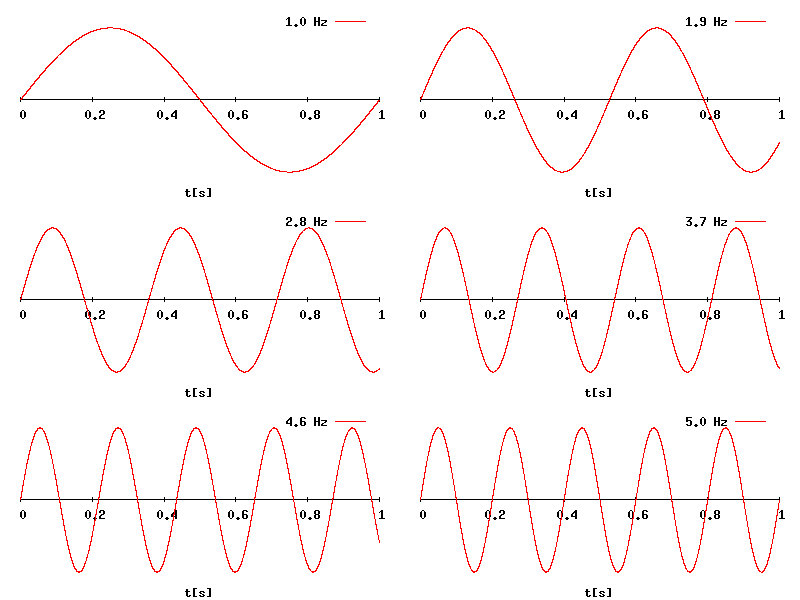

Characteristics and common multiples
Hertz measures cycles per second. For many practical ranges physicists and engineers use decimal multiples to express large or small values compactly. Typical prefixes include:
- kilohertz (kHz) = 10³ Hz, common for audio and low-frequency signals
- megahertz (MHz) = 10⁶ Hz, used in radio broadcasting and computing clocks
- gigahertz (GHz) = 10⁹ Hz, frequent in microwave links and modern processors
There is also a related quantity called angular frequency, usually denoted ω, which equals 2π times the ordinary frequency (ω = 2πf) and has units of radians per second. For many oscillatory systems it is useful to distinguish between cycles per second (Hz) and angular rate (rad·s−1).
Examples and human perception
Frequencies occur throughout nature and technology. In acoustics, musical notes correspond to specific frequencies: the pitch known as Middle C on a piano is commonly cited near 261.65 Hz, meaning about 262 vibrations per second when that key sounds. Human hearing typically spans roughly 20 to 20,000 Hz, while other animals have different ranges—for example, some owls may hear roughly between 200 and 12,000 Hz. Electrical power lines commonly operate at 50 Hz or 60 Hz depending on the region, producing the alternating current frequency experienced in mains electricity.
Uses and measurement
Hertz is used across many fields: acoustics, radio and telecommunications, electronics, mechanical vibrations, and the timing of digital systems. Radio services are allocated by frequency bands measured in kHz, MHz or GHz. Computing devices specify clock rates in hertz to indicate instruction or cycle speeds.
Common ways to measure frequency include oscilloscopes, frequency counters, spectrum analyzers and phase-locked loop systems. Measurement method choice depends on the frequency range and required precision: time-domain equipment (oscilloscopes) visualizes cycles directly, while counters and analyzers provide precise numeric readouts.
History and terminology
The term hertz honors the German physicist Heinrich Rudolf Hertz, recognized for experimental work on electromagnetic waves. Historically the same quantity was often called "cycles per second," and that phrasing remains descriptive, though the standardized name in the SI system is hertz. Because Hz is simply s−1, it emphasizes frequency as a fundamental rate in time-based phenomena.
For further reading on principles and applications of frequency, standards and measurements see introductory resources on SI units, practical guides to seconds and timekeeping, and materials covering musical pitch and acoustics linked above.
Questions and answers
Q: What is a hertz?
A: A hertz is a unit of frequency derived from time in the International System of Units (SI).
Q: How is frequency measured using hertz?
A: Frequency is measured by how often something happens over a unit of time, with a frequency of 1 hertz meaning something happens once per second.
Q: Are there other ways to express the unit of frequency besides hertz?
A: Yes, other expressions can be used to express frequency besides hertz, as shown in the table.
Q: What is the frequency of Middle C on the piano?
A: The frequency of Middle C on the piano is 261.65 (262) Hz, meaning there are 262 vibrations every second.
Q: What range of sound frequencies can humans hear?
A: Humans can hear sounds in the range of 20 to 20,000 Hz.
Q: What range of sound frequencies can owls hear?
A: Owls can hear sounds in the range of 200 to 12,000 Hz.
Q: After whom is the unit of frequency, hertz, named?
A: The unit of frequency, hertz, is named after a German physicist Heinrich Rudolf Hertz.
Related articles
Author
AlegsaOnline.com Hertz: the SI unit of frequency Leandro Alegsa
URL: https://en.alegsaonline.com/art/43909
Sources
- hyperphysics.phy-astr.gsu.edu : "Sensitivity of Human Ear"
- lsu.edu : "Frequency Hearing Ranges in Dogs and Other Species"
- arrl.org : "Frequency Allocations"
- smeter.net : "Aviation Radio Bands and Frequencies"