
Heinrich Böll: German novelist, short-story writer and Nobel laureate
Heinrich Böll (1917–1985) was a major German writer of the postwar era, noted for novels and stories that critiqued society and conscience; awarded the Nobel Prize in Literature in 1972.
Heinrich Böll (born December 21, 1917 in Cologne — died July 16, 1985 in Langenbroich, Eifel) was a prominent German writer. He rose after World War II to become one of the most widely read authors in West Germany and internationally. In 1972 he received the Nobel Prize in Literature, an acknowledgment of his influence on postwar letters.
Image gallery
5 Images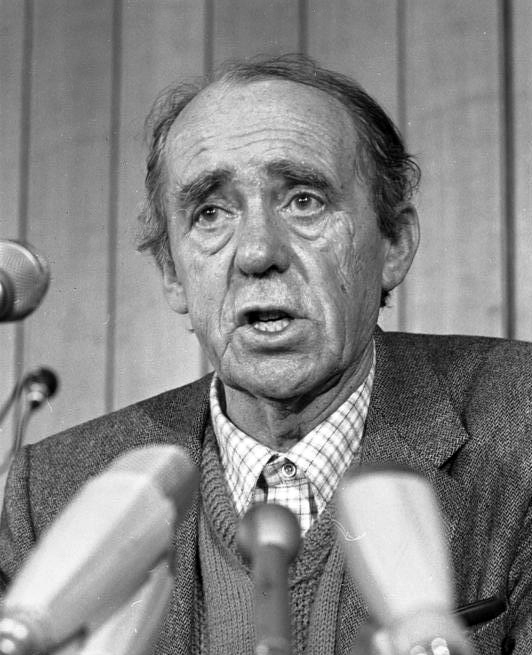


Life and career
Böll grew up in a Catholic household and served as a soldier during World War II; his wartime experiences and captivity shaped much of his early work. After the war he worked as a journalist and became involved in the literary renewal of Germany, associating with groups of writers who sought to confront moral questions and social reconstruction. His output includes novels, short stories and essays written in a direct, often ironic style.
Themes and style
Böll's fiction commonly addresses ordinary people caught in political, moral or bureaucratic pressures. He combined realist description with satirical and empathic tones, probing guilt, memory and the lingering effects of war. His moral concern and plainspoken language made his books accessible while still engaging complex ethical questions.
Selected works
- Billiards at Half-past Nine (Billard um halb zehn) — a study of a family across generations
- The Clown (Ansichten eines Clowns) — a social satire on postwar hypocrisy
- Group Portrait with Lady (Gruppenbild mit Dame) — one of his later major novels
- Short stories and essays that address civil society and conscience
Böll received other major German literary honors during his life and was active in public debates on human rights, freedom of expression and the responsibilities of intellectuals. His work has been widely translated and continues to be studied for its ethical insight and narrative craft.
Notable aspects of his legacy include a sustained critique of postwar German society and a reputation as a moral voice in literature. Institutions, translations and scholarly studies keep his books in circulation, and his influence on contemporary German prose remains significant.
Related articles
Author
AlegsaOnline.com Heinrich Böll: German novelist, short-story writer and Nobel laureate Leandro Alegsa
URL: https://en.alegsaonline.com/art/43268