
Gymnosperms — seed plants with exposed ("naked") seeds
Gymnosperms are non-flowering seed plants whose seeds develop exposed on scales or stalks. This article summarizes their groups, structure, fossil history, ecological roles and differences from angiosperms.
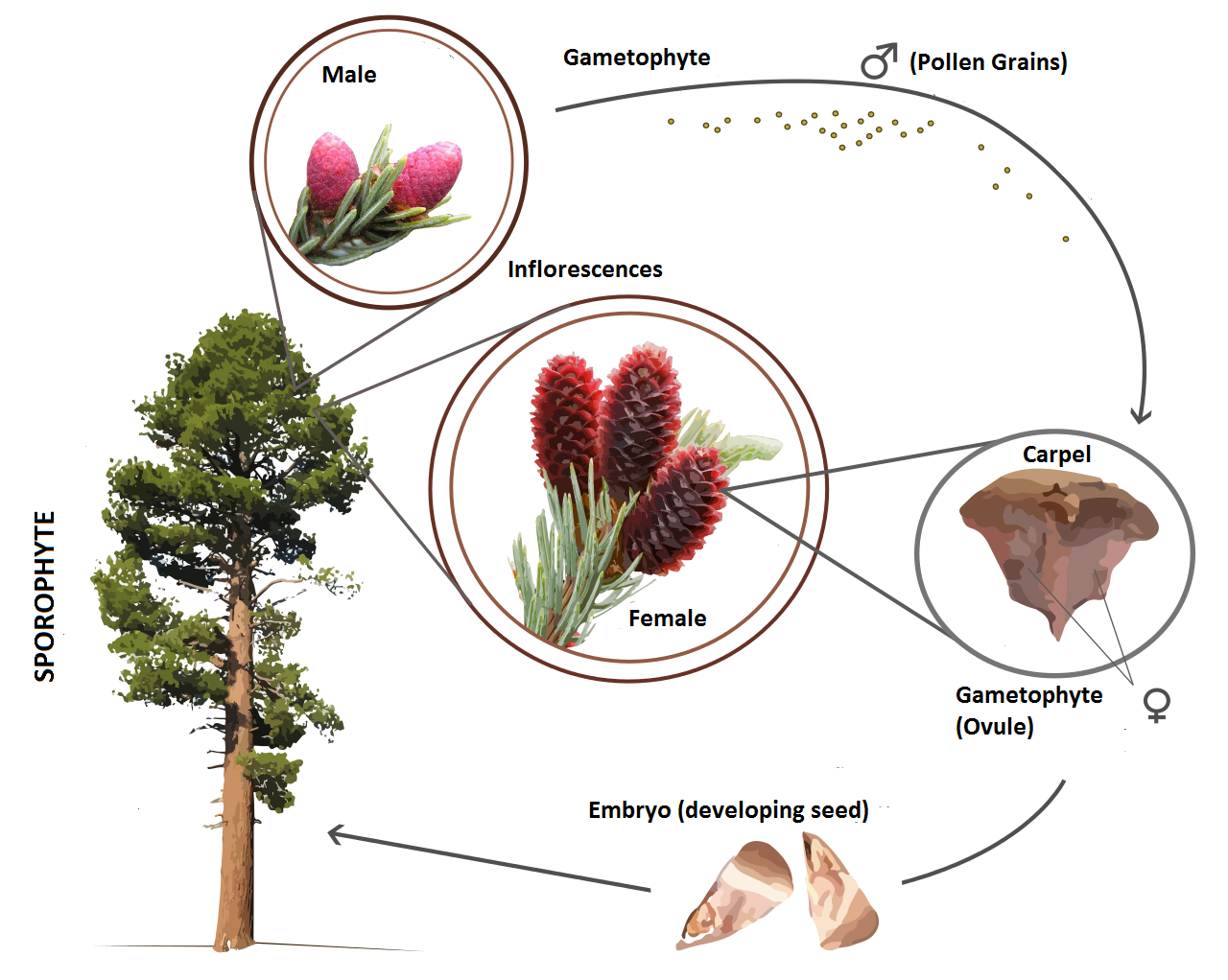
The term gymnosperm refers to a diverse assemblage of seed-producing plants whose ovules or seeds are not enclosed within an ovary at the time of pollination. In other words, gymnosperms bear "naked seeds," a feature that contrasts with the enclosed seeds of angiosperms. Together with angiosperms, gymnosperms make up the seed plants or spermatophytes. Modern gymnosperms range from towering conifers in boreal forests to small, unusual survivors such as Ginkgo.
Image gallery
5 Images


Major living groups
- Conifers — the largest living lineage, including familiar trees used for timber and paper. Examples include pines and cypresses.
- Cycads — palm-like plants with stout trunks and large, pinnate leaves; many species are rare or threatened.
- Ginkgo — represented by a single living species, known for its fan-shaped leaves and long fossil history.
- Gnetales — a small but morphologically varied group that includes genera such as Gnetum, Welwitschia and Ephedra.
Key characteristics
Gymnosperms are vascular plants with true roots, stems and leaves. Their reproductive structures often form cones or cone-like organs: seeds develop exposed on the surfaces of modified leaves or scales, or occasionally at the tips of short stalks as in Ginkgo. Pollination is frequently by wind rather than by animal vectors. While many gymnosperms rely on tracheids for water transport, some groups show vessel-like cells, illustrating important anatomical variation among lineages.
Evolution and fossil record
Gymnosperms have a long fossil record that predates the rise of flowering plants. During the Mesozoic era they were ecologically dominant in many terrestrial habitats. The fossil record also preserves diverse extinct gymnosperm groups, including seed ferns (Pteridosperms) and the so-called cycadeoids (Bennettitales); these and other early types are discussed under fossil gymnosperms. Many modern lineages persisted through major environmental changes, though the dominance of gymnosperms declined after angiosperms diversified.
Uses, ecology and notable facts
Gymnosperms provide important ecosystem services and human uses: conifer forests supply timber, resins and habitat; cycads and Ginkgo are cultivated as ornamentals; some species have cultural or medicinal significance. Ecologically, gymnosperms are key components of boreal, montane and dryland ecosystems. Conservation concerns affect certain cycads, conifers and other taxa because of habitat loss and overexploitation.
Distinctions from flowering plants
The primary difference is reproductive: angiosperms enclose ovules within an ovary (a defining floral feature), whereas gymnosperm seeds are exposed at pollination. This leads to different pollination and seed-dispersal strategies. Taxonomically and phylogenetically, the relationships among the living gymnosperm groups and their fossil relatives have been refined by molecular and morphological studies, but some aspects of their deep evolutionary branching remain active areas of research.
For concise overviews of particular groups or structures see cone morphology and specialized pages on conifers, cycads, Gnetales and Ginkgo.
Related articles
Author
AlegsaOnline.com Gymnosperms — seed plants with exposed ("naked") seeds Leandro Alegsa
URL: https://en.alegsaonline.com/art/41603
Sources
- doi.org : 10.1111/j.1469-8137.2011.03862.x
- doi.org : 10.1093/molbev/msm059