
Hardwood (wood from angiosperm trees)
Hardwood is timber from flowering (angiosperm) trees, typically deciduous or broad-leaved evergreen. Its structure, density and uses vary by species; common uses include furniture, flooring and instruments.
Hardwood is the timber produced by flowering plants known as angiosperms. Unlike coniferous softwoods, hardwoods come from trees that are usually deciduous or from broad-leafed evergreens. The term covers a very wide range of trees and properties: while many hardwoods are dense and durable, some — for example soft hardwoods such as balsa — are among the lightest woods. In botanical terms hardwoods bear their reproductive structures inside a covering (so their seeds are enclosed), unlike gymnosperms whose seeds are exposed in cones. The phrase "hardwood" is therefore a practical, not strictly scientific, label and should be understood as a broad category rather than a single quality level.
Image gallery
10 Images


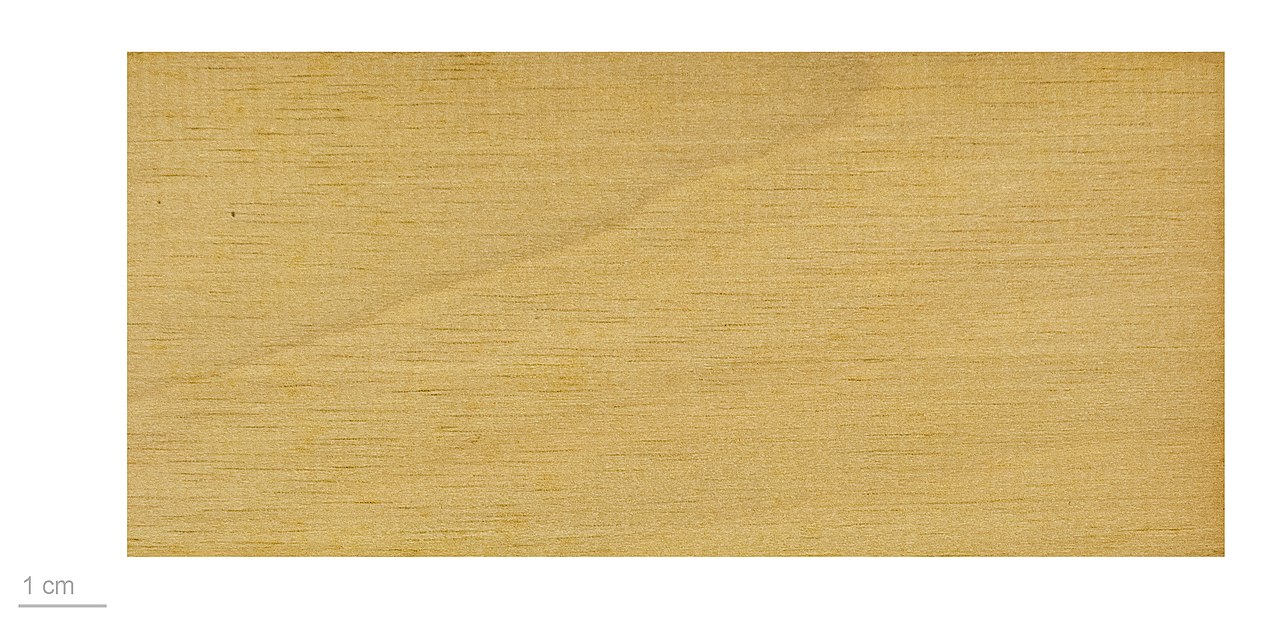

Anatomy and physical characteristics
The distinctive properties of hardwood arise from its cellular structure. Hardwood xylem contains vessel elements and pores that transport water; these xylem vessels differ from the simpler tracheid-dominated arrangement of many softwoods. Hardwood cell walls are strongly lignified, a process that increases strength and rigidity; many hardwoods are therefore heavier and harder than typical softwoods. Density and grain pattern vary widely by species, producing woods that are open-porous, ring-porous or diffuse-porous. Some very dense species — often referred to as ironwoods — are so compact that they will not float in water; certain known examples are sometimes cited among the heaviest timbers recorded.
Common species and classification
Common hardwood trees include oak, maple, walnut, cherry, beech and birch, as well as tropical examples such as mahogany and teak. The category also includes light woods like balsa and exceptionally dense woods sometimes called black ironwood. In contrast with softwoods, which derive from conifers, hardwoods come from broad-leaf genera whose annual growth and form often differ from resinous conifers. Because the group is large and diverse — far more numerous in species than softwoods — grouping is typically done by botanical family, mechanical properties and traditional trade names rather than a single defining trait.
Uses and practical importance
Hardwoods are prized for applications that require strength, wear resistance or attractive grain. Typical uses include furniture, flooring, cabinetry, veneers, turned objects, tool handles and many musical instruments. Some hardwoods are preferred for carving and specialty work because of fine grain and dimensional stability; others are chosen primarily for durability outdoors or resistance to insects and decay. In industrial contexts hardwoods are also processed into veneers, plywood and specialty products. Woodworkers and manufacturers choose species to match required hardness, workability and appearance.
Distinctions, working qualities and sustainability
It is important to distinguish between the informal notion of "hardness" and measurable mechanical properties such as Janka hardness, specific gravity and compressive strength. Workability — how easily the wood cuts, holds fasteners or takes glue and finish — also varies and influences selection for particular projects. Because many valued hardwoods are slow-growing or come from tropical forests, concerns over supply and habitat have led to certification programs and sustainable forestry practices. Consumers and craftsmen increasingly look for responsible sourcing, reclaimed wood, or alternatives when choosing hardwoods for construction and design.
Further reading and resources
- Tree biology and timber
- Broad-leaf evergreen species
- Contrast with softwood
- Carving and craft techniques
- Cell wall structure
For introductory guides, identification keys and property tables consult trusted timber handbooks or regional forestry resources. Responsible use and clear labeling help preserve hardwood diversity while allowing continued use in furniture, construction and the arts. Gymnosperm and xylem contrasts, as well as specific species profiles, provide useful starting points for deeper study.
Note: This article uses conventional trade and botanical distinctions and should be read as a general overview rather than a technical manual. Additional resources include genus- and species-level monographs, woodworking references and sustainable forestry guides. See also: seed types, cone-bearing plants and practical notes on conifers.
Related topics: wood hardness, species diversity, balsa and regional timber traditions. For hands-on advice about selecting wood for a project, consult local suppliers or woodworking courses that cover drying, jointing and finishing hardwood lumber.
Questions and answers
Q: What is hardwood?
A: Hardwood is wood from deciduous trees and broad-leaf evergreen trees. All hardwoods are angiosperms, which are flowering plants, the largest group of land plants.
Q: How does hardwood differ from softwood?
A: Softwood comes from conifers, cone bearing seed plants, while hardwoods usually have broad leaves and come from deciduous or broad-leafed evergreen trees. Hardwoods also grow slower than softwoods and some are excellent for carving.
Q: Are all hardwoods harder than softwoods?
A: No, not all hardwoods are harder than softwoods; balsa wood is an example of this.
Q: How many species of hardwood exist compared to softwood?
A: There are about 100 times more species of hardwood than there are softwoods.
Q: What causes the properties of the wood?
A: The properties of the wood are caused by its structure; hardwoods have a denser structure which is why they're usually harder and heavier. They also have xylem vessels used to transport water and their cell walls contain lignin which is a strong material used to support plants above the surface. Softwoods have a similar vascular structure but with less lignin present than most hardwoods.
Q: What type of wood is recognized as being one of the hardest?
A: Black ironwood has been recognized by Guinness Book Of World Records as being one of the heaviest woods and therefore one of the hardest types of wood available.
Q: Why do iron woods sink in water rather than float like other woods do?
A: Iron woods sink in water because they're so dense; this density contributes to them being one of the hardest types of wood available
Related articles
Author
AlegsaOnline.com Hardwood (wood from angiosperm trees) Leandro Alegsa
URL: https://en.alegsaonline.com/art/42433
Sources
- cltad.arts.ac.uk : "Hardwoods"
- mr-dt.com : "Hardwoods"
- design-technology.org : "Year 10 Manufacturing (Resistant Materials)"
- waynesword.palomar.edu : "Botanical Record Breakers - Part 1 of 2"
- waynesword.palomar.edu : "Hardwoods Trees & Shrubs With Dense, Hard Wood"
- ahec.org : "About U.S. Hardwoods"
- tft-forests.org : "Words into Action"
- paperonline.org : "Pulping properties of hardwoods and softwoods"