
Gobi Desert
A broad overview of the Gobi Desert: its geography, climate, landscapes, wildlife, human history, economic uses and conservation challenges across Mongolia and China.
Overview
The Gobi is a vast semi-arid to arid region that stretches across parts of northern China and southern Mongolia. Its name appears in local languages, for example Mongolian as Говь and in Chinese characters as 戈壁 with the pinyin form Gēbì. The Gobi is the largest desert region in Asia and one of the largest deserts on Earth; it is often described as a cold desert because of its wide seasonal temperature swings.
Image gallery
10 Images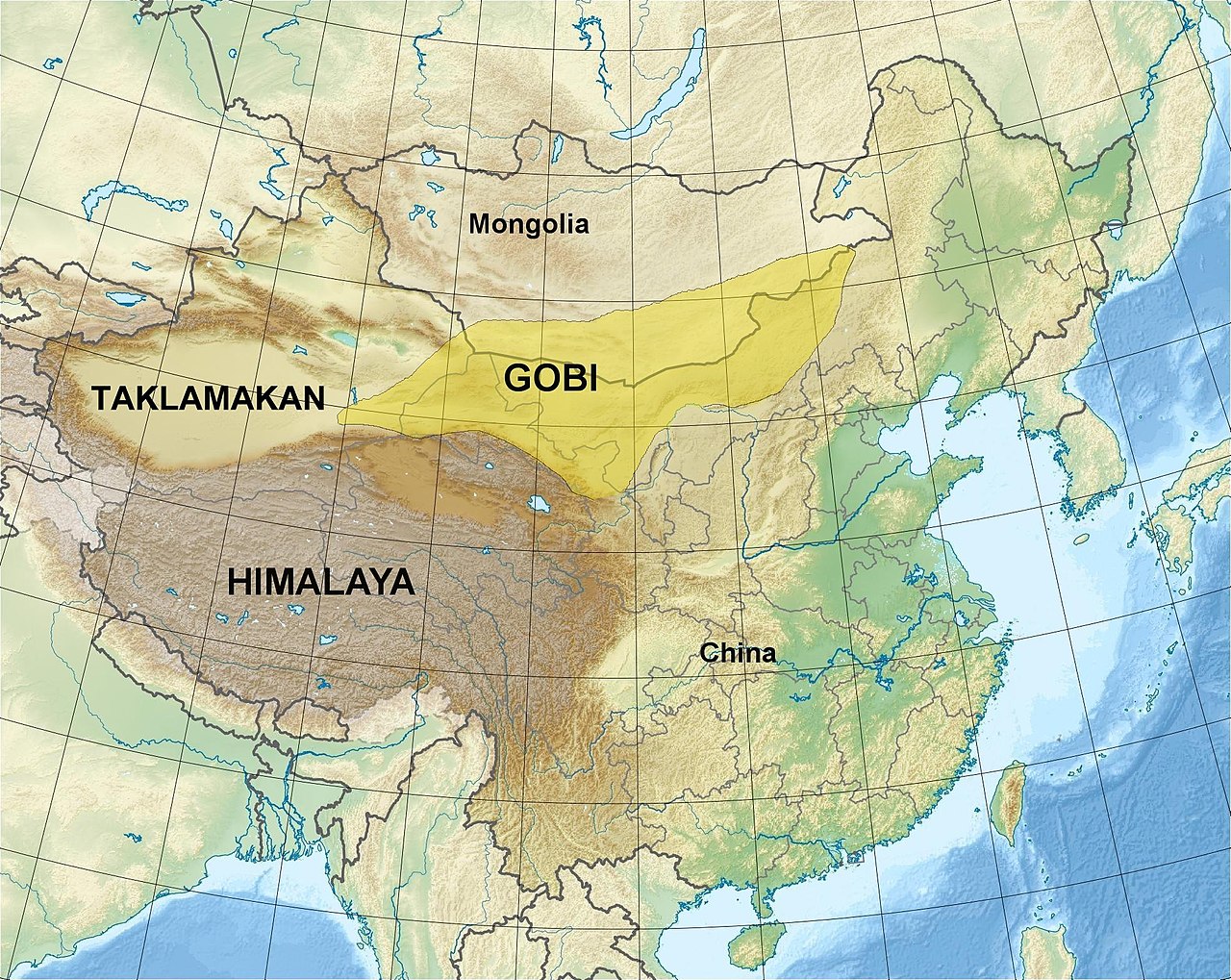


Location and climate
The Gobi lies mainly within the borders of Mongolia and northern China, occupying basins and lowlands that are bounded by mountain ranges and plateaus. The region's aridity is largely a rain-shadow effect: the Tibetan Plateau and the Himalayas block moist air masses, so precipitation is low and unevenly distributed. Winters can be extremely cold and summers hot, and precipitation often falls as brief, intense storms rather than steady rain.
Landforms and geology
The Gobi is not a single flat sea of sand but a mosaic of landscapes: gravelly plains (reg), occasional sandy dunes (erg), salt flats, dry riverbeds and low mountain ranges. To the north it is edged by the Altai Mountains and to the southeast by the North China Plain. Underneath these surfaces lie complex sedimentary basins that have preserved important fossils and geological records.
Flora and fauna
Vegetation is sparse and adapted to drought and temperature extremes: hardy shrubs, grasses and scattered drought-tolerant forbs occur where moisture allows. Wildlife includes species adapted to open, dry conditions: wild camels (Bactrian), wild equids, various gazelles and several predators, including foxes and big cats in upland areas. The Gobi is also notable for rare endemics such as the critically endangered Gobi bear and for areas that have yielded significant paleontological discoveries.
Human history and uses
Human presence in the Gobi has long been shaped by nomadic herding, seasonal mobility and trade routes. For centuries the region lay along branches of transcontinental caravan routes that connected Central Asia and eastern China. Archaeological and paleontological work in places like the Flaming Cliffs revealed fossilized dinosaurs and eggs in the early 20th century, drawing scientific attention to the region. Today, parts of the Gobi are used for pastoralism, mining and increasingly for infrastructure and tourism.
Threats and conservation
The Gobi faces environmental pressures from climate variability, desertification, overgrazing and expanding mining and development projects. Local and international conservation initiatives aim to protect critical habitats, support sustainable grazing practices and reduce the impacts of industrial activity. Protected areas and community-based stewardship are central tools in efforts to conserve the region's biodiversity and cultural heritage.
Distinctive facts and further resources
- The Gobi is often categorized as a cold desert because of severe winter lows and strong diurnal temperature ranges; it is the largest desert in Asia and among the largest worldwide.
- Its formation and climate are strongly influenced by the Tibetan Plateau and surrounding ranges, which create a rain-shadow effect.
External links
Related articles
Author
AlegsaOnline.com Gobi Desert Leandro Alegsa
URL: https://en.alegsaonline.com/art/39364
Sources
- commons.wikimedia.org : Gobi Desert
- worldcat.org : OCLC 411792
- tools.wmflabs.org : 42°35′N 103°26′E / 42.59°N 103.43°E / 42.59; 103.43
- wikidata.org : wikidata.org/wiki/Q42070
- d-nb.info : 4093637-5
- id.ndl.go.jp : 00628517
- aleph.nkp.cz : ge311544
- viaf.org : 243456761
- worldcat.org : viaf-243456761