
Geography of Afghanistan
Overview of Afghanistan’s physical geography: mountains, rivers, climate, ecosystems, and strategic location in central Asia, with major features and implications for people and environment.
Overview
Afghanistan occupies a central position on the Asian landmass and is commonly described as being in Central and South Asia. It is a landlocked country framed by mountain ranges, high plateaus and intermontane basins. Its position at the crossroads of different regions has shaped climate patterns, waterways and human history.
Image gallery
10 Images


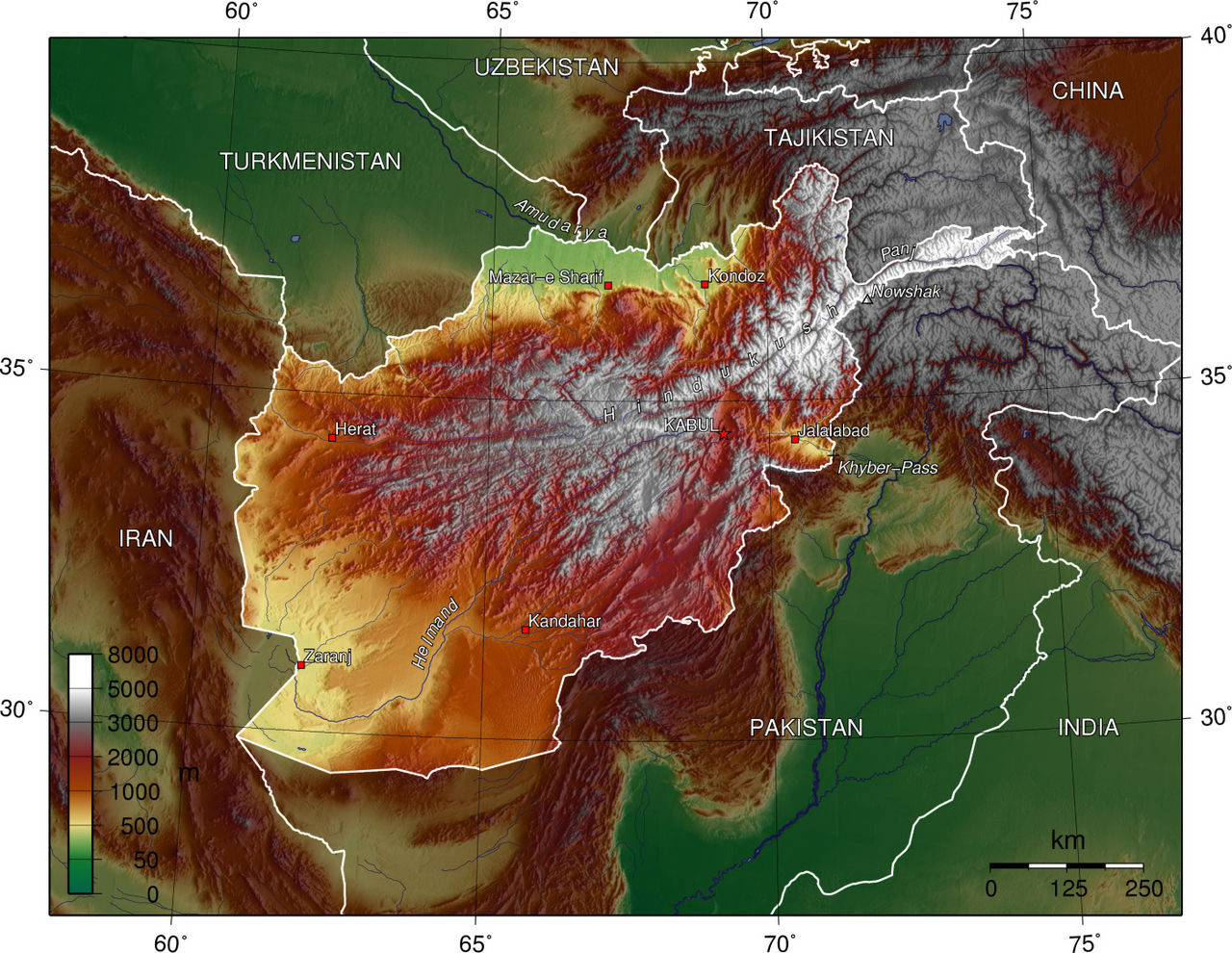


Topography and mountain systems
The country is predominantly mountainous, and large parts of its interior are dominated by ranges and highlands rather than extensive plains. The most prominent range is the Hindu Kush, which rises sharply and contains many of Afghanistan’s highest peaks, including its best-known summit, Noshaq. Mountain ridges and valleys create a complex landscape of passes and basins, with steep relief that influences settlement, transport and agriculture. Deserts and arid plateaus lie more often in the southwest and south.
Rivers, drainage and water systems
Although largely arid, Afghanistan is drained by several important rivers that begin in its highlands and flow toward neighboring basins. Major rivers include:
- Amu Darya — forms part of the northern drainage and is fed by tributaries in the northeastern highlands.
- Kabul River — runs eastward from central Afghanistan toward Pakistan and is crucial for irrigation around the capital region.
- Helmand River — drains much of the southwest, terminating in internal basins and supporting large agricultural areas where irrigated.
- Other rivers such as the Hari and numerous smaller streams provide seasonal flows and connect mountain catchments to lowland plains.
Climate, ecosystems and land use
Afghanistan’s climate is continental and generally dry: cold winters and hot summers with pronounced seasonal extremes at different elevations. Higher elevations receive snowfall that replenishes rivers in spring, while lowlands are more arid. Vegetation ranges from alpine meadows and coniferous stands at altitude to steppe, shrubland and sparse desert scrub. Productive land is limited; irrigation and river valleys support the bulk of farming and population centers.
Geology, hazards and regional importance
The country lies where the Indian Plate meets the Eurasian Plate, producing uplifted ranges and periodic earthquakes. Its rugged terrain has historically shaped trade routes, cultural exchange and strategic movement between Central, South and West Asia. Transboundary rivers and shared watersheds also make Afghanistan’s hydrology important to neighboring countries.
Notable distinctions
Afghanistan is distinguished by being landlocked, having a predominantly mountainous relief, and containing headwaters for rivers that influence wider regional basins. These physical characteristics continue to affect settlement patterns, agriculture, infrastructure and geopolitical considerations across the region.
For maps and further geographic data see general references on Asia and regional studies of Afghanistan.
Questions and answers
Q: Where is Afghanistan located?
A: Afghanistan is located in the middle of Asia.
Q: Is Afghanistan a landlocked country?
A: Yes, Afghanistan is a landlocked country.
Q: What type of terrain does Afghanistan have?
A: Afghanistan has a mountainous terrain, with most of the Hindu Kush mountains.
Q: How many major rivers are in Afghanistan?
A: There are four major rivers in Afghanistan, including the Amu Darya, the Hari River, the Kabul River and the Helmand River.
Q: Does Afghanistan have any smaller rivers or bodies of water?
A: Yes, Afghanistan also contains a number of smaller rivers, lakes, and streams.
Q: What is the name of the river that flows through the capital city of Afghanistan?
A: The river that flows through the capital city of Afghanistan is the Kabul River.
Q: What is the name of the river that forms part of the border between Afghanistan and Pakistan?
A: The river that forms part of the border between Afghanistan and Pakistan is the Helmand River.
Related articles
Author
AlegsaOnline.com Geography of Afghanistan Leandro Alegsa
URL: https://en.alegsaonline.com/art/38128
Sources
- cia.gov : Afghanistan · webcitation.org
- bgs.ac.uk : Gold and copper discovered in Afghanistan
- wise-uranium.org : Uranium Mining Issues: 2005 Review
- pajhwak.com : 16 detained for smuggling chromites
- eurasianet.org : Afghanistan’s Energy Future and its Potential Implications
- pajhwok.com : Govt plans to lease out Ainak copper mine