
Helmand River
Major river of southwestern Afghanistan, rising in the Hindu Kush and flowing to the Sistan marshes; important for irrigation, culture and transboundary water issues.
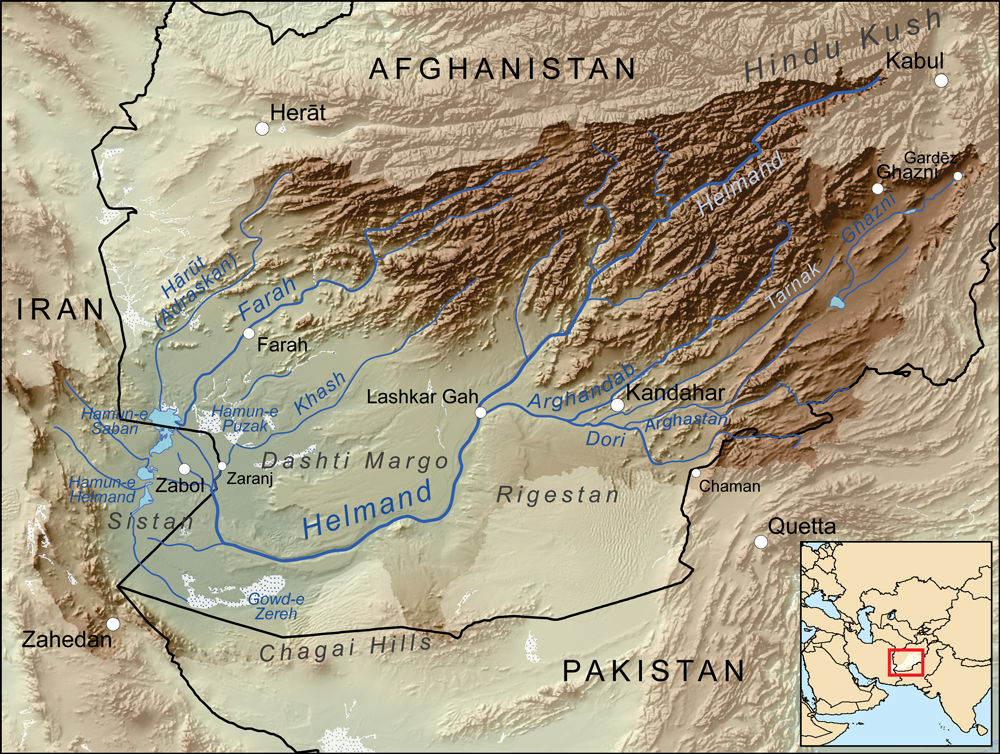
The Helmand River is the longest river wholly within Afghanistan and a defining watercourse of southwestern Central Asia. Rising in the highlands of the Hindu Kush, it flows generally southwest across arid plains before terminating in a system of seasonal lakes and marshes on the Afghan–Iranian border. The river has shaped local agriculture, settlement and historical trade routes for millennia and remains central to regional water management and ecology.
Image gallery
3 Images

Names and etymology
The river is known by several names in local languages and older classical sources. In Pashto it appears as Hirmand and in Persian as Hīrmand. Classical authors recorded related forms: Greek writers used forms similar to Etýmandros and Latin sources sometimes rendered a version like Erymandrus. The modern name is commonly interpreted to mean "dammed" or "place of a dam" in local parlance, reflecting its long human association with irrigation structures.
Course and physical characteristics
The Helmand rises in the western slopes of the Hindu Kush, roughly west of Kabul, and runs for approximately 1,150 km (about 710 miles). From its mountain sources the river descends into broad alluvial plains, crosses the desert of Dashti Margo and then branches into the Sistan basin. Its waters historically fed the Hamun wetland complex, a seasonal lake and marsh system near the Afghan–Iranian frontier around Zabol.
Regional importance and human use
The Helmand supplies irrigation to a large swath of southwestern Afghanistan and supports agriculture in Helmand Province — a region that takes its name from the river (Helmand Province). Canals, diversion works and small dams have been built along its course to support cropping, particularly of wheat, orchards and poppy cultivation in recent decades. Because much of the basin is arid, the river’s flow profoundly affects local livelihoods and seasonal migration.
Ecology, disputes and management
The river and the terminal wetlands are ecologically significant, providing habitat for migratory birds and supporting reed beds used by local communities. Water levels vary seasonally and from year to year, making the system vulnerable to drought. Transboundary water sharing with neighboring Iran has been a recurring diplomatic and practical issue, as reductions in downstream inflows have caused shrinkage of the Hamun lakes and stresses on fisheries and pasture. Contemporary management efforts balance irrigation demands, conservation of wetlands and the need for cooperative agreements across borders.
Notable facts
- It is the longest river located primarily in Afghanistan.
- The river’s headwaters are in a mountainous region associated with traditional caravan and trade routes.
- Seasonal flooding and the operation of dams and canals strongly influence agricultural output and settlement patterns along the channel.
- For further general information on river systems and regional geography consult resources linked here: river overview.
Because the Helmand’s course, uses and basin communities cross administrative and national boundaries, it remains an important subject of study for hydrologists, historians and policy makers concerned with water security and sustainable development in arid regions.
Related articles
Author
AlegsaOnline.com Helmand River Leandro Alegsa
URL: https://en.alegsaonline.com/art/43410
Sources
- postconflict.unep.ch : "History of Environmental Change in the Sistan Basin 1976 - 2005"
- iranica.com : "HELMAND RIVER"