
Gel (semi-solid colloidal material)
A gel is a semi-solid system in which a liquid is immobilized within a three-dimensional network, producing materials that are viscoelastic and widely used in food, medicine, and materials science.
Overview
A gel is a soft, semi-solid material formed when a liquid becomes constrained within a continuous three-dimensional network of a different phase. Although most of a gel’s mass is liquid, the network of crosslinks gives the bulk material enough rigidity to hold shape and to display both solid-like and liquid-like responses to stress. For a concise summary of basic properties see basic description.
Image gallery
10 Images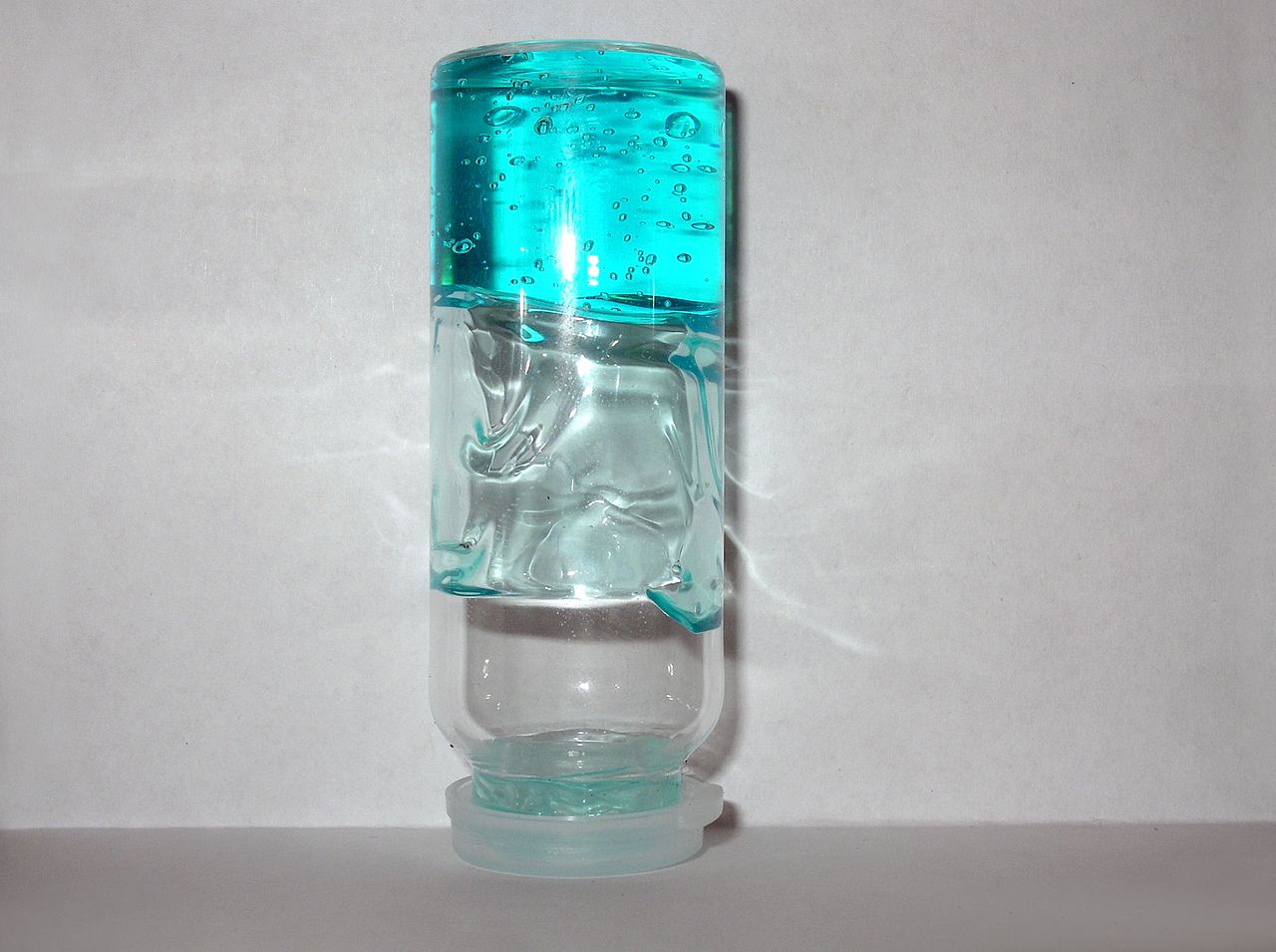



Structure and physical properties
On the microscopic level a gel consists of a web of polymer chains or particles that are linked together, either by chemical bonds or by weaker physical attractions. These crosslinks create an elastic framework within which the liquid is trapped, producing viscoelastic behaviour: the material deforms under long-term load like a viscous liquid but springs back under short deformations like an elastic solid. The role of crosslinking is discussed further at network formation and the stabilising interactions are outlined at interaction types. Gels are classed among colloids because they combine dispersed and continuous phases; an overview of colloidal systems is available at colloid basics.
Types and composition
Gels are named for their dominant solvent and structure. Common categories include hydrogels (water-based), organogels (organic solvent-based), and specialty forms such as xerogels and aerogels produced by drying techniques. The terms and how gels are prepared are summarized at preparation methods, and the distinction between continuous and dispersed phases is explained at phase roles.
Examples and uses
Practical examples are familiar: culinary jellies and gelatin desserts, plant-derived agar used in cooking and microbiology, contact lenses made from soft hydrogels, silica gels used as desiccants, and synthetic slimes used in toys and education. Specific examples and applications can be explored at food gels, agar uses, and hydrogel biomaterials.
History and notable facts
The study of gels grew from 19th-century investigations of colloids and gelatinous substances; the word "gel" is related to terms for congealing and solidification. Over time, advances in polymer chemistry and materials science expanded gels into engineered biomaterials and advanced porous materials. For historical context and recent developments see historical notes.
Practical considerations and distinctions
Gels differ from related materials such as sols (liquid suspensions), emulsions, and crystalline solids by the presence of a percolating network. Many gels show thixotropy (shear-thinning and recovery) and undergo sol–gel transitions in response to temperature, pH, or chemical triggers, which makes them useful as controlled-release media, scaffolds for tissue engineering, and rheology modifiers. For further reading consult the linked topics above for technical details and applications.
Additional resources: general overview, network structure, crosslink chemistry, colloid theory, synthesis, phase description, culinary gels, agar, contact lenses, historical overview
Related articles
Author
AlegsaOnline.com Gel (semi-solid colloidal material) Leandro Alegsa
URL: https://en.alegsaonline.com/art/37855