
Glass transition (Tg): the change from rigid to rubbery in amorphous materials
The glass transition is a reversible, temperature-dependent change in amorphous materials from a hard, brittle state to a softer, rubbery or viscous state. Key concepts, measurement, factors, and applications.
The glass transition describes how an amorphous material changes its mechanical and thermal behavior as temperature changes. In simple terms, a material below its glass transition temperature (Tg) behaves like a hard, brittle solid; above Tg it becomes softer, rubbery or viscous and can flow on long time scales. This phenomenon is most important for materials that lack a long-range crystalline order, commonly called amorphous solids, and is central to polymer science, glass technology and many branches of materials engineering.
Image gallery
5 Images



What changes at Tg
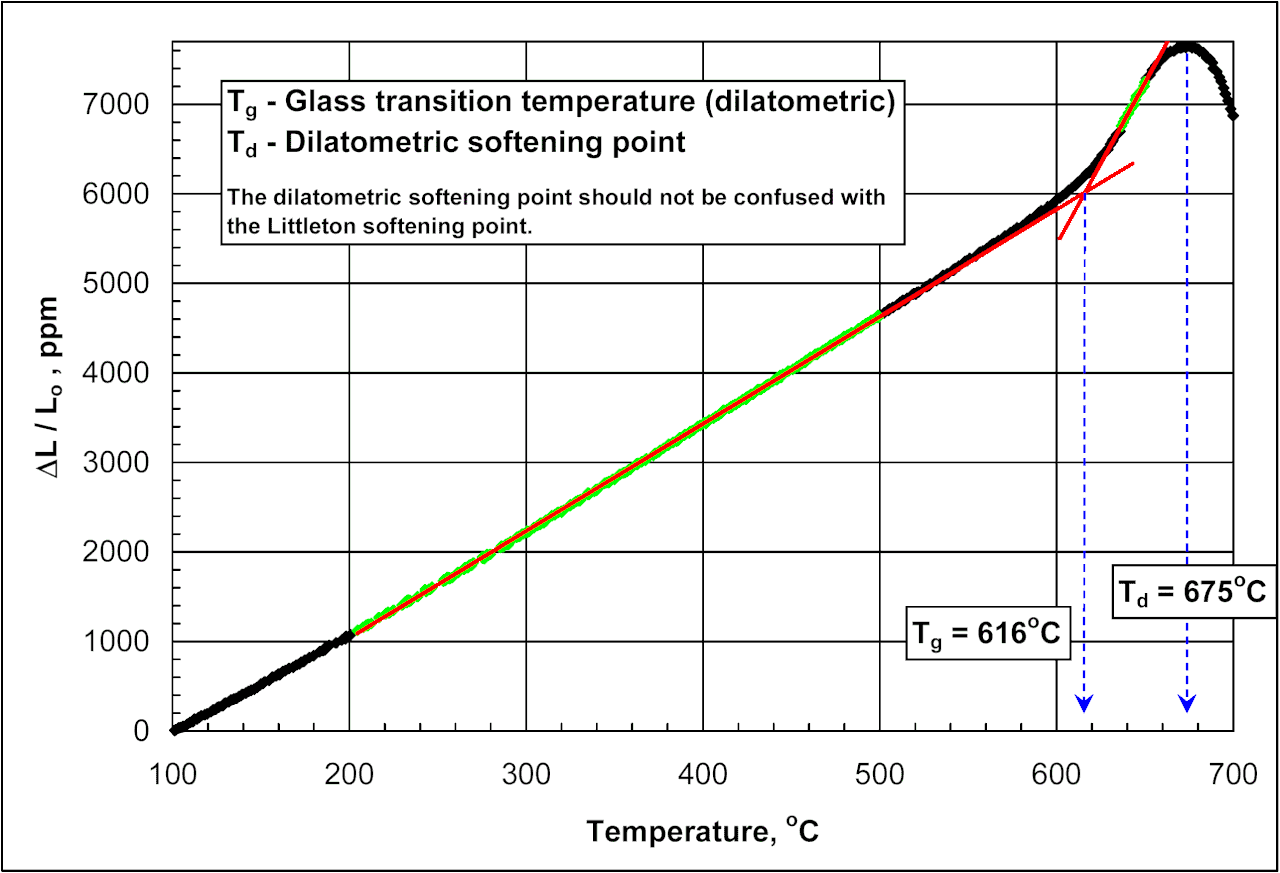
The glass transition is not a sharp equilibrium phase change with a latent heat like melting; instead it is a kinetic crossover tied to molecular mobility and relaxation times. As temperature increases through Tg, typical observables include a step change in heat capacity, a large drop in shear modulus, a marked decrease in viscosity, and a change in thermal expansion coefficient. A polymer above Tg often shows rubbery elasticity, whereas below Tg it appears brittle and glass-like. Because the transition depends on how fast the material is probed or cooled, reported Tg values are operational and can shift with timescale and thermal history.
How Tg is measured
- Differential scanning calorimetry (DSC): detects the heat-capacity step at Tg.
- Dynamic mechanical analysis (DMA): shows the modulus drop and mechanical damping peak.
- Thermomechanical analysis (TMA) / dilatometry: reveals changes in thermal expansion.
- Viscosity and dielectric spectroscopy: probe molecular relaxation rates and flow behavior.
These techniques emphasize different aspects of the transition, so reported Tg values should always cite the measurement method. The material commonly called a glass is an amorphous solid that has been kinetically frozen below its Tg by cooling (vitrification).
Factors that affect Tg
Tg depends on molecular structure and interactions. For polymers and organic glasses, higher chain stiffness, stronger intermolecular forces, and crosslinking raise Tg; adding small molecule plasticizers or solvents lowers it by increasing free volume and segmental mobility. Molecular weight and the presence of bulky side groups also influence Tg. For inorganic glasses (for example silicates), composition and network connectivity control the transition temperature. Many materials that can crystallize have a melting temperature Tm above Tg; in practice Tg is almost always lower than the crystalline melting temperature when a crystalline state exists.
Applications and significance
Understanding Tg is crucial in polymer processing, product performance and stability: it determines service temperature ranges, impact resistance, and the behavior of coatings, adhesives and packaging. In pharmaceuticals, controlling the glassy state of amorphous drugs affects solubility and shelf life. Geology and volcanology also use vitrification concepts when describing natural glasses and the cooling of lava. Some thermosetting plastics do not melt before they decompose, but they still exhibit a glass transition that governs their mechanical properties.
Distinctions and notable points
Unlike melting, the glass transition is time- and rate-dependent; researchers sometimes debate whether it represents an underlying thermodynamic phase change or a purely kinetic arrest. Practical rules remain robust: Tg marks where long-range molecular rearrangements become too slow to equilibrate on experimental timescales, and it guides the design and processing of materials across many industries. For clarity, terms often used in descriptions include vitrification for forming a glass by cooling a liquid and the observation that below Tg a material behaves as a solid while above Tg it may behave as a rubbery or viscous material.
For additional technical background and experimental protocols, see standard texts in polymer science and glass technology or sources linked from introductory materials: amorphous solids overview, mechanical properties, and measurement guides such as DSC and DMA notes.
Related articles
Author
AlegsaOnline.com Glass transition (Tg): the change from rigid to rubbery in amorphous materials Leandro Alegsa
URL: https://en.alegsaonline.com/art/39125