
Dungan language: a Sinitic tongue of Central Asian Hui descendants
Dungan is a variety of Mandarin spoken by the Dungan/Hui diaspora in Central Asia and Xinjiang. It is tonal and analytic, uses a Cyrillic script, and preserves regional Gansu–Shaanxi features plus Arabic and Persian loanwords.
Overview: The Dungan language is the vernacular of the Dungan people, an ethnic group whose ancestors migrated from northwest China to Central Asia. Most speakers live in parts of the former Soviet Union and in western China’s Xinjiang region. The community refers to its speech as the Hui language and traces its roots to Muslim communities and to people who were descendants of the Chinese Muslim Hui people.
Image gallery
2 Images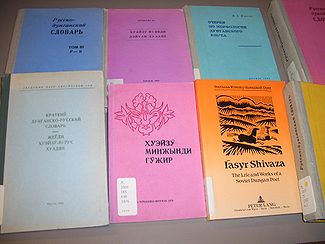

Characteristics
Linguistically, Dungan is considered a daughter language of Mandarin Chinese, reflecting the forms of Mandarin once spoken in parts of northwest China. Its core phonology and grammar remain recognizably Sinitic: it is tonal and largely analytic, relying on word order and particles rather than inflection. Dungan shows many features inherited from regional spoken varieties, especially those of Gansu and Shaanxi, and these local dialects help explain why speakers of those mainland varieties often have a degree of mutual intelligibility with Dungan.
Writing system and vocabulary
Unlike most varieties of Chinese that use Chinese characters, Dungan has been written in a Cyrillic-based orthography since the early 20th century; this reflects Soviet language planning and the practical needs of literacy in Cyrillic-dominant places. The lexicon retains a strong Sinitic core but incorporates religious, household, and cultural words borrowed from languages associated with Islamic and Central Asian life. Notably, Dungan contains more borrowings from Arabic and Persian than modern standard Mandarin, and many of these loanwords continue in everyday use. It also preserves some older terms that have fallen out of use in contemporary Standard Chinese.
History and distribution
The origins of Dungan are tied to migration and social change. Members of the Hui Muslim population moved westward in different historical periods; those who settled in Central Asia adapted their speech to new contexts while retaining a Mandarin-derived core. Over time, isolated development, contact with Turkic languages and Russian, and state policies produced the distinct Dungan identity and language seen today. Communities are concentrated in rural and urban pockets, where the language functions as the primary home language for many families.
Status, use, and literacy
Dungan serves as a community and cultural language: it appears in oral storytelling, everyday conversation, local radio and some print, and in religious and family settings. Educational and official uses vary by country and era; literacy programs and modern media have used the Cyrillic script to teach reading and writing. Because Dungan speakers live across national borders, language maintenance faces pressures from dominant state languages, but the speech continues to be an important marker of group identity.
Notable distinctions
- Dungan is a Sinitic language spoken mainly outside China, making it a prominent example of a diaspora Chinese variety.
- Its Cyrillic orthography and additional Central Asian and Islamic vocabulary set it apart from inland Mandarin varieties.
- Despite divergences, significant intelligibility remains with some northwest Mandarin dialects and speakers sometimes can understand one another, illustrating continuing linguistic ties.
For readers who wish to explore further topics—community history, comparative phonology, or contemporary language policy—each of the items above can be a starting point for deeper study.
Dungan language — Dungan people — ethnic group — former Soviet Union — Xinjiang — descendants — Hui people — daughter language — Mandarin Chinese — Gansu — Shaanxi — dialects — mutual intelligibility — tonal — analytic — Chinese characters — Arabic — Persian — loanwords — terms — Standard Chinese
Questions and answers
Q: What is the Dungan language?
A: The Dungan language is the native language of the Dungan people.
Q: Who are the Dungan people?
A: The Dungan people are an ethnic group living in regions of the former Soviet Union and Xinjiang who are descendants of Hui people.
Q: What do the Dungan call their language?
A: The Dungan call their own language the Hui language.
Q: What is the Dungan language based on?
A: The Dungan language is a daughter language of Mandarin Chinese based on Gansu and Shaanxi dialects.
Q: Can speakers of both Gansu and Shaanxi dialects understand each other in Dungan?
A: Yes, speakers of both Gansu and Shaanxi dialects can largely understand each other in Dungan. This is called mutual intelligibility.
Q: Does Dungan have any similarities with Chinese?
A: Yes, like Chinese, Dungan is both tonal and analytic.
Q: How does the writing system of Dungan differ from that of Chinese?
A: Dungan is written in Cyrillic instead of Chinese characters. Additionally, there are differences in vocabulary, with Dungan having more Arabic and Persian loanwords and several terms no longer used in Standard Chinese.
Related articles
Author
AlegsaOnline.com Dungan language: a Sinitic tongue of Central Asian Hui descendants Leandro Alegsa
URL: https://en.alegsaonline.com/art/29238
Sources
- everything.explained.today : "Dungan people explained"