
Common basilisk (Basiliscus basiliscus)
A medium-to-large neotropical lizard known for its ability to run across water. Found in lowland rainforests near rivers from Central to South America; notable for crest, long tail, and specialized hind feet.
Overview
The common basilisk (Basiliscus basiliscus) is a lizard of the family Corytophanidae that inhabits wet tropical forests and river corridors. Widely known as the "Jesus Christ lizard," it has attracted attention for its remarkable locomotor ability to sprint briefly across the surface of water.
Image gallery
4 Images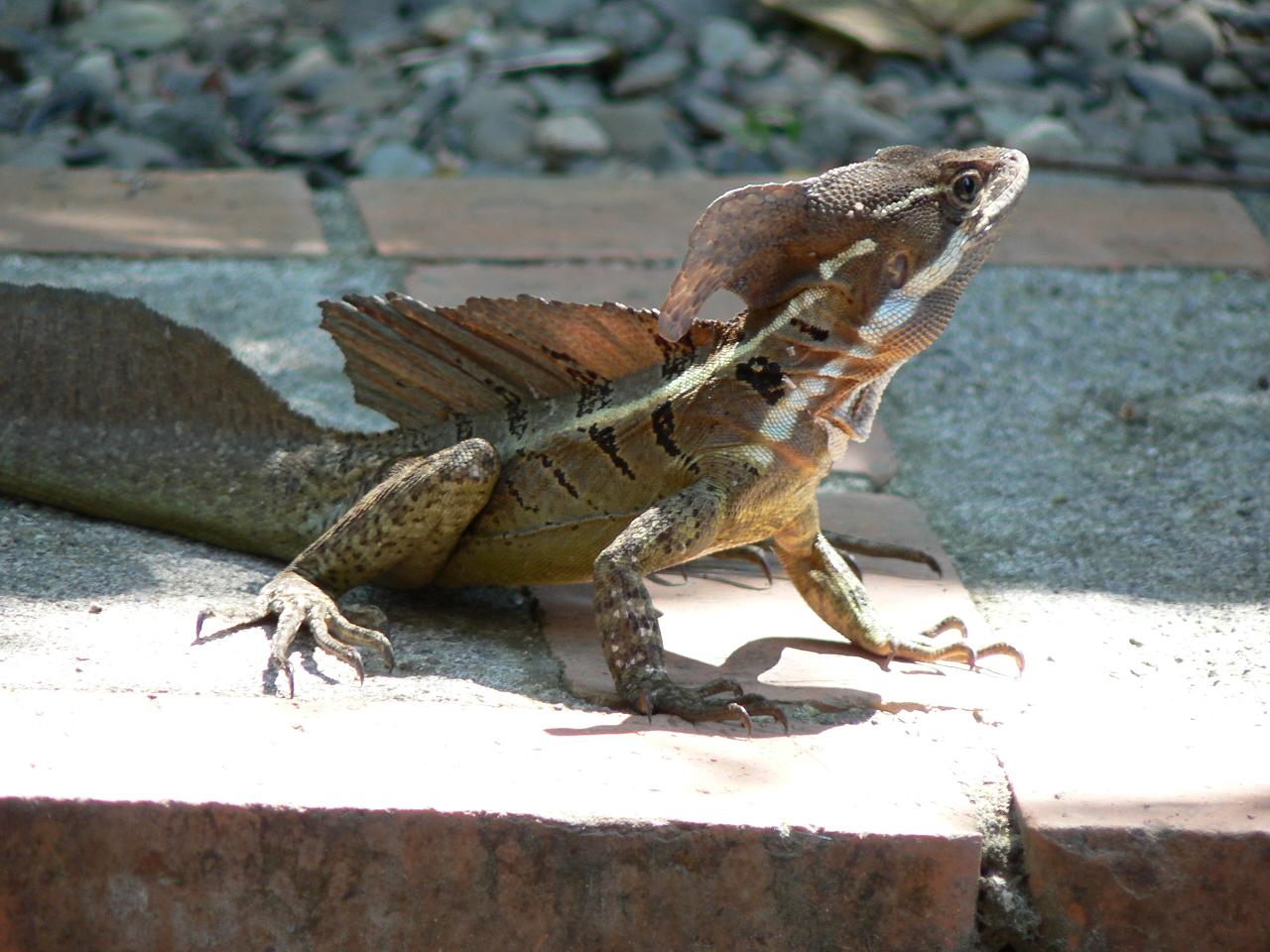


Physical characteristics
Basilisks are slender, agile reptiles with long tails and well-developed crests—especially in males, which often display taller head and dorsal crests used in display and signaling. They have large hind feet edged with scales and skin fringes that expand during rapid movement, increasing surface area and helping to support brief runs on water.
Habitat and distribution
These lizards favor riverbanks, flooded forest edges and lowland rainforest close to flowing water. Their native range includes parts of Central America and northern South America, where they exploit the interface between terrestrial and aquatic environments for feeding and escape.
Behavior and ecology
Diurnal and primarily insectivorous, basilisks feed on insects, other small animals and some plant matter. When threatened they use a combination of sprinting, climbing and diving to evade predators. Their signature behavior—briefly running on water—is powered by rapid strides, specialized feet and an upright running posture; juveniles are especially adept at this maneuver. They are also capable swimmers and will dive to avoid capture (run across water).
Reproduction, role and conservation
Basilisks are oviparous and deposit clutches of eggs in warm, moist substrates near water. As mid-level predators they help control insect populations and may assist in seed dispersal when consuming fruit. While not globally threatened as a species, local populations can be affected by habitat loss, river pollution and deforestation.
Notable distinctions and related species
The common basilisk is one of several species in the genus Basiliscus; it is often compared to the striped basilisk and the green basilisk. Its combination of crested ornamentation, semi-arboreal habits and the ability to sprint on water distinguishes it from many other lizards and makes it a subject of ecological and biomechanical study.
- Distinctive adaptations: large hind feet, skin fringes, long tail for balance.
- Diet: primarily insects and small vertebrates; sometimes fruit.
- Behavior: diurnal, territorial displays by males, rapid escape responses.
Related articles
Author
AlegsaOnline.com Common basilisk (Basiliscus basiliscus) Leandro Alegsa
URL: https://en.alegsaonline.com/art/21990