
Common chimpanzee (Pan troglodytes)
An encyclopedic overview of the common chimpanzee: appearance, behaviour, cognition, tool use, social structure, distribution, conservation status and its relationship to humans.
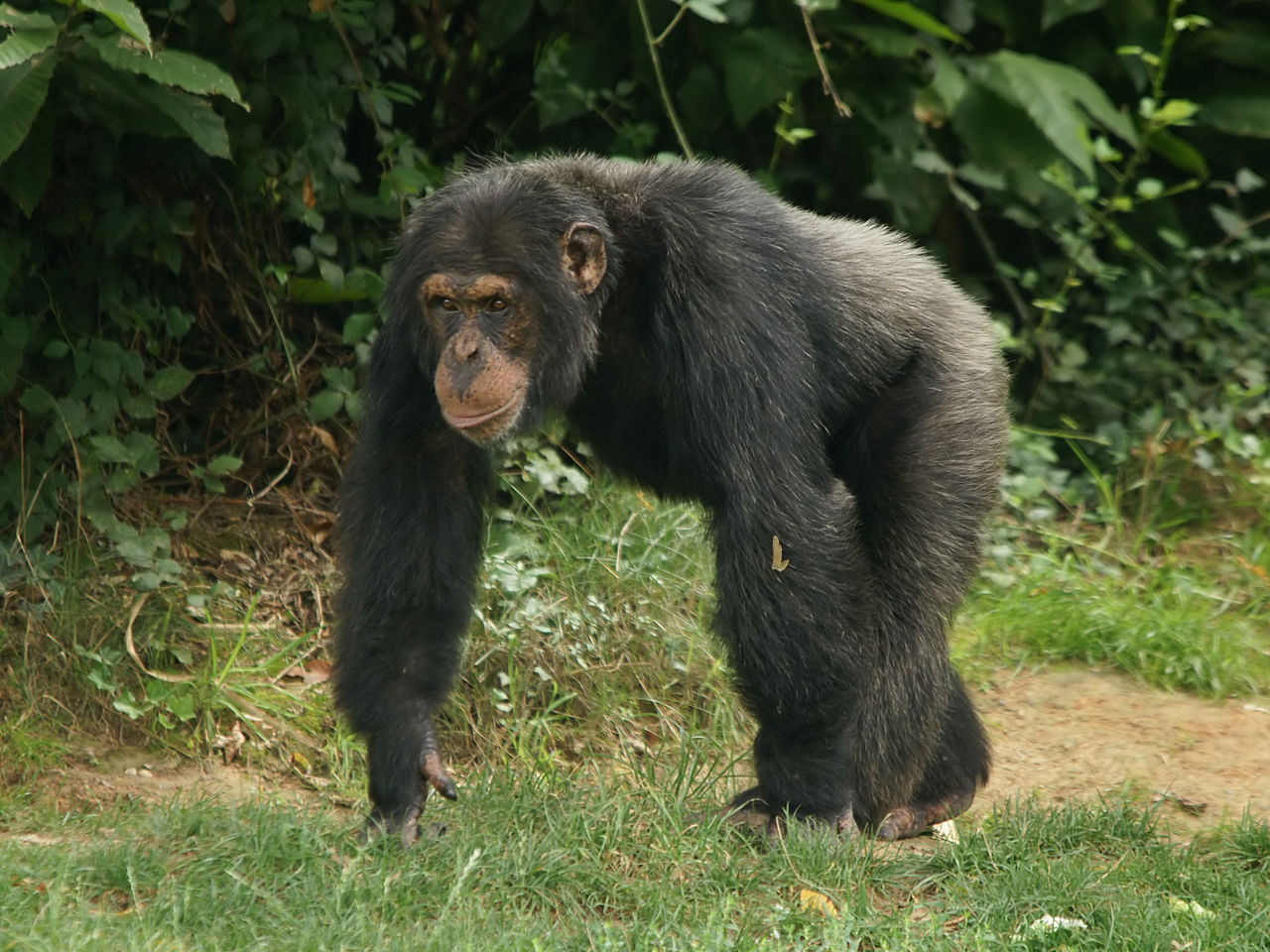
The common chimpanzee (Pan troglodytes) is one of two living species in the genus Pan, the other being the bonobo (Pan paniscus). Often shortened to "chimpanzee" or "chimp," this great ape is a close evolutionary relative of modern humans: fossil evidence and genetic studies show chimpanzees and humans share a recent common ancestor. Wild populations live across forested and mosaic savannah landscapes in parts of West Africa and Central Africa, where they occupy a variety of habitats from dense tropical forest to woodland-edge environments.
Image gallery
10 Images



Physical characteristics and life cycle
Common chimpanzees are robust apes with adult body sizes that vary by population and sex. Individuals often weigh between about 40 and 65 kg and stand roughly 1.2–1.6 m tall when upright. Their faces are generally bare, with prominent brows and a range of hair coloration across individuals and regions. Reproduction follows a slow life history: gestation lasts around eight months (gestation), infants are typically weaned at about three years, and juveniles reach sexual maturity near eight to ten years of age (puberty). Lifespans in captivity can approach five decades; wild lifespans are shorter on average, influenced by disease and predation.
Behaviour, society and cognition
Chimpanzees live in multi-male, multi-female communities that can number from a few dozen to more than a hundred individuals, although daily activities usually occur in smaller foraging parties. Social life is complex and often described as male-centered: many groups exhibit a dominance system where high-ranking males play a prominent role (male), and relationships are structured through alliances, grooming and ritualised displays (social hierarchy). Conflict does occur, but chimpanzees also use reconciliation, coalition-building and nonviolent signals to manage disputes.
Tool use, hunting and diet
One of the most notable traits of common chimpanzees is their habitual use and manufacture of tools. Across populations they modify sticks, leaves and stones to extract termites, ants and honey, to process food, and sometimes to access water. Some communities have been observed fashioning pointed sticks to hunt small mammals, such as tree-dwelling primates (bushbaby), demonstrating culturally transmitted techniques. Their diet is omnivorous with a strong plant component—fruit, leaves, flowers and seeds—but also includes insects and vertebrate prey taken during coordinated hunts.
Distribution, threats and conservation
The species is listed as endangered on the IUCN Red List (IUCN) and faces substantial pressures across its range. Major threats are habitat loss and fragmentation from agriculture and logging, illegal hunting for bushmeat, and infectious disease. Estimates of wild population size vary; recent surveys suggest numbers are in the low hundreds of thousands but have declined or become locally extirpated in many regions. Conservation strategies combine protected areas, anti-poaching efforts, community-based programs and public health measures to reduce disease transmission.
Scientific and cultural significance
Chimpanzees play a central role in studies of primate behaviour, cognition and human evolution because of their cognitive capacities, social complexity and genetic proximity to humans. Research on their tool use, problem-solving and communication informs debates on culture and language precursors. At the same time, ethical and conservation concerns shape how researchers interact with populations and how societies prioritize their protection.
Quick facts
- Taxonomy: Genus Pan; two extant species including the bonobo and the common chimpanzee (both species).
- Range: West Africa to Central Africa.
- Notable behaviours: tool manufacture, cooperative hunting, complex social bonds.
- Conservation: listed by IUCN; threats include habitat destruction, poaching and disease.
For further reading on specific populations, field studies and conservation programs, consult regionally focused resources and the primary literature; many long-term research sites publish summaries and management recommendations for preserving chimpanzee diversity and habitat.
Questions and answers
Q: What is the scientific name of the common chimpanzee?
A: The scientific name of the common chimpanzee is Pan troglodytes.
Q: How much does a common chimpanzee weigh?
A: A common chimpanzee typically weighs between 40 and 65 kg (88 and 143 lb).
Q: How long is the gestation period for a common chimpanzee?
A: The gestation period for a common chimpanzee is eight months.
Q: At what age does an infant chimp reach puberty?
A: An infant chimp reaches puberty at around 8 to 10 years old.
Q: What is the average lifespan of a captive common chimpanzee?
A: The average lifespan of a captive common chimpanzee is about 50 years.
Q: What types of tools do chimpanzees use?
A: Chimpanzees are known to use sticks, rocks, grass, and leaves as tools for getting honey, termites, ants, nuts, and water. They have also been seen making sharpened sticks in order to spear Senegal bushbabies out of small holes in trees.
Q: Is the species listed on IUCN Red List as an endangered species?
A: Yes, the common chimpanzee is listed on IUCN Red List as an endangered species with estimated population numbers ranging from 170,000 to 300,000 individuals.
Related articles
Author
AlegsaOnline.com Common chimpanzee (Pan troglodytes) Leandro Alegsa
URL: https://en.alegsaonline.com/art/21995
Sources
- commons.wikimedia.org : Common chimpanzee
- janegoodall.org : "Chimpanzee Central"
- pbs.org : "Jane Goodall's Wild Chimpanzees"
- janegoodall.org : Tool use