
Central America: geography, people, history, and significance
Region connecting North and South America; seven countries with diverse landscapes, cultures, languages and a rich history from ancient civilizations to modern economies.
Overview
Central America is the narrow land bridge linking the continents of the Americas. This region lies between southern Mexico and the northwestern edge of South America and includes the isthmus, adjacent Pacific and Caribbean coasts, and nearby islands. Geographers refer to it as a distinct region of the Americas, noted for its strategic location and ecological variety. The land area of Central America is on the order of half a million square kilometers, and its population numbers in the tens of millions, concentrated unevenly in highland cities and coastal plains.
Image gallery
10 Images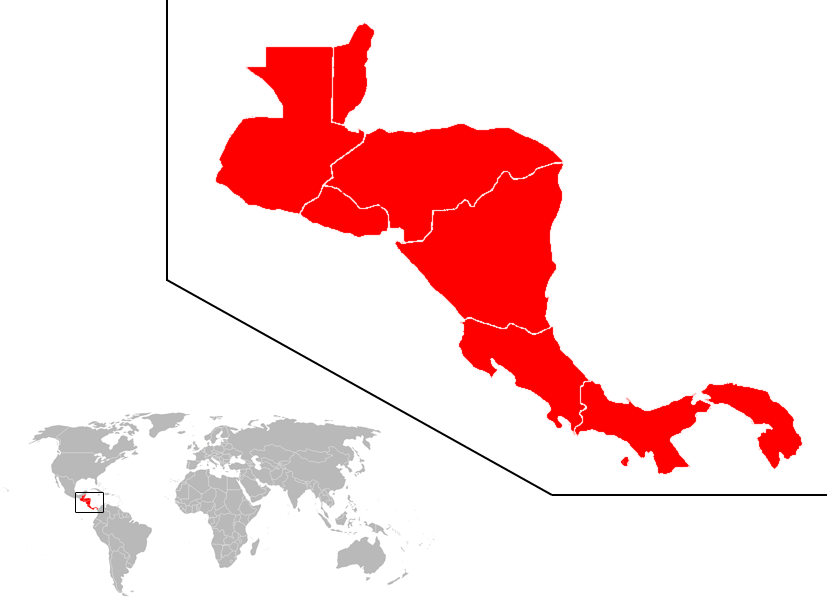


Geography and environment
The region is dominated by a spine of mountains and volcanic ranges that run roughly northwest–southeast, interrupted by fertile valleys and coastal lowlands. It has two coasts, facing the Caribbean Sea and the Pacific Ocean, which yields notable differences in climate, biodiversity and economic activity. Tropical rainforests, cloud forests, mangroves and coral reefs are common; Central America is recognized as a global biodiversity hotspot because of its endemic species and migratory corridors. The area is also seismically active, with frequent earthquakes and many volcanoes.
Countries and demographics
Central America consists of seven independent states. Listed roughly from largest to smallest by area, they are:
 Nicaragua — the largest country by land area in the region.
 Honduras — with extensive Caribbean coastline and mountainous interior.
 Guatemala — the most populous country in the region and home to the largest Central American city.
 Panama — at the southeastern end of the isthmus, notable for the Panama Canal.
 Costa Rica — prominent for conservation and ecotourism.
 Belize — the only Central American state with English as its official language.
 El Salvador — the smallest by area and one of the most densely populated.


History and peoples
Human settlement in the region dates back thousands of years and includes advanced pre-Columbian cultures, most famously the Maya civilization in the highlands and lowlands of the northern isthmus. European contact in the 16th century led to Spanish colonization of most of the area, while British influence persisted along the Caribbean coast and later shaped Belize. After independence movements in the early 19th century, several states briefly formed a federal republic before becoming separate nations. Indigenous groups, descendants of African slaves, mestizo majorities and more recent immigrant communities together create a multicultural social fabric.
Languages and culture
Spanish is the predominant language in six of the seven countries; Spanish is the lingua franca in most public life. In Belize, English is the official language, though many residents are bilingual in Spanish and other local languages. Indigenous languages such as Mayan tongues, Garifuna, Miskito and others remain vital in many communities. Cultural expression blends indigenous, European and African influences in music, cuisine, religious practice and festivals.
Economy, transport and global importance
Economies in the region vary: some countries rely on agriculture and remittances, others have diversified into services, manufacturing and tourism. The isthmus is globally important because of maritime routes and the Panama Canal, which transforms international shipping between oceans. Biodiversity and natural landscapes make conservation and ecotourism significant economic and policy concerns. The region also faces shared challenges such as vulnerability to hurricanes, climate change impacts, inequality and governance issues.
Notable distinctions and links
Central America is often defined by both geography and cultural-historical ties rather than strict political boundaries. Notable distinctions include the Spanish-speaking majority versus English-speaking Belize, the Maya cultural legacy in Guatemala, the canal and transoceanic role of Panama, and the region's role as a biological corridor. For further reading consult general regional summaries and country profiles via regional portals and atlases: Spanish language resources, general geography introductions at regional sites, and encyclopedia entries on the Americas. Additional country-specific information is available through national publications and travel and conservation organizations (see portals identified by regional links, northern border resources, Caribbean references, and other repositories at global data, country lists, Honduran sources, Costa Rican resources, Salvadoran material, and broader language or demographic studies at urban centers and migration overviews at language and migration studies.)
Images and illustrative maps of the region appear above: 
Questions and answers
Q: What is Central America?
A: Central America is the central geographic region of the continent known as the Americas. It goes from Mexico in the north-west, to Panama in the south-east. It also comprises the Caribbean Sea and its countries.
Q: How large is Central America?
A: Central America has an area of 524,000 square kilometers (202,000 sq mi). It is almost 0.1% of the Earth's surface.
Q: What are the countries in Central America?
A: The countries in Central America are Nicaragua, Honduras, Guatemala, Panama, Costa Rica, Belize and El Salvador.
Q: Which country has the largest population by country in Central America?
A: Guatemala has the largest population by country in Central America with more than 14 million people. They also have the most populated city in Central America which is Guatemala City.
Q: What language do most people speak in Central America?
A: Most people speak Spanish as their official language with Belize being a non-Spanish speaking country whose official language is English although there are now at least 195,597 (62.8%) of people who speak Spanish there too. Some people also speak indigenous or creole languages like Maya languages.
Q: How dense is population density in Central American countries?
A: Population density across all countries of Cental American averages 77 people per square kilometer
Related articles
Author
AlegsaOnline.com Central America: geography, people, history, and significance Leandro Alegsa
URL: https://en.alegsaonline.com/art/18006
Sources
- eprints.ucm.es : Demografía de la lengua española
- webng.com : webng.com/jerbarker/home/eia-toolkit/downloads/Van04/RojasVancouver.pdf
- rainforests.mongabay.com : "Belize Deforestation Rates and Related Forestry Figures"
- rainforests.mongabay.com : "Costa Rica Deforestation Rates and Related Forestry Figures"
- rainforests.mongabay.com : "El Salvador Deforestation Rates and Related Forestry Figures"
- rainforests.mongabay.com : "Guatemala Deforestation Rates and Related Forestry Figures"
- rainforests.mongabay.com : "Honduras Deforestation Rates and Related Forestry Figures"
- rainforests.mongabay.com : "Nicaragua Deforestation Rates and Related Forestry Figures"
- rainforests.mongabay.com : "Panama Deforestation Rates and Related Forestry Figures"