
Cherokee people
The Cherokee are an Indigenous people of the southeastern United States with a distinct language, social structures, history of forced removal, and three federally recognized nations today.
Overview
The Cherokee are an Indigenous people of North America who historically inhabited lands in what is now the eastern and southeastern United States. They are one of the groups broadly described among the historic Five Civilized Tribes by European Americans. The Cherokee refer to themselves by names derived from their own language (for example, Aniyvwiya) and are part of the wider family of Native Americans that Europeans encountered in the 16th century and later.
Image gallery
10 Images





Society and material culture
Traditional Cherokee settlements included permanent towns with houses built from locally available materials such as wood, bark, and earth. These were not nomadic tipis but fixed dwellings, and social life centered on family households, clan relations and town councils. Agriculture—especially the cultivation of corn, beans and squash—was important alongside hunting, fishing and gathering. Craftsmanship in pottery, basketry and carved wood was widely practiced.
Language and the syllabary
The Cherokee language is part of the Iroquoian language family and remained an oral language for much of its history. In the early 19th century a silversmith named Sequoyah created a syllabary—a set of written symbols representing syllables rather than individual letters—that made literacy rapidly accessible to many Cherokee. The syllabary enabled newspapers, legal documents, and bilingual education in the 19th century and remains an important part of language revitalization efforts today.
Political organization and leadership
Cherokee political life historically combined town-level councils and broader national gatherings. A traditional dual leadership model, often described in sources as different roles for wartime and peacetime leaders, coexisted with clan and council authority. In the 19th century Cherokee society became increasingly centralized under a written constitution modeled in part on U.S. institutions. Prominent leaders such as John Ross sought to represent Cherokee interests in treaty negotiations and to resist forced removal during a period of intense pressure from state and federal governments.
Removal, displacement, and modern nations
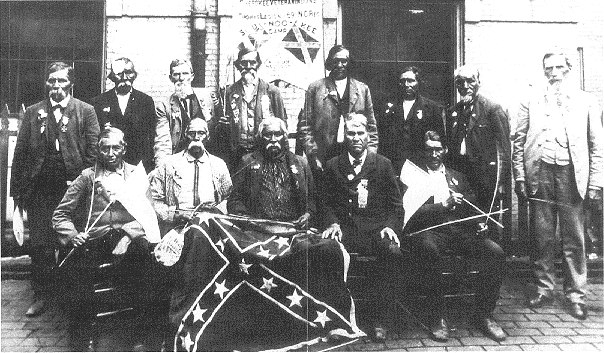
During the 1830s the U.S. government implemented policies that led to the forced removal of many Cherokee people to lands west of the Mississippi River. Large numbers were relocated to Indian Territory (present-day Oklahoma), and others were displaced into interior regions described in older accounts, including the Ozark hills. A portion of the people evaded removal and today form the Eastern Band in the Appalachian region.
- Federally recognized Cherokee nations include:
- Cherokee Nation (based in Oklahoma)
- Eastern Band of Cherokee Indians (North Carolina)
- United Keetoowah Band of Cherokee Indians (Oklahoma)
Contemporary life and legacy
Today Cherokee communities maintain cultural programs, language classes, and legal and political institutions. Cherokee artists, musicians and scholars contribute to broader public life, while tribal governments provide services such as education, healthcare and cultural preservation. The Cherokee syllabary and a living oral tradition help sustain identity across generations.
Notable facts: The adoption of a written syllabary in the early 19th century led to unusually high literacy rates in Cherokee communities for that period. Debates over treaties and removal in the 19th century had long-term effects on Cherokee society and are central to the tribe's modern history.
For further reading and sources, consult historical summaries, tribal websites and language revitalization projects that document Cherokee history and contemporary developments. See also resources on the Native American experience in colonial and early United States history and regional studies of the southeastern United States.
Related articles
Author
AlegsaOnline.com Cherokee people Leandro Alegsa
URL: https://en.alegsaonline.com/art/19293
Sources
- commons.wikimedia.org : Cherokee
- indians.org : Indians.org
- ncsl.org : National Conference of State Legislators