
Ozarks (Ozark Plateau) — geography, geology, and cultural history
Highland region of the central United States spanning Missouri, Arkansas, Oklahoma and Kansas, known for its plateau-and-mountain topography, karst features, forests, and distinct regional culture.
The Ozarks, also called the Ozark Plateau or Ozark Mountains, form a broad highland area in the central United States. The region extends across much of southern Missouri, large parts of northern and northwestern Arkansas, and into northeast Oklahoma and the extreme southeast of Kansas. As both a physiographic and cultural region, the Ozarks are frequently described in terms of their geology and the rural communities that developed there (central U.S. context, cultural overview).
Image gallery
10 Images


Physical characteristics
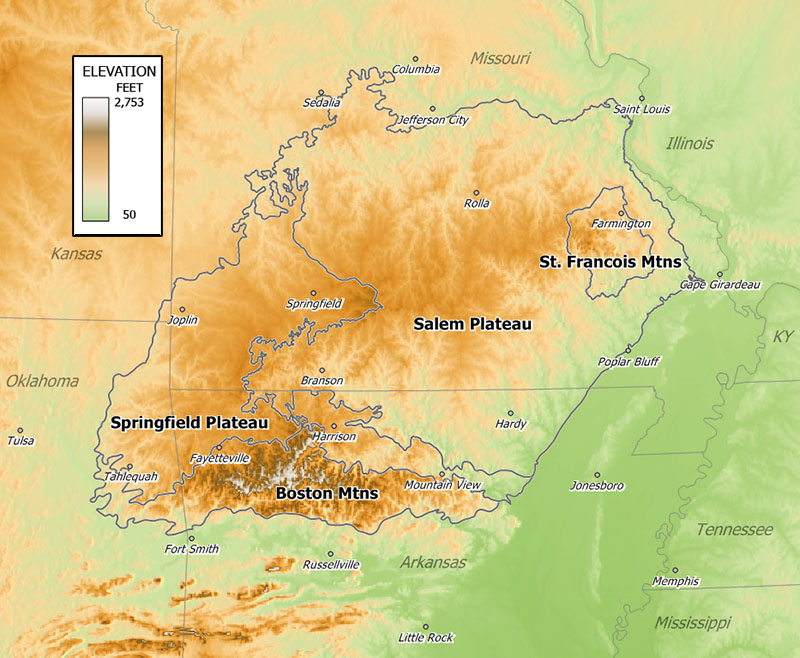
The landscape consists of dissected plateaus, steep ridges, and isolated mountains rather than a single continuous mountain chain. Bedrock of ancient sedimentary rocks—limestone, dolomite, and sandstone—has been sculpted by erosion to produce deep valleys, bluffs, caves and numerous springs. Because much of the subsurface is soluble, karst features (sinkholes, caverns, clear springs) are common and supply many rivers and streams that drain the region. The combination of upland forests, rocky outcrops and river valleys gives the area a varied topography and habitats.
Name and human history
The name "Ozarks" is derived from the French phrase Aux Arcs, applied in the colonial era and linked to references to the native Quapaw or related groups (Quapaw). European exploration, settlement, and later American expansion shaped land use patterns: small farms, timber harvesting, and mining appeared alongside long-standing Indigenous presence. The region retains a distinct cultural identity rooted in folk music, crafts, and local traditions (cultural history).
Ecology and natural resources
Forests of oak, hickory and pine cover much of the Ozarks and support diverse wildlife. The karst hydrology creates large springs and clear streams prized for freshwater biodiversity. Natural resources include timber, freshwater fisheries, and localized mineral deposits; conservation and sustainable management are ongoing concerns as recreation and development increase (geologic and hydrologic studies).
Uses, recreation, and economic importance
Outdoor recreation—hiking, boating, fishing, cave exploration and hunting—now contributes significantly to local economies. Small towns and regional centers serve as gateways to state parks, reservoirs and conservation areas. Agriculture remains important in upland valleys, while tourism and service industries have grown around scenic attractions and cultural festivals (regional tourism).
Regional distinctions and notable facts
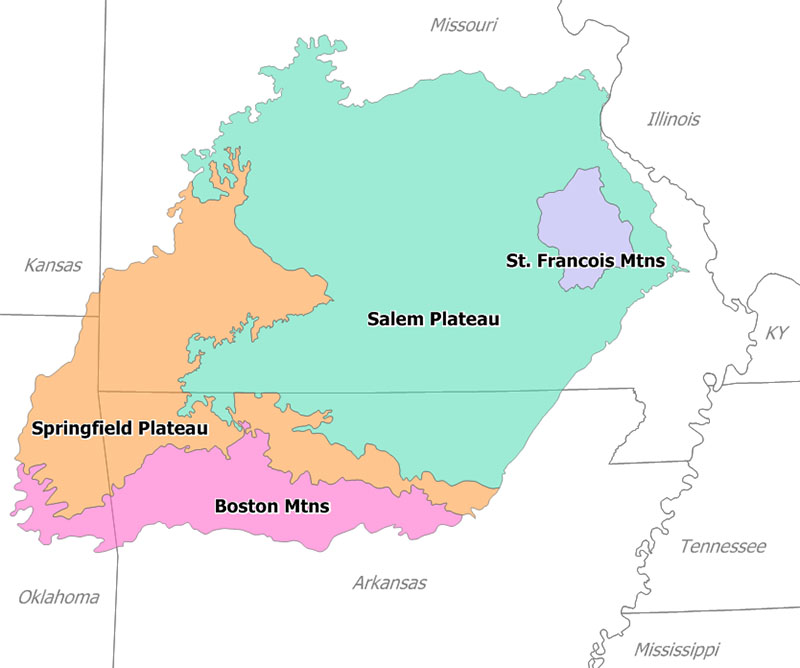
The Ozarks are often distinguished from the nearby Appalachian system by origin and structure: the Ozark highlands are an uplifted plateau deeply eroded into hills and valleys rather than folded mountains. Subregions include the Boston Mountains, Salem Plateau and Springfield Plateau, each with characteristic rock types and landforms. Because the Ozarks cross multiple state lines, their identity is both geological and cultural, linking communities across northwest and northeast corridors of settlement and movement (southeast margins, Kansas borderlands).
Related articles
Author
AlegsaOnline.com Ozarks (Ozark Plateau) — geography, geology, and cultural history Leandro Alegsa
URL: https://en.alegsaonline.com/art/73856
Sources
- fs.usda.gov : "Ozark-St. Francis National Forest; Forest Information"