
Five Civilized Tribes: Cherokee, Chickasaw, Choctaw, Creek (Muscogee) and Seminole
Collective name used by European-American settlers for five Southeastern Native nations—Cherokee, Chickasaw, Choctaw, Creek (Muscogee) and Seminole—recognized for adopting many colonial institutions.
The phrase "Five Civilized Tribes" refers to a group of five Native American nations historically located in the southeastern United States: the Cherokee, Chickasaw, Choctaw, the Creek or Muscogee, and the Seminole. The term originated with European-American settlers who observed that these nations had adopted a range of Anglo-American practices such as written constitutions, Christianity, settled farming, centralized leadership, and commercial relations with neighbors. It is important to note that the label reflects a colonial judgment and can be misleading or pejorative in contemporary contexts.
Image gallery
4 Images

Characteristics and adaptation
Members of these nations engaged in various forms of cultural exchange that included learning English, developing written legal codes and governments modeled in part on U.S. institutions, embracing market agriculture, and in some cases establishing schools and newspapers. A notable cultural innovation was the Cherokee syllabary, created by Sequoyah, which enabled widespread literacy in the Cherokee language. At the same time, each nation retained distinct languages, ceremonies, kinship systems, and political traditions rooted in centuries of Indigenous history.
Historical development and removal
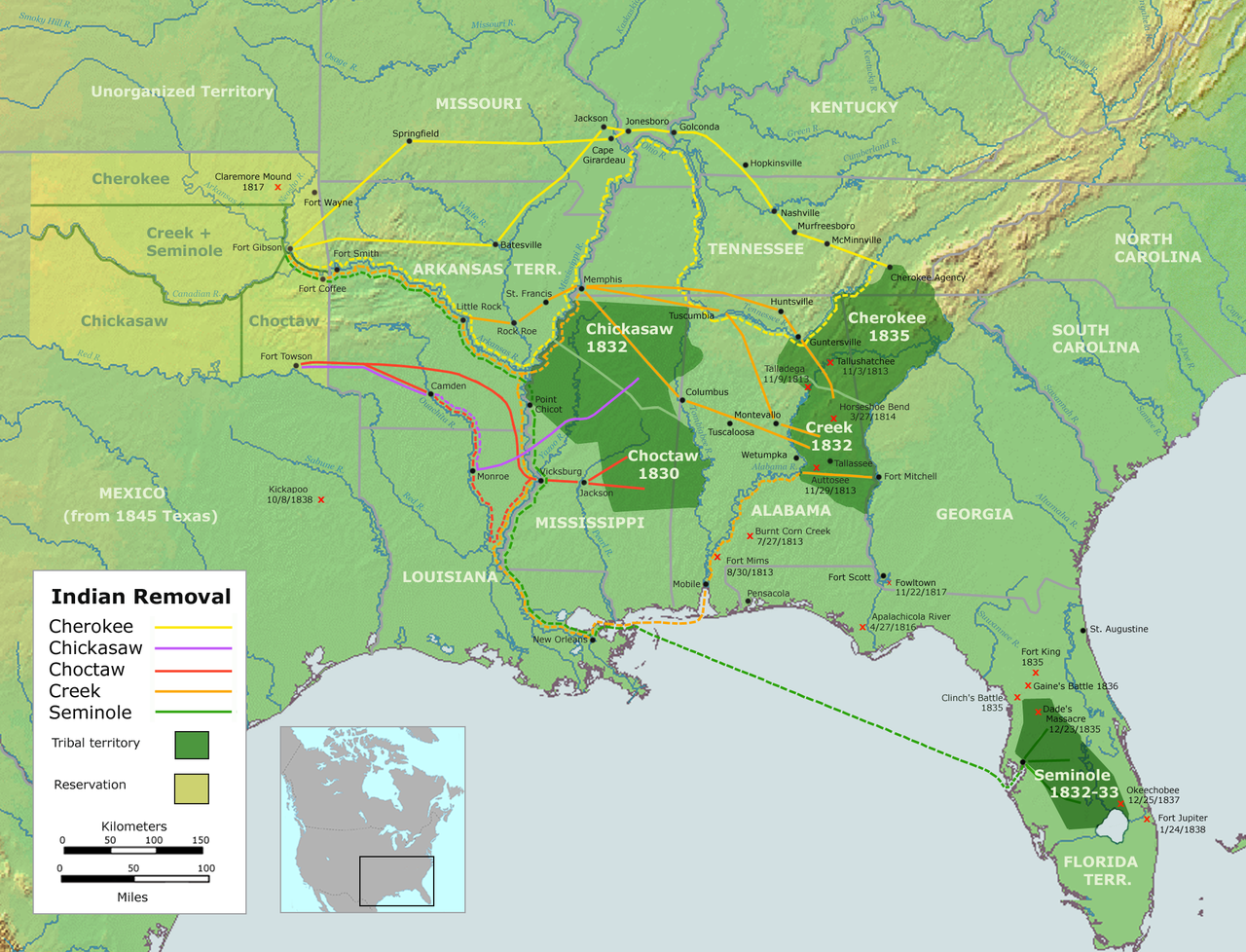
Relations with European settlers and later state and federal governments were complex: alliances, trade, intermarriage, and conflict all occurred. During the 19th century, pressure for land and state expansion prompted policies that culminated in forced removals. Legislation and treaties led to the relocation of many tribal members to lands west of the Mississippi River—an episode that included the Cherokee "Trail of Tears" and similar displacements affecting the other nations. These removals reshaped the geography, demography, and political life of the tribes.
Social issues and distinctions
The Five Tribes varied internally in social organization and responses to U.S. influence. Some members and leaders adopted plantation-style agriculture and, in certain communities, held enslaved African Americans—an aspect that complicates simplified narratives of assimilation. Others resisted assimilation and fought to preserve traditional ways. The tribes also diverged in how they reconstructed sovereignty after removal and in their legal relations with the U.S. government.
Modern legacy and sovereignty
Today these nations are federally recognized tribes with governments, courts, and programs that serve their citizens. They play active roles in cultural revitalization, language preservation, economic development, and legal advocacy for tribal sovereignty and treaty rights. Modern tribal institutions reflect a blend of traditional practices and innovations developed in response to federal policy and local needs.
List of the Five
Understanding the Five Civilized Tribes requires recognizing both the adaptive strategies these nations used to survive and thrive amid colonization, and the enduring consequences of removal and assimilation policies. For further reading, consult tribal websites and reputable historical sources that center Indigenous perspectives and primary documents.

Related articles
Author
AlegsaOnline.com Five Civilized Tribes: Cherokee, Chickasaw, Choctaw, Creek (Muscogee) and Seminole Leandro Alegsa
URL: https://en.alegsaonline.com/art/34680