
Al Capone: Prohibition-era gangster and Chicago mob boss
Alphonse 'Al' Capone (1899–1947) led a Chicago crime organization during Prohibition, famed for bootlegging and violence, convicted of tax evasion in 1931 and later debilitated by illness.
Overview
Alphonse Gabriel Capone (January 17, 1899 – January 25, 1947), commonly known as Al Capone and nicknamed "Scarface," was an Italian-American organized crime figure who rose to prominence during the U.S. Prohibition era (1920–1933). Born and raised in Brooklyn, Capone relocated to Chicago in his early twenties and built a powerful criminal organization that operated in Illinois and beyond. His name became synonymous with the era's mix of illegal alcohol trade, street violence, and political corruption.
Image gallery
10 Images




Rise and organization
Capone's ascent followed years of street-level involvement with gangs and rackets. By the mid-1920s he was the public face of a highly organized syndicate that combined enforcement, politics and business-like operations. The group's structure allowed it to coordinate distribution, protect supply lines and absorb competition. Although Capone cultivated an image of a generous public figure, his network relied on intimidation and selective violence to maintain dominance.
Activities and methods
During Prohibition the central enterprise was the illegal alcohol trade: smuggling and bootlegging liquor filled warehouses and speakeasies, while other enterprises—such as illegal gambling and prostitution—supplemented income. The organization used bribery, alliances with corrupt officials, and enforcement squads to secure territory and distribution channels. Incidents of gangland killing and public massacres from the period contributed to Capone's notoriety, even when direct legal proof of his involvement was lacking.
Prosecution, conviction and imprisonment
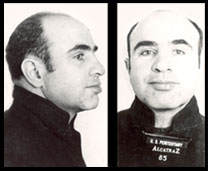
Local law enforcement struggled to indict Capone for violent crimes, so federal authorities pursued financial charges. In 1931 he was prosecuted and convicted for federal income tax evasion, a tactic used against several organized crime leaders of the time. Sentenced to 11 years in federal prison, Capone served time in several institutions, including the high-security prison at Alcatraz. The conviction marked the end of his effective control over the Chicago syndicate, although the organization continued under other leaders.
Decline and death
While incarcerated Capone's health deteriorated. He suffered from advanced neurosyphilis that progressively impaired his mental and physical capabilities; contemporaneous accounts and later histories often note the role of syphilis in his decline. Released early in 1939 on grounds of deteriorating health, he returned to Florida where he lived quietly for several years. In the final phase of his life he experienced a stroke, briefly regained consciousness, developed pneumonia, and ultimately died after a cardiac arrest on January 25, 1947, at his home surrounded by family.
Legacy and cultural impact
Capone remains one of the most famous figures of American criminal history. His career illustrated how Prohibition reshaped illicit markets and how organized crime could intersect with politics and law enforcement. He has been the subject of countless books, films and songs. For example, the pop artist Michael Jackson recorded a track titled "Al Capone" during sessions for the 1987 album Bad; the song was not included on the original release but later appeared on a reissue. Capone's life continues to be studied as part of the broader history of crime, policy and urban development in 20th-century America.
Notable facts
- Commonly called "Scarface," a nickname he reportedly disliked.
- Achieved peak influence during Prohibition, when demand for illegal alcohol created huge profits.
- Convicted not for violent crimes but for tax evasion, a legal route used to curb organized crime leaders.
- Spent his final years debilitated by illness and away from public life.
Related articles
Author
AlegsaOnline.com Al Capone: Prohibition-era gangster and Chicago mob boss Leandro Alegsa
URL: https://en.alegsaonline.com/art/113906
Sources
- oldghostshome.com : "Mount Carmel"
- nytimes.com : "Capone Dead At 48. Dry Era Gang Chief" · web.archive.org