
90377 Sedna — distant trans-Neptunian object and dwarf planet candidate
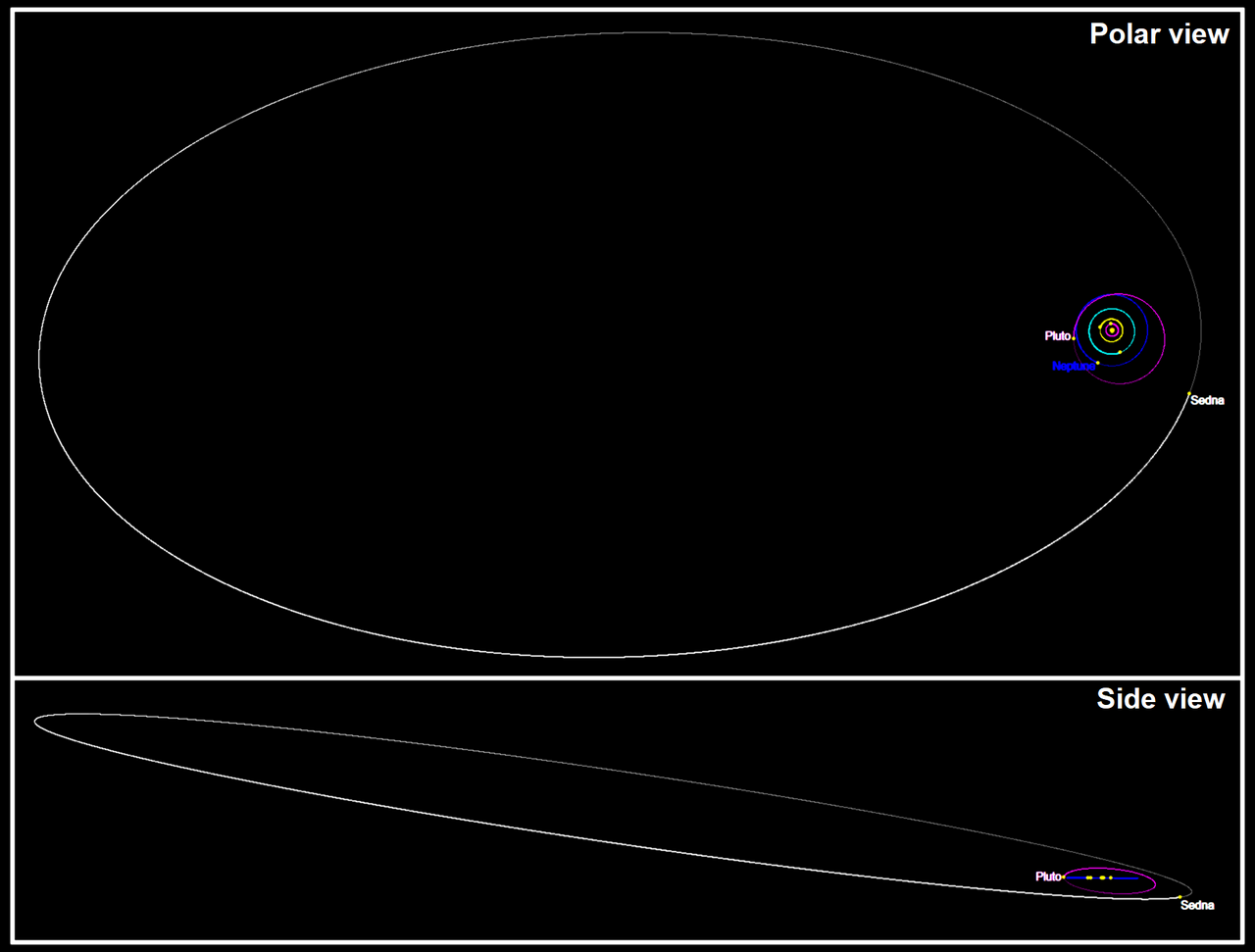
90377 Sedna is an extreme trans-Neptunian object discovered in 2003. It follows a highly elongated, multi‑millennial orbit and is considered a likely dwarf planet and member of the inner Oort cloud.

Overview
90377 Sedna is a distant icy body discovered on November 14, 2003 by astronomers Mike Brown, Chad Trujillo and David Rabinowitz. It is classified as a trans‑Neptunian object and is widely regarded as a candidate dwarf planet. Sedna stands out because it travels on one of the most elongated paths known around the Sun, taking many thousands of years to complete a single circuit. At present it is one of the most remote known objects associated with the planetary region of the Solar System.
Image gallery
10 Images






Physical characteristics
Sedna is an icy, dark world estimated to measure roughly between 1,250 and 1,800 kilometres across, a size range that places it near or within the lower bound of established dwarf planets; these estimates are based on its brightness and assumed surface reflectivity (diameter). Its surface is extremely cold, with temperatures that are believed to remain well below freezing—estimates commonly cite values near −240°C—so volatile ices such as methane, nitrogen and water are expected to be present in solid form. Photometric and spectral observations suggest a reddish surface in visible light, possibly due to organic tholins formed by irradiation of surface ices.
Orbit and dynamics
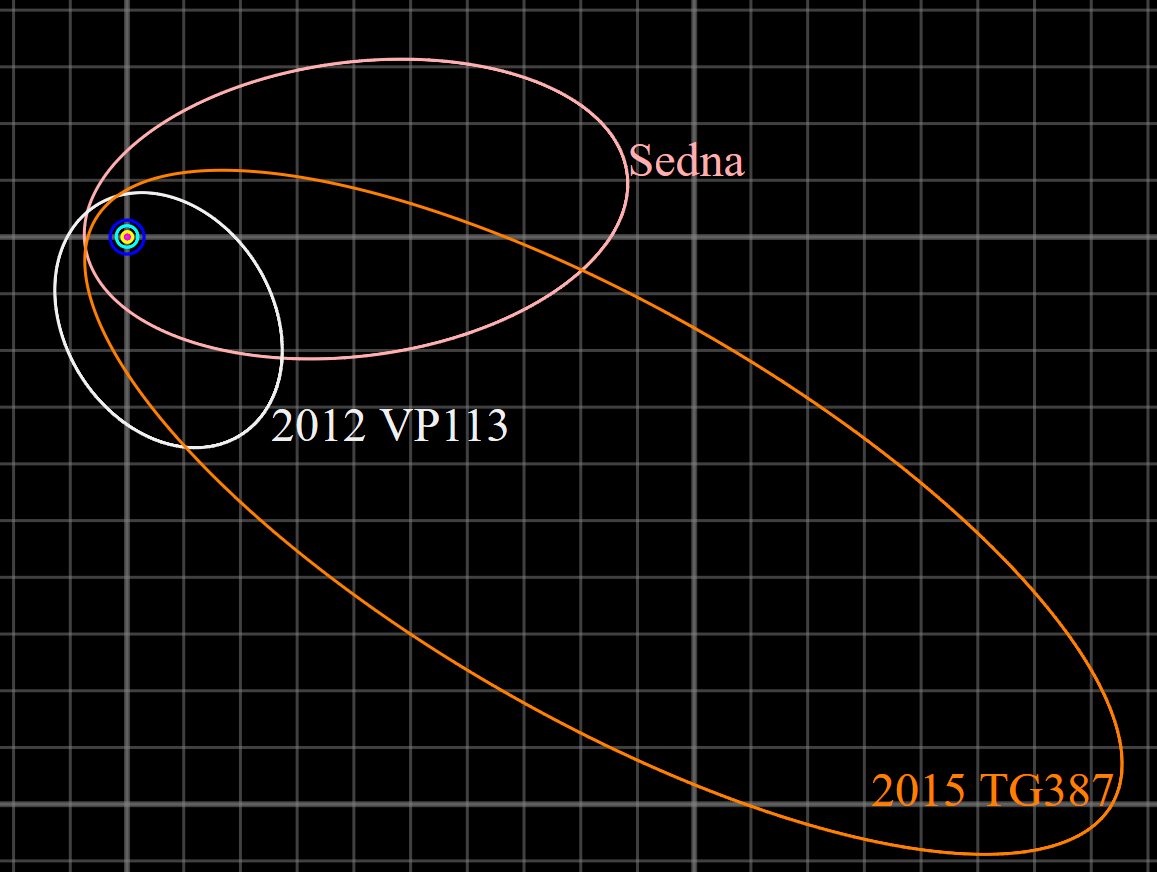
Sedna follows a highly eccentric, distant orbit that differs markedly from those of classical Kuiper belt objects. Its orbital period is on the order of ten thousand years—often given as about 11,400 years—so Sedna spends the majority of its orbit far from the Sun. Because of this extreme orbit it is sometimes considered part of a transitional population between the Kuiper belt and the inner Oort cloud. Sedna's most recent approach to the Sun (perihelion) places it much closer than its distant aphelion; it will reach that perihelion again in the 21st century, a point of interest for future observations (perihelion).
Discovery, name and cultural note
The discovery of Sedna required careful surveys of faint, slow‑moving objects; given its distance, Sedna appears almost stationary compared with nearer solar system bodies. Its chosen name comes from the Inuit creator and sea goddess, a figure from Arctic tradition, and reflects the cultural practice of selecting mythological names for distant Solar System objects (Inuit, Arctic Ocean). As with many minor planets, Sedna's official name was approved by the International Astronomical Union after its orbit and characteristics were sufficiently constrained.
Observation and exploration prospects
Sedna is faint because very little sunlight reaches it; that makes direct imaging and high‑resolution study difficult from Earth. Ground‑based and space telescopes have provided useful photometry and low‑resolution spectra, but no spacecraft mission has visited Sedna. Space agencies, including NASA, have studied mission concepts and occasional mission proposals have been discussed, particularly because Sedna will have a relatively close passage (in astronomical terms) around its perihelion in the coming decades. However, as of now no mission to Sedna is formally scheduled.
Importance and open questions
Sedna is scientifically important because its unusual orbit and remote location preserve information about the early Solar System and the dynamical processes that shaped the outer planetary region. Key questions include how Sedna acquired such an elongated trajectory, whether a distant massive perturber or past stellar encounters played a role, and how many similar objects exist beyond the Kuiper belt. Some models and searches suggest that dozens to perhaps over a hundred other Sedna‑like bodies awaiting discovery could exist at comparable distances, but detecting them will remain challenging due to their faintness. Continued sky surveys and targeted observations aim to refine Sedna's physical properties and to locate additional distant objects that can illuminate the outer architecture of our planetary system.
Notable distinctions
- Sedna's extreme orbit places it among the most remote known objects bound to the Solar System.
- Its size makes it a strong candidate for classification as a dwarf planet, though detailed interior and shape information is lacking.
- Because of its slow motion across the sky and great distance, Sedna was difficult to detect; statistical estimates of similar objects remain uncertain.
Further study of Sedna, whether by advanced telescopes or a future spacecraft, would help clarify its composition, origin and the broader population of distant, icy bodies that trace the outer boundaries of our planetary system.
Related articles
Author
AlegsaOnline.com 90377 Sedna — distant trans-Neptunian object and dwarf planet candidate Leandro Alegsa
URL: https://en.alegsaonline.com/art/113114
Sources
- gps.caltech.edu : "Sedna"
- nasa.gov : "Planet-Like Body Discovered at Fringes of Our Solar System"