
99942 Apophis — near‑Earth asteroid and notable 2029 flyby
Overview of asteroid 99942 Apophis: discovery, orbit and physical traits, history of impact concerns, the 2029 close approach, ongoing observations and scientific importance.
Overview

Image gallery
10 Images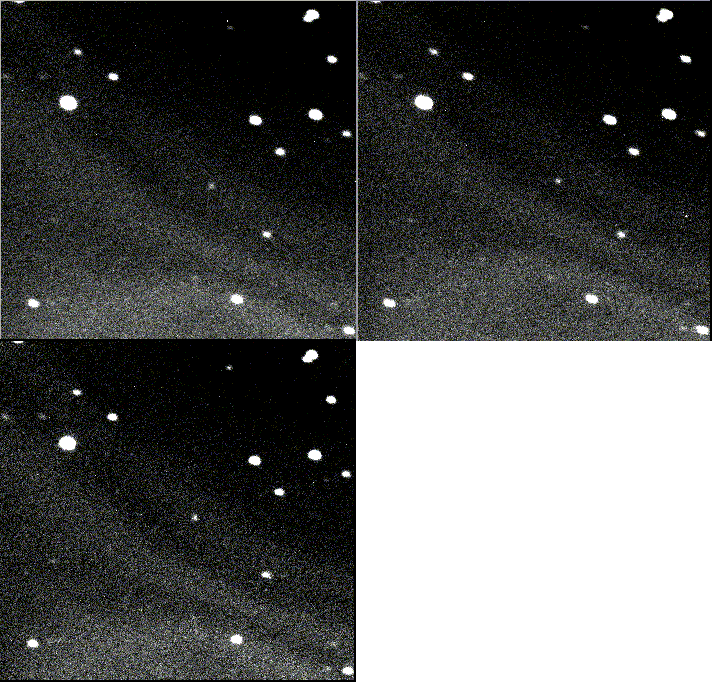






Orbit and physical characteristics
Apophis follows an orbit that crosses Earth's path and brings it into the vicinity of our planet on multiple occasions. Its 2029 encounter will be exceptionally close compared with typical asteroid flybys, passing inside the distance of geostationary satellites. The close approach will provide a rare opportunity to refine measurements of its shape, rotation, mass distribution and surface properties using radar and optical instruments (orbital data).
Discovery and naming
Discovered in 2004, the object was quickly designated 99942 and given the name Apophis, after the Egyptian mythological serpent Apep. Early follow‑up observations prompted rapid reassessments of its orbit as more astrometric data became available. The initial uncertainty and subsequent refinement illustrate how additional observations can dramatically change impact probabilities (early observations).
History of impact concern and risk assessments
When first announced, some orbital solutions indicated a possible impact on a later return, which led to intensive study by astronomers and automated monitoring systems. The concept of a "gravitational keyhole" — a narrow region of space near Earth such that passage through it can alter an asteroid's path into a future collision course — was central to early concern about Apophis. That keyhole is extremely small, only a few hundred metres across in most analyses, so predicting whether Apophis would pass through it required high‑precision tracking (keyhole explanation).
As more observations accumulated, the computed orbit was revised and the probability of impact for the well‑publicized dates dropped. By mid‑2006 and in subsequent updates, impact risk assessments were lowered to levels considered effectively negligible for the foreseeable future, although careful monitoring continues to watch for any perturbations or nongravitational forces that might alter the path (risk updates).
2029 close approach and its significance
On its 2029 pass Apophis will come unusually close to Earth, changing its orbit due to Earth's gravity and offering a rare scientific and observational opportunity. That encounter will allow detailed radar imaging from ground facilities and will help constrain the asteroid's rotation state, internal structure and surface features. The gravitational interaction during 2029 will also determine how the orbit evolves for decades to come, so predicting post‑2029 outcomes is a major focus of study (2029 encounter studies).
Scientific and practical importance
- Refined orbit determination: Close‑approach tracking reduces long‑term uncertainties and improves models used by planetary defense systems (tracking programs).
- Physical characterization: Radar and spectroscopy during close approach will reveal shape, spin and surface composition, informing models of asteroid formation and evolution (physical studies).
- Planetary defense practice: Apophis has been used as a case study for impact mitigation planning, illustrating how early detection, precise follow‑up, and international coordination reduce public concern (defense planning).
Current status and notable facts
Apophis remains a closely observed object. Automated systems and human teams continue to publish refined orbits and uncertainty estimates; while early media reports emphasized impact odds for specific years, later analyses show those particular impact scenarios to be extremely unlikely. The object has become one of the best documented near‑Earth asteroids, serving both as a subject of scientific study and as an example of how impact probabilities are updated with better data (monitoring pages and probability reports).
Overall, 99942 Apophis highlights the importance of continuous observation, international data sharing and public communication in assessing and responding to asteroid impact hazards.
Questions and answers
Q: What is (99942) Apophis?
A: (99942) Apophis is a near-Earth asteroid.
Q: Why did Apophis worry people in December 2004?
A: Apophis worried people in December 2004 because initial observations seemed to show that it would hit the Earth in 2029.
Q: What is a "gravitational keyhole"?
A: A "gravitational keyhole" is an area in space no more than about 400 meters across that an object can pass through, which can affect its trajectory and potentially cause it to collide with the Earth.
Q: Why was Apophis considered a Level 1 danger on the Torino impact hazard scale?
A: Apophis was considered a Level 1 danger on the Torino impact hazard scale until August 2006 because it was thought to have a high probability of hitting the Earth in 2036.
Q: When was Apophis lowered to a Level 0 on the Torino Scale?
A: Apophis was lowered to a Level 0 on the Torino Scale on August 5, 2006.
Q: What is the probability that Apophis will hit the Earth on April 13, 2036?
A: As of October 19, 2006, the probability that Apophis will hit the Earth on April 13, 2036 is around 1 in 45,000.
Q: Is there a chance that Apophis will hit the Earth in 2038?
A: Yes, there is a chance that Apophis could hit the Earth in 2038, but the probability for that encounter is much lower at 1 in 12.3 million.
Related articles
Author
AlegsaOnline.com 99942 Apophis — near‑Earth asteroid and notable 2029 flyby Leandro Alegsa
URL: https://en.alegsaonline.com/art/113146