
90482 Orcus — a large Kuiper belt object and dwarf-planet candidate
90482 Orcus is a large trans-Neptunian object in 2:3 resonance with Neptune, known for its anti-aligned orbit relative to Pluto and for its companion Vanth. It is considered a likely dwarf planet.

90482 Orcus is a prominent trans-Neptunian body discovered in 2004 and classified among the population of distant small worlds beyond Neptune. It is generally described as a Kuiper belt object (Kuiper belt object) and is regarded by many astronomers as a likely dwarf planet based on its size and shape. Orcus attracts attention because its orbit and some physical traits resemble those of Pluto, yet it occupies a dynamically different niche.
Image gallery
10 Images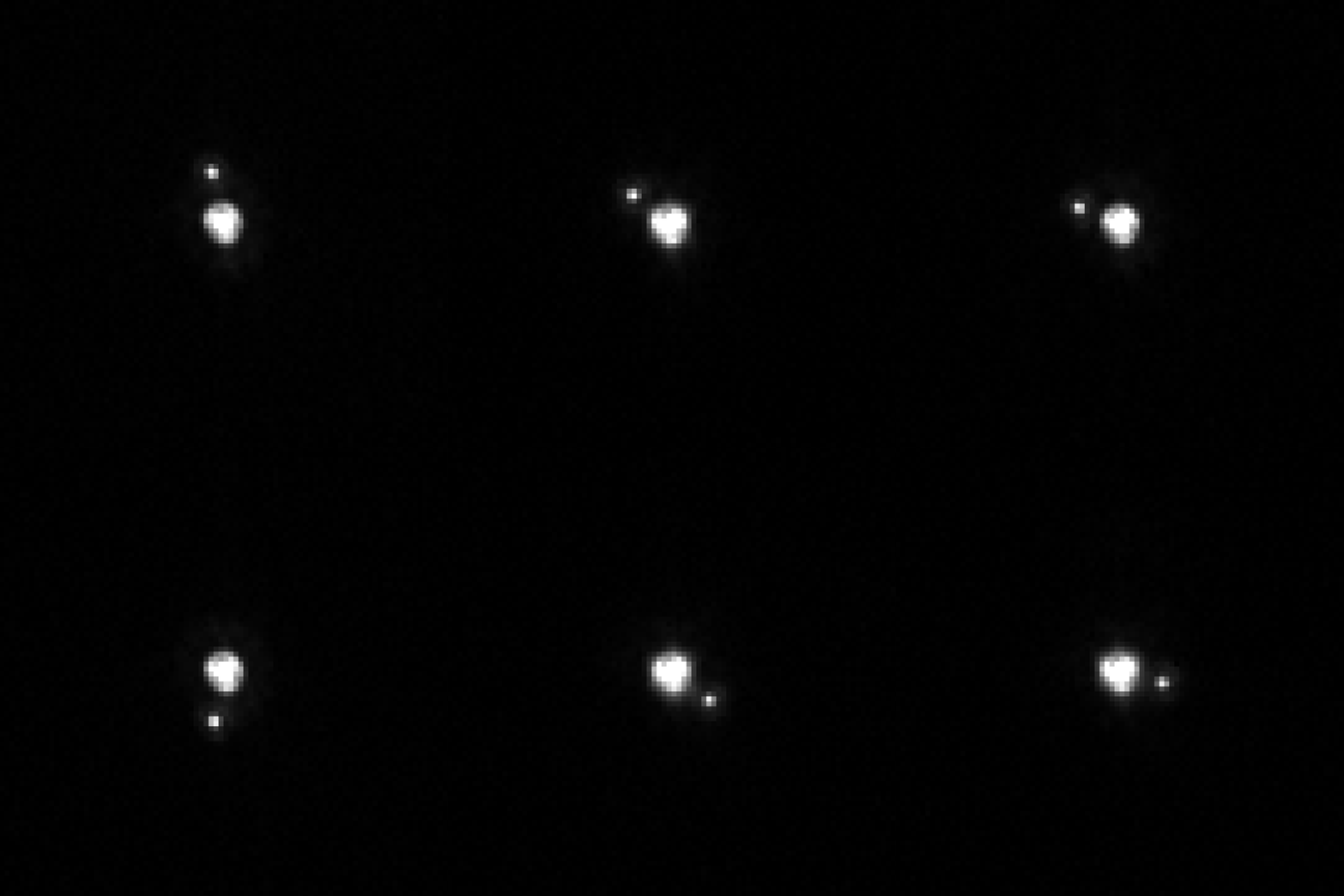





Physical characteristics
Orcus appears to be a mixture of rock and ices, with a surface that shows signs of water ice and possibly other frozen volatiles. Its diameter is substantially smaller than Pluto's but large enough that self-gravity probably made it close to spherical, which is a criterion used when assessing dwarf-planet status. The surface reflectivity (albedo) and colour measurements suggest a relatively fresh or ice-rich exterior compared with many more distant objects.
Orbit and resonance
Orcus follows a 2:3 mean-motion orbital relationship with Neptune, meaning it completes two orbits of the Sun for every three orbits of Neptune. This type of commensurability is called a orbital resonance and places Orcus among the class known as "plutinos." Unusually, Orcus's orbit is oriented so that it is roughly opposite Pluto in longitude; this anti-aligned arrangement keeps the two objects from close approaches despite sharing the same resonance.
Discovery, naming and satellite
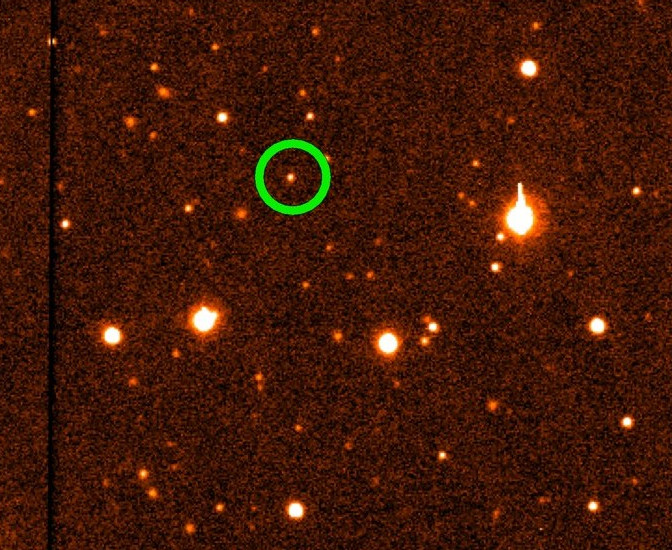
The object was discovered by a team led by Michael Brown, Chad Trujillo and David Rabinowitz in early 2004, although precovery images extending the observational record to earlier decades are known. It received the permanent number 90482 and the name Orcus, after a Roman deity associated with the underworld—chosen to reflect its kinship with Pluto. Orcus has a notable satellite, Vanth, discovered some years after Orcus itself; observations of the satellite have been important for estimating Orcus's mass and for studying tidal interactions in the system.
Importance and context
- Orcus helps astronomers study the diversity of bodies in the Kuiper belt and the processes that shaped the outer Solar System.
- Its anti-Pluto configuration provides a natural laboratory for understanding resonant dynamics among trans-Neptunian objects.
- As a likely dwarf planet, Orcus figures in debates over classification criteria and the population of mid-sized icy worlds.
Further study of Orcus—including spectroscopy, detailed photometry, and continued tracking of its satellite—continues to refine knowledge of its composition, interior, and evolutionary history. For general context on objects like Orcus, see resources on the Kuiper belt and dwarf-planet classification provided by astronomical organizations and review articles (Kuiper belt, dwarf planet).
Orcus remains an illustrative example of how objects beyond Neptune can resemble familiar planets in some ways while differing in orbital configuration and scale, offering clues to the Solar System's formation and dynamical evolution.
Questions and answers
Q: What is 90482 Orcus?
A: 90482 Orcus is a Kuiper belt object (KBO) and a dwarf planet.
Q: Who discovered 90482 Orcus?
A: 90482 Orcus was discovered by Michael Brown, Chad Trujillo, and David Rabinowitz on February 17, 2004.
Q: What was 90482 Orcus originally known as?
A: 90482 Orcus was originally known as the provisional designation 2004 DW.
Q: Was 90482 Orcus seen in pictures before its official discovery?
A: Yes, 90482 Orcus was seen in pictures taken on November 8, 1951.
Q: Is there a similarity between the orbit of 90482 Orcus with that of Pluto?
A: Yes, 90482 Orcus is in orbital resonance with Neptune just like Pluto.
Q: Does 90482 Orcus stay on the same side of the Sun as Pluto?
A: No, 90482 Orcus stays on the opposite side of the Sun from Pluto.
Q: Who is credited with the discovery of 90482 Orcus?
A: Michael Brown, Chad Trujillo, and David Rabinowitz are credited with the discovery of 90482 Orcus.
Related articles
Author
AlegsaOnline.com 90482 Orcus — a large Kuiper belt object and dwarf-planet candidate Leandro Alegsa
URL: https://en.alegsaonline.com/art/113115
Sources
- boulder.swri.edu : "Orbit Fit and Astrometric record for 90482" · webcitation.org
- arxiv.org : "Physical Properties of Kuiper Belt and Centaur Objects: Constraints from Spitzer Space Telescope"
- bbc.co.uk : "Overlooked dwarf planet candidates"
- physics.nau.edu : "Kuiper Belt Object Magnitudes and Surface Colors" · webcitation.org
- ssd.jpl.nasa.gov : "HORIZONS Web-Interface" · webcitation.org
- ssd.jpl.nasa.gov : "JPL Small-Body Database Browser: 90482 Orcus (2004 DW)" · webcitation.org · webcitation.org
- boulder.swri.edu : Distant EKO