
Brian P. Schmidt — astrophysicist and Nobel laureate
Brian P. Schmidt is an Australian-based astrophysicist who shared the 2011 Nobel Prize for evidence that the universe's expansion is accelerating. He is a senior researcher and professor at the Australian National University.
Overview
Brian P. Schmidt (born 1967) is an observational astrophysicist noted for his role in demonstrating that the expansion of the universe is accelerating. His work using distant Type Ia supernovae as cosmological probes helped reveal an unexpected component of the cosmos often called dark energy. Schmidt holds senior appointments at the Australian National University and is a prominent figure in astronomy research and public science communication.
Image gallery
6 Images


Research and methods
Schmidt's most influential research employed Type Ia supernovae, a class of stellar explosions whose intrinsic brightness can be calibrated well enough to serve as "standardizable candles." By measuring the apparent brightness of these supernovae and comparing it with their redshift, researchers infer distances and the rate at which the universe has expanded over time. This technique, when applied to samples of distant supernovae, produced the surprising result that distant objects appeared dimmer than expected in a decelerating universe, implying acceleration instead.
Career, affiliations, and roles
Schmidt is based at the Australian National University (ANU), where he has served in research and academic leadership roles within the Research School of Astronomy and Astrophysics and at the Mount Stromlo Observatory (Mount Stromlo). He has held competitive national research fellowships and led observational programs and international collaborations that collect, analyze and interpret supernova data. His work typically combines telescope observations, careful calibration of instruments, and statistical analysis to translate observed light into cosmological constraints.
Awards, recognition, and impact
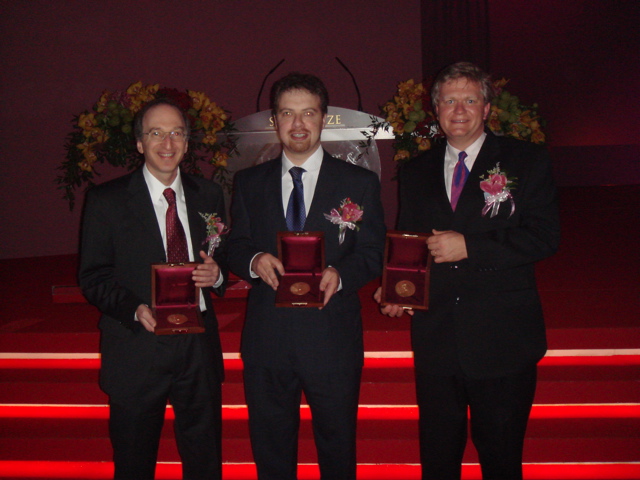
For his contributions to observational cosmology, Schmidt shared major international honors. Most notably he was a co-recipient of the 2011 Nobel Prize in Physics, awarded jointly with Saul Perlmutter and Adam Riess, for the discovery that the expansion of the universe is accelerating. He also shared the Shaw Prize in Astronomy in 2006. These recognitions reflect the broad importance of the supernova results, which provided evidence for a dominant, repulsive component of the universe now usually described as dark energy.
Significance and continuing influence
The discovery of cosmic acceleration reshaped cosmology, motivating new theoretical work and extensive observational programs designed to measure the properties of dark energy and test whether cosmic acceleration arises from a cosmological constant, a dynamic field, or a breakdown of general relativity on large scales. Schmidt's work remains a foundation for modern surveys and experiments seeking to map the expansion history of the universe and understand its ultimate fate. For general background on the phenomenon his team helped reveal see expansion of the universe.
Selected themes and legacy
- Techniques: Precision photometry and spectroscopy of Type Ia supernovae to derive luminosity distances and redshifts.
- Collaboration: Large, multi-institution teams that cross-check results and control systematic uncertainties.
- Broader effects: Stimulated new instruments, sky surveys, and theoretical work on dark energy and cosmic acceleration.
Schmidt's career exemplifies how careful observation and international collaboration can produce results that transform our understanding of fundamental physics and the large-scale structure and fate of the universe.
Questions and answers
Q: Who is Brian Schmidt?
A: Brian Schmidt is a Distinguished Professor, Australian Research Council Laureate Fellow and astrophysicist at the Australian National University Mount Stromlo Observatory and Research School of Astronomy and Astrophysics.
Q: What is Brian Schmidt known for?
A: Brian Schmidt is widely known for his research in using supernovae as Cosmological Probes.
Q: What is Brian Schmidt's current position?
A: Brian Schmidt currently holds an Australia Research Council Federation Fellowship.
Q: What awards did Brian Schmidt share with Saul Perlmutter and Adam Riess?
A: Brian Schmidt shared both the 2006 Shaw Prize in Astronomy and the 2011 Nobel Prize in Physics with Saul Perlmutter and Adam Riess.
Q: What was the contribution for which Brian Schmidt won the Nobel Prize in Physics?
A: Brian Schmidt won the Nobel Prize in Physics for providing evidence that the expansion of the universe is accelerating.
Q: Where does Brian Schmidt work?
A: Brian Schmidt works at the Australian National University Mount Stromlo Observatory and Research School of Astronomy and Astrophysics.
Q: What is Brian Schmidt's field of research?
A: Brian Schmidt's field of research is astrophysics, with a focus on using supernovae as Cosmological Probes.
Related articles
Author
AlegsaOnline.com Brian P. Schmidt — astrophysicist and Nobel laureate Leandro Alegsa
URL: https://en.alegsaonline.com/art/115643
Sources
- web.archive.org : Brian P Schmidt - Curriculum Vitae