
28978 Ixion
28978 Ixion is a Kuiper belt object and plutino discovered in 2001. It is a large trans-Neptunian body (possible dwarf planet) in 2:3 resonance with Neptune and is named after the mythological Ixion.
28978 Ixion is a trans-Neptunian body located in the Kuiper belt. It was discovered on 22 May 2001 and initially received the provisional designation 2001 KX76. Observers identified Ixion as a plutino — a population of objects locked in a 2:3 orbital resonance with Neptune — and it is considered one of the larger known members of that group.
Image gallery
7 Images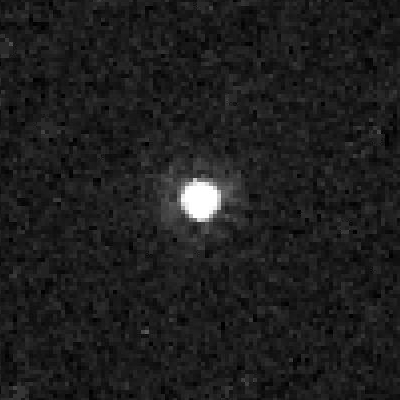



Orbit and classification
Ixion follows an orbit similar to Pluto’s in that it completes two revolutions for every three made by Neptune, and so is classified as a plutino. This resonant relationship helps keep its orbit stable over long timescales. Its average distance from the Sun lies near the region occupied by other plutinos, and its orbital period is on the order of a few centuries. Because of its size and likely rounded shape, some researchers list Ixion among trans-Neptunian objects that could qualify as dwarf planets.
Physical characteristics
Direct measurements of Ixion’s size and surface are limited by the object’s distance and faintness. Thermal and reflected-light observations indicate a diameter on the order of several hundreds of kilometres; many estimates place it near about 800 km, but published values vary depending on the assumed surface reflectivity (size and albedo estimates). Photometric studies show a low-amplitude lightcurve, implying either a relatively spheroidal shape or a surface with modest albedo variations. Spectral data suggest a moderately red color and weak near-infrared features that may indicate small amounts of water ice or other volatile ices.
Discovery, name and numbering
Found on 22 May 2001 during surveys of the outer Solar System, Ixion was assigned the minor planet number 28978 after its orbit became well determined (discovery record). It was later named for the mythological figure Ixion, a character from Greek mythology who appears in ancient sources as a punished king (mythological namesake). Before its formal naming it was known by its provisional designation, 2001 KX76.
Scientific importance and observations
As a relatively large plutino, Ixion helps astronomers study the population of resonant trans-Neptunian objects and the processes that shaped the outer Solar System. Observations across visible and infrared wavelengths — and occasional thermal measurements — are used to refine estimates of its size, albedo, rotation period and surface composition. Continued monitoring contributes to understanding of collisional history, surface evolution and the distribution of volatiles among distant small bodies (Kuiper belt context). Additional targeted observations and space-based studies could tighten constraints on Ixion’s status as a dwarf planet (dwarf planet candidacy).
Notable facts and distinctions
- Ixion is a plutino, sharing the 2:3 resonance with Neptune (plutino classification and orbital resonance explanation).
- It is often ranked among the largest plutinos and among the more sizable Kuiper belt objects.
- Its provisional designation was 2001 KX76 and it carries the permanent minor-planet number 28978 (designation record).
Related articles
Author
AlegsaOnline.com 28978 Ixion Leandro Alegsa
URL: https://en.alegsaonline.com/art/112767
Sources
- boulder.swri.edu : "Orbit Fit and Astrometric record for 28978"
- ssd.jpl.nasa.gov : "JPL Small-Body Database Browser: 28978 Ixion (2001 KX76)"
- arxiv.org : "Physical Properties of Kuiper Belt and Centaur Objects: Constraints from Spitzer Space Telescope"
- johnstonsarchive.net : "TNO/Centaur diameters and albedos"